By Lisa Dahm
Hawaii Catholic Herald
A year ago, Father Mark Gantley, judicial vicar and director of canonical affairs for the Diocese of Honolulu, suffered cardiac arrest at the end of a 25-mile bike ride.
Two people, Danielle Burgos and Eva Andrade, were able to make medical decisions for the incapacitated 62-year-old priest while he underwent triple-bypass open-heart surgery at Adventist Health Castle Medical Center in Kailua.
Years earlier, Father Gantley had designated both women as his first and second decision makers, and they were able to quickly act for him when his emergency occurred since he took time to thoughtfully create an advanced directive.
“For me and Danielle, it was easy because we knew what he wanted,” said Andrade, executive director of the Hawaii Catholic Conference and the president and chief executive officer of Hawaii Family Forum. “It wasn’t easy for us to watch him go through that, but we were not trying to figure out, ‘Would he like this treatment or was it going to create a burden.’ It was all laid out, and that makes it easier for everybody.”
An advanced healthcare directive is a legal document that states a person’s wishes about receiving medical care either during an emergency or at the end of life if they are unable to make their own decisions. It ensures that a person’s life values are respected.
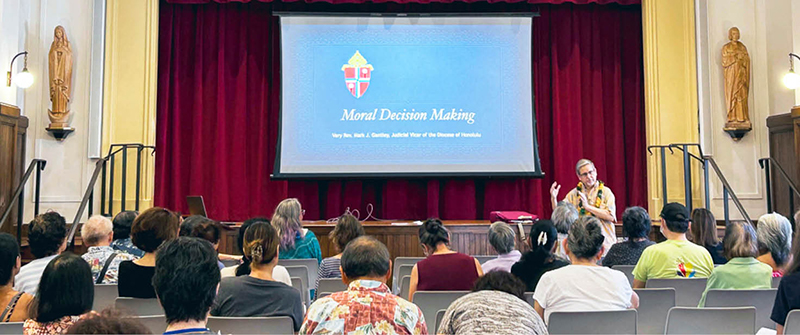
Last month, Father Gantley, Andrade and Hope Young, the advance planning director for Kokua Mau, presented “Preparing a Catholic Advanced Health Directive” at Sacred Heart Parish in Punahou to a full audience.
“The whole purpose of our workshop is to encourage people to (address) their advanced healthcare directives,” Father Gantley said. “It’s going to help you ensure that your wishes and your values are the ones that are going be taken into consideration, and that you’re setting up the right people to make sure that those things that you want at the end of your life happen.”
In her section of the workshop, which the three speakers offer to parishes throughout the diocese, Young discusses how to have meaningful conversations with a loved one about personal preferences at the end of life, and why these conversations are important.
Father Gantley addresses the moral aspects of how to make decisions in advanced healthcare directives that align with the Catholic Church. He also reviews the requirements for using artificial hydration and nutrition, and the importance of being stewards rather than owners of our lives.
Andrade then walks participants through the advanced healthcare directive approved by the Diocese of Honolulu. The first part is a power of attorney for healthcare, and the second part gives instructions for healthcare decisions and end-of-life decisions.
The document also offers an optional summary statement on what is important to the person where they can discuss what makes life worth living to them — such as seeing family, hobbies and pets. The document can be signed by either two witnesses or a notary.
Communication is vital
According to Andrade, the workshop is carefully crafted to assist people with filling out the advanced healthcare directive and to help them explore their preferences in a meaningful way that may produce the best results.
“Anybody could work on their own directive at home with their family, which they should,” Andrade said. “But having other people talk about their experiences gives people things to think about because there’s no way someone is going to be able to walk through every possible scenario on their own.”
In one section, Young has participants close their eyes and picture their death and explore what they would want. They then discuss it with another participant who is not a spouse or close friend.
“People feed off each other’s energy, questions and discussion — it helps them through their own,” Andrade added.
Having an advanced healthcare directive is vital, but communicating its contents with family members is a critical step in the process. She said that having healthcare directives that are openly discussed and reviewed takes a huge burden off family members.
Andrade first learned about advanced healthcare directives and family dynamics when she served on the ethics board at St. Francis Healthcare System of Hawaii more than 20 years ago. There, she learned how those directives on paper shape the outcome of a person’s end-of-life experience.
“What I learned is that for families that talk and get along, even those families can have major difficulty when it comes to the decision-making of someone at the end of their life,” Andrade said.
For those who discuss their advanced healthcare directives early and often, though more difficult, it can be cathartic and lead to a positive and smooth end-of-life experience.
Andrade said that personally, her second daughter is her first decision maker since she lives close by, and her oldest daughter is her second decision maker. Together, their strengths and personalities would produce a balanced response following her wishes.
“But I’m free to change that at any time,” Andrade said.
Reviewing advanced healthcare directives often is important, since people’s situations regularly change, and their wishes may transform as they age, marry or lose a spouse.
Faith in action
Father Gantley’s near-death experience gave him the unintended opportunity to test his advanced healthcare directive, though he remembers none of it before waking in a hospital room.
“Fortunately, I was on the campus of Windward Community College, and someone saw me and notified the security office,” Father Gantley said. “The security guard came and resuscitated me and did CPR until the firemen got there.”
Father Gantley said they were unable to identify him immediately in the flurry of the accident, but they contacted Bishop Larry Silva who had Father Gantley’s documents on file and was able to immediately contact Burgos and Andrade.
“I wasn’t in a state of mind to make these decisions, but here I was — the decisions had to be made,” Father Gantley said of the experience. “I didn’t have confidence in myself since I was not in the condition to make them. So, I was reassured when I found out that the people I chose made the right decisions. This points out that it’s not just the hours before your death that matter — this is relevant for your whole life.”
For more information, visit www.catholichawaii.org/cahcd or contact Andrade at eandrade@rcchawaii.org.