By Ryan K. Brown
Special to the Herald
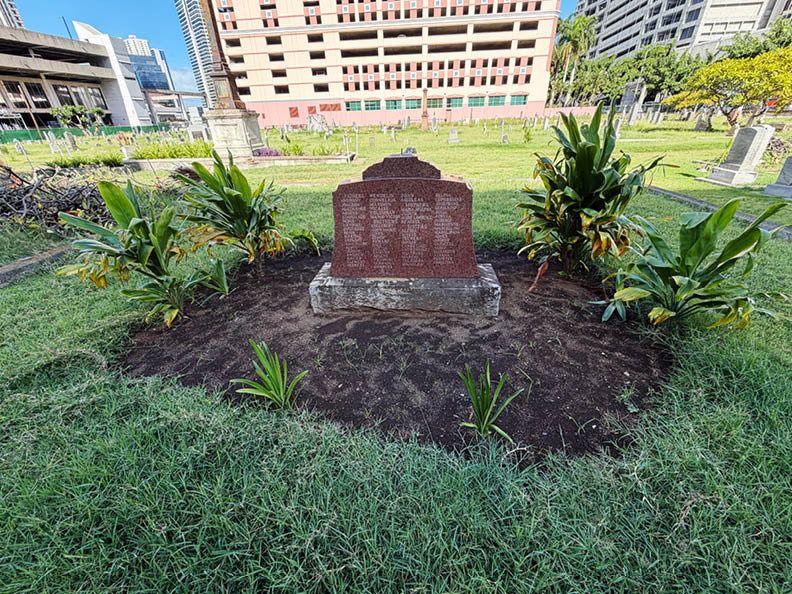
At the corner of King Street and Ward Avenue, a few steps from Thomas Square, lies one of the most sacred and least visited places in the Catholic history of these islands. The King Street Catholic Cemetery in Honolulu holds the remains of four of Hawaii’s early bishops and dozens of the Sacred Hearts priests, brothers and sisters who planted the faith here, laid to rest among the Hawaiian, Portuguese and immigrant families they served.
On Nov. 2, All Souls’ Day, the Church in Hawaii will return to this ground to celebrate a memorial Mass. As the Church marks the bicentennial of Catholicism in Hawaii (1827–2027), few places tell that 200-year story more quietly, or more completely.
Given by the alii
The cemetery took shape in the 1840s, after the Edict of Toleration of 1839 allowed Catholics to worship openly in the islands. The Kingdom of Hawaii granted the first Sacred Hearts missionaries the initial lot, recorded as Land Claim No. 4, and several prominent Catholics purchased a second parcel and gave it to the Church.
Records suggest the original land was given around 1845, possibly by Chiefess Lydia Kamake‘e Pi‘ikoi, who controlled the Kewalo area at the time. More land followed in 1866, bought from Manuel Paiko, and again around 1912 from W.C. Achi. In the late 19th century, Sacred Hearts Father Valentin Franckx added the details that transformed the site into a proper cemetery.
For more than a century, from the first mission in 1827 until 1940, the Church in Hawaii was led by members of the Congregation of the Sacred Hearts of Jesus and Mary. Its missionaries came from countries across Europe, among them France, Belgium and Germany, and King Street is where many of them were laid to rest.
Since 1853, some 40 early members of the congregation have lain together in a common grave here. Sacred Hearts sisters rest in the same ground.
(Bishop Louis Maigret, who led the mission until his death in 1882, is not here; he was entombed beneath the sanctuary of the Cathedral Basilica of Our Lady of Peace.)
At the center of the cemetery stands a tall iron cross, raised by Bishop Herman Koeckemann. When he died in 1892, he was buried beneath it. Koeckemann, a native of Germany, led the Church in Hawaii from 1882 until his death and made Catholic schooling a priority as Portuguese families arrived to work the plantations.
Three of his successors lie near him. Bishop Gulstan Ropert (1839-1903), a Breton, arrived in Honolulu in 1868 and led the Church from 1892 until his death. In 1873 he had volunteered for the Molokai mission; the assignment went instead to a young Belgian priest named Damien.
Bishop Libert H. Boeynaems (1857-1926), born in Antwerp, began as a pastor on Kauai and served as vicar apostolic from 1903-1926, founding schools and orphanages across the islands.
Bishop Stephen Alencastre (1876-1940) was born on Porto Santo in the Madeira Islands and brought to Hawaii as an infant. He was the first bishop of Hawaii raised in the islands, and the first to place Hawaiian symbols in his coat of arms.
The faithful departed
The missionaries do not rest alone. Around them lie the people they baptized, married and buried, a cross-section of Catholic Honolulu from the second half of the 19th century into the early 20th.
Here is Maria Kamila, daughter of Don Francisco de Paula Marin, the Spanish horticulturist who introduced many plants and fruits to the islands. Here is Princess Eugenie Ninito Sumner of Tahiti, wife of High Chief John Kapilikea Sumner and a friend of Queen Lili‘uokalani.
Here is Joseph J. Fern, the first mayor of Honolulu, and Manuel Nunes, one of the Madeiran craftsmen credited with bringing the ukulele to Hawaii. And here, row upon row, are the Portuguese families who filled the pews of the city’s parishes a century ago.
To walk the grounds is to read the names of the Church in Hawaii as it grew: Hawaiian, French, Belgian, German, Portuguese and more, one family of faith.
That story draws visitors well beyond the Church. “King Street Cemetery is an important part of Hawaii’s Catholic history, but its appeal goes far beyond Hawaii Catholics,” said Deacon Keith Cabiles, chancellor of the Diocese of Honolulu, who oversees the cemetery. “Families and descendants from all over the world come here, people interested in Hawaiian history, and residents of the surrounding neighborhoods who appreciate this oasis in the middle of town.”
Decline and renewal
Burials continued through about 1930 but became rare in the 1940s. The state Department of Health later closed the cemetery to new burials, and Catholic interments moved to Diamond Head Memorial Park.
The decades since have not been gentle. In November 1971, the widening of King Street required the relocation of 39 sets of remains. In the early 1980s, a fire at the cemetery destroyed its records. State records show a nonprofit King Street Cemetery Preservation Society was registered from 1989 to 2000.
More recently, vandalism and unauthorized camping, which worsened during the COVID-19 shutdown, kept the gates locked most days.
The Diocese of Honolulu has since stepped up its care, with security and a landscape crew, and volunteers have joined the effort to restore the grounds.
“Our volunteers have a vision of nurturing this humble cemetery into an even more beautiful and welcoming place — somewhere people can come to pray, walk, learn, remember and discover,” Deacon Cabiles said. “We hope it can become a true pilgrimage site in the heart of Honolulu.”
All Souls on King Street
Bishop Michael T.T. Castori, SJ, will celebrate the All Souls’ Day memorial Mass Nov. 2 at 12 p.m. at the King Street Cemetery. All are welcome; find updates and additional details at catholichawaii200.org.
From Nov. 1-8, Catholics who visit a cemetery and pray for the departed may, under the usual conditions, gain a plenary indulgence applicable to the souls in purgatory. There is no more fitting place in Honolulu to do so.
For Deacon Cabiles, the cemetery’s gift is its stillness. “As many times as I’ve walked these grounds, I’m still in awe of the peace I feel here,” he said. “And I still discover something new every time.”