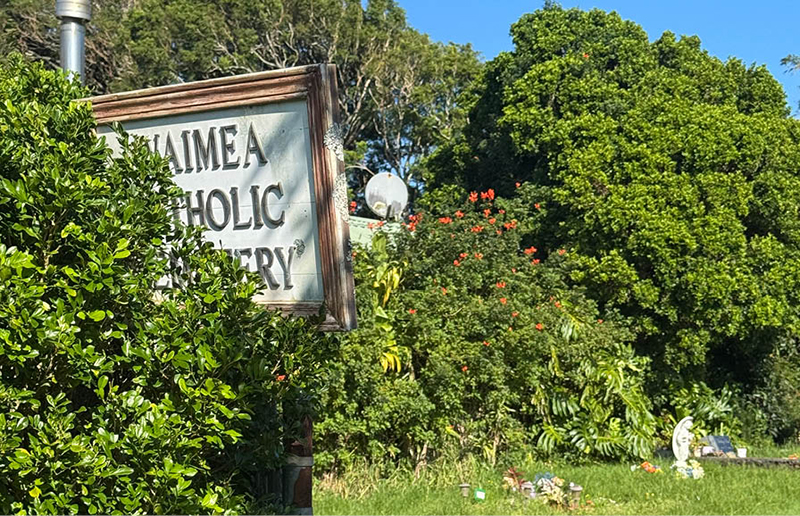
Choosing to be buried at one’s home parish invites prayer and remembrance for years to come
By Lisa Dahm
Hawaii Catholic Herald
As faithful who believe in the resurrection of the body, Catholics in Hawaii have been entrusting their burial after death to the hallowed ground of their parish home for the past 200 years — the place where they received their sacraments and found a peaceful community to strengthen their faith.
All Souls’ Day, Nov. 2, offers Catholics an opportunity every year to honor those buried in their cemeteries who trusted their community to pray for them and care for their remains once their earthly life was over.
While all Catholic cemeteries on Oahu are now closed and most on the neighbor islands have limited space, Deacon Keith Cabiles, chancellor for the Diocese of Honolulu, said that both the corporal work of mercy of burying the dead and the spiritual work of mercy of praying for the dead are vital actions that all Catholics should practice.
“It’s important for us to maintain cemeteries and, more importantly, to pray for the dead and to remember more than just our loved ones at All Souls’ Day as a parish,” said Deacon Cabiles. “Praying for the dead, it’s an expression of our continuing love for those we bury. It’s a sign of our Christian hope.”
He said praying for the dead is not only an act of remembrance but also is an expression of love and faith in the afterlife.
Honoring ancestors
From the front door of St. Benedict Church in Honaunau on Hawaii island, the view is a vast expanse of cemetery spanning more than an acre.
Marjorie Fujimoto, the parish coordinator for liturgical ministry, was baptized in the church and serves as one of the sacramental leaders. She knows many of the names on the cemetery’s marked graves, though many were constructed of wood and are no longer legible.
“My grandmother was born and baptized here, and she now is in the grave here,” Fujimoto said. “My mother is also here, along with a lot of uncles, aunts, cousins and everybody else. They’re all buried in there.”
At St. Benedict, parishioners maintain the grounds, and families of the deceased are active in its upkeep.
Fujimoto said that when the parish has a funeral, she and others in the parish, including secretary Carolyne Craven and parish administrator Father William Quiamjot, work together to assist the family of the deceased.
“It’s part of my faith and what I am called to do,” she said. “It’s also important because I know the people, and helping them with what they need at their time of bereavement is part of who I am as a Catholic and a person.”
The cemetery at Annunciation Church in Waimea, also on Hawaii island, is tucked away about a half mile from the church property.
Though many parishioners do not know of its location, an all-volunteer maintenance crew has been maintaining the cemetery for the past 15 years. Several of the long-term members include Craig and Michael Higaki, Tom Kelly, Lyle and Christine Arafiles, and Gary and Sherry Schubert.
Together, they keep the cemetery clear as part of their parish work.
“It is my way to contribute, my stewardship,” said Higaki, who also serves in other capacities in the parish. “You have a good feeling when you do it, not only a sense of accomplishment, but it is doing what you can do for the parish.”
Hallowed grounds
With limited to no access to Catholic cemeteries in Hawaii, another opportunity has arisen in recent years for parishioners to reside at their home parishes after they die — by having their cremated remains inurned in columbaria installed on parish grounds.
“It was a longtime dream of (Bishop Emeritus Larry Silva’s) actually for us to have a columbaria project,” Deacon Cabiles explained. “The whole idea behind that was for us to provide the opportunity for us to be buried on the same ground that we worship.
“I think for someone to be buried right there where they grew up and probably where their whole family went to is a great thing.”
There are six completed columbaria on Oahu and Maui and 14 more in the planning stages across the diocese, including on Hawaii island and on Kauai.
According to the Order of Christian Funerals, cremated remains should be treated with respect, placed in a worthy vessel and committed to a sacred site, such as buried in a grave or entombed in a mausoleum or columbarium rather than scattered or kept in a home, which are not the “reverent disposition” the Church requires.
Deacon Cabiles said that though many cemeteries and mausoleums have Catholic sections, there is a difference when a parishioner is inurned in their “house of worship.”
“This is where you get your spiritual fulfillment and probably your entire family,” he said. “It just means so much for us to be there.”
Duane Pavao, director of cemeteries for Hawaii Catholic Cemeteries, said the company, which is a ministry of the Diocese of Honolulu will change its name to Alba Ministries on All Souls’ Day to better reflect its mission.
“‘Alba’ means ‘first light,’ and so we want to make sure that we are focusing on the ministry side and helping Catholic folks with that corporal work of mercy of burying the dead,” Pavao said.
“It also leans into the fact that we help the families, not just simply with buying a niche, but with counseling and helping them get through the grief process.”
Pavao said that for people who are inurned at their parish, Catholics who are not even born yet are going to be praying for them at the church many years from now.
“In a way, you get, like, an adopted family of your parishioners that are always praying for the soul of that individual,” he said.
“At the same time, we want to make sure we’re praying for those people who have passed, because that’s the best thing that we can do for them,” Pavao added.
Pavao said another benefit of columbaria is evangelization of families.
In one parish, he said there were two adult sons who no longer attended Mass. Once their mother died and was inurned in their family parish, the sons began attending Mass twice a month just to visit her niche.
“We’re hoping from an evangelical point of view that maybe, if we bring a few people, especially the younger folks, if we can bring a few people sort of back to the faith, that would be great,” Pavao said. “We want to focus on the fact that for us, anyway, a burial is not the end; it’s the beginning of a new life for that person.”
For more information on parishes with columbaria, visit the Hawaii Catholic Cemeteries website at hawaiicatholiccemeteries.org, or contact your parish to find out if a columbarium is being planned.