By Celia K. Downes
Hawaii Catholic Herald
Equipped with the expertise of local leaders and resources from a national group, the Diocese of Honolulu is working to help move Catholic parents and families toward the center of faith formation for their youngest members: their children, from infants to high schoolers.
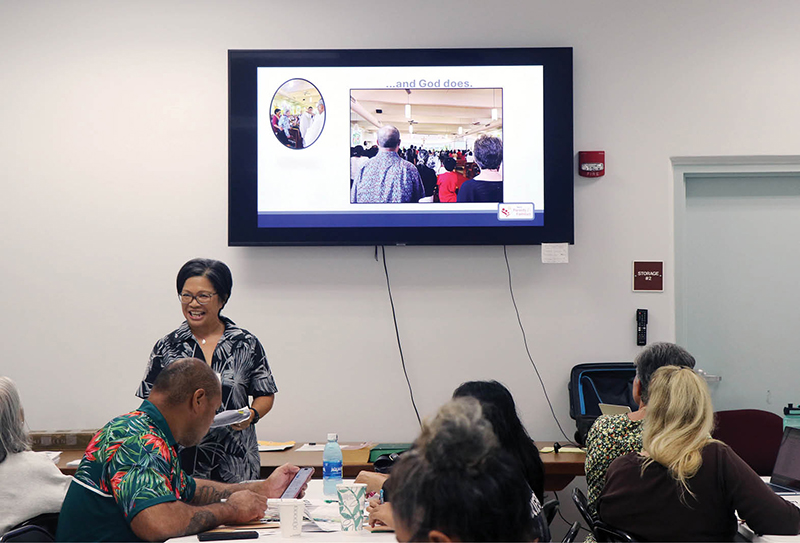
A recent workshop gave parish stakeholders from across the diocese — pastors, catechists, faith formation leaders, families and individual parishioners — an opportunity to learn more about how they can strengthen faith in the home, build a culture that supports parents as their children’s main faith teachers, and simply listen to families and their needs.
Led by Jayne Ragasa-Mondoy, the diocese’s former director of faith formation who now is a national consultant with the National Community for Catechetical Leaders, the Sept. 26 workshop at St. Elizabeth Church in Aiea included several dozen representatives from parishes across Oahu.
In an interview before the workshop, Ragasa-Mondoy described its goals as threefold: to build a knowledge base about how families share religion and spirituality in children’s first two decades of life; to help parish leaders assess existing and innovative approaches that will build upon what families are currently doing to transmit faith and values at home; and to connect leaders with NCCL and local resources to help them best serve parish families.
“Family ministry has long been close to my heart,” she said. “Now in my semi-retired stage of life, it is truly a gift to have the time and opportunity to partner with NCCL to develop a research-based process for placing parents and families at the center of faith formation.”
Workshop attendee Lowella Gaerlan and her husband are youth ministry leaders at St. George Church in Waimanalo.
Gaerlan said her position as a parish leader was one reason for her attendance at the workshop; another, she added, was that “as parents, we want to be able to tell (other) parents you can have your own domestic church.”
The daylong workshop followed an intensive schedule that comprised both large- and small-group discussions. Participants were eager to share their own experiences with working with families.
Ragasa-Mondoy described success stories from parishes participating in a comprehensive NCCL cohort that started two years ago.
At one parish, maintaining contact with parents of newly baptized children kept the families engaged with the community, Ragasa-Mondoy shared. Another parish has helped its families establish strong bonds, so much so that they now come to each other’s aid (such as making sure children did not miss out when a parent could not bring them to church) without question.
After the workshop, Ragasa-Mondoy said it met her expectations both in attendance and in the “high level of interest in exploring how to strengthen faith transmission at home.”
“I was completely in awe of those gathered,” she added. “There was so much wisdom in the room and, collectively, many decades of experience and dedicated service to the Church. “The trust and respect they held for one another led to conversations that were honest and engaging.”
Ragasa-Mondoy said that the attendees appreciated learning a “systematic, research-based and practical” process for reaching out to and supporting families, especially parents with very young children. They were also grateful for the resources and ideas they now have to use right away and in the future.
Subsequent sessions to check parishes’ progress and continue the discussion are planned, Ragasa-Mondoy said. Training resources will also be available through NCCL.
Cohort is going strong
The Sept. 26 workshop marked another way that the Diocese of Honolulu is working in partnership with the National Commission for Catechetical Leaders to help parishes support the families in their communities.
In 2024, nine parishes from four islands formed a cohort that became part of a 23-diocese national initiative whose goal is to “establish a solid, research-backed foundation for how religious and spiritual transmission takes place within the home,” according to Tanya Barbero, the local family project coordinator for the NCCL program.
The national program receives grant funding from the Lilly Foundation.
Barbero, who is also the family faith formation director for St. Anthony of Padua Church in Wailuku — one of the nine parishes in the cohort — explained that “the parish’s role is to support and equip parents, not replace them.”
“As Catholics, we call the family the domestic church — the first place where children experience God, learn to pray and begin living their faith.”
The parishes in the cohort (eight are still active) have participated in several rigorous training sessions as well as regular virtual meetings to review their plans and resources.
Ragasa-Mondoy noted that the cohort’s parish leaders “are shining examples of spirit-inspired commitment.”
“Some leaders are employed by the parish, others are volunteers, yet all have been generous with their gifts and mutual support for one another, which is necessary to work through the ebbs and tides of launching a new initiative,” she said.
Barbero said the cohort’s success stories so far include providing activities to help parents and teens grow in faith together; strengthening baptism preparation so parents and godparents know about their important role in nurturing the child’s faith; engaging families with elementary-age children; and starting new endeavors such as a family rosary project and a children’s Mass.
“Family-centered faith formation is not a one-size-fits-all program, but an opportunity to listen, respond and create meaningful experiences that help faith grow within our families,” Barbero said.
Grant funding for the Diocese of Honolulu’s cohort will sunset in 2028, Ragasa-Mondoy said. The diocesan Office of Evangelization and Catechesis will shift management of the family faith formation initiative to its office from the NCCL, due to the many requests from parishes for continued training, resources and support.