By Lisa Dahm
Hawaii Catholic Herald
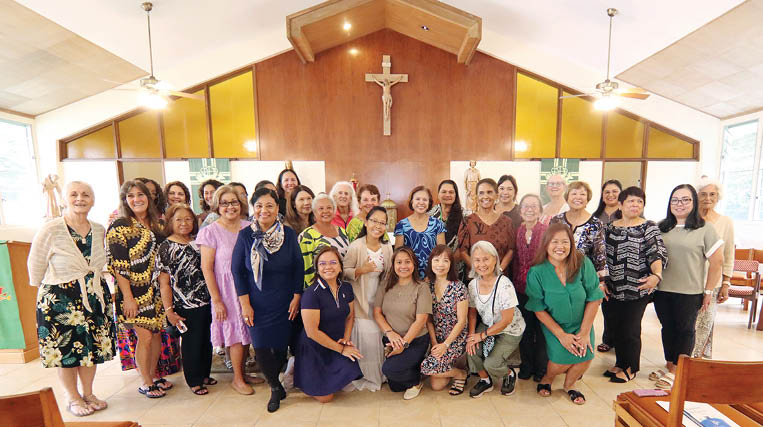
Since the first permanent deacons were ordained in the Diocese of Honolulu in 1981 under Bishop John J. Scanlan, their wives have been working in lockstep, serving beside them in their vocation.
Before entering formation, candidates must receive permission from their wives — their signatures are on the deacon’s ordination covenant above that of the pastor or supervisor.
And while each diocese in the country is different, in the Diocese of Honolulu wives of married deacon candidates are required to go through the same five-year, rigorous coursework and training program that their husbands attend through Chaminade University of Honolulu.
Both deacon candidates and their wives also have an opportunity to go beyond the required curriculum and earn a master of pastoral theology. They spend one weekend a month at St. Stephen Diocesan Center in Kaneohe during their formation.
Dustyn Ragasa, director of the pastoral theology master’s program at Chaminade, said having both the deacon candidate and his wife in formation is essential — wives offer invaluable insights and perspectives.
Ragasa said that though wives are only required to attend and have no evaluation rubrics to pass if they are not seeking a degree, about 80% of them voluntarily participate in the discussions and lectures.
“It’s a really powerful witness to the universal call to holiness,” Ragasa said. “I think the temptation might be (to think) the men are being ordained, the women are just kind of there along (for) the ride, but I think what this formation program does is it shows everybody, man and woman, that they have an important role in the church. I think the women respond to that. That’s why they take their studies so seriously.”
Both called to serve
Deacons’ wives not only serve their husbands, families and parishes, they often hold full-time jobs as teachers, veterinarians, healthcare workers, administrators and more, just as deacons do.
Deacon Keith Cabiles and his wife, Hazell Cabiles, are co-directors for the deacon formation program in the Diocese of Honolulu, which is now in its 12th cohort.
Hazell, a preschool teacher, said she was excited when her husband first considered applying for the diaconate formation in 2020.
Though the work is important, serving as a member of the clergy requires deacons to enter a covenant of sworn obedience to the bishop, as well as their parish pastor. Hazell Cabiles said this life-changing commitment affects the entire family, which is why requiring wives to attend five years of the formation program with their husbands prepares them both for their husbands’ ordination.
“When you look at ‘diakonia,’ it means ‘service,’” Hazell Cabiles said “Service to others is what Jesus calls all of us to do. If this is the ministry for your family, by God’s grace it will work. And your family will be blessed for it.”
It was only in 1964 when the Second Vatican Council approved the restoration of the diaconate as a permanent order in the three-fold hierarchy of holy orders — bishop, priest and deacon. Three years later, St. Paul VI reestablished the order of diaconate through the apostolic letter “Sacrum Diaconatus Ordinem.”
The deacon’s ministry of service covers three main areas — word, liturgy and charity. This includes proclaiming the Gospel and assisting the celebrant at the altar during Mass, celebrating funerals, baptisms and weddings, and giving instructions to prospective converts for initiation into the Christian community.
All in the family
Deacon Michael Weaver’s father, Deacon Jerome Weaver, was ordained in the diocese’s second cohort in 1984. His mother, Verna Weaver, died shortly before his own ordination in 2015.
He and his wife, Cecelia Weaver, were already married when the senior Weavers went through formation.
Deacon Weaver, who is director of permanent deacons for the diocese, remembers that growing up, his parents had six children with little extra time for parish work.
“Once he was ordained, she started to work for parish outreach, and she helped him with classes that he was conducting,” Deacon Weaver said. “It really was an opportunity for her to get more involved in the parish along with him. It was important to her.”
Deacon Weaver and Cecelia, who was a second-grade teacher at St. Anthony School in Kailua for 39 years, both earned a pastoral theology master’s degree when they were part of Cohort 7, which was ordained in 2015. They also served as mentors for a deacon formation cohort with Deacon and Hazell Cabiles.
Cecelia Weaver said each wife, whether outgoing or more introverted, finds her level of parish participation and ministry work that best suit her abilities and comfort level. Parishioners often find kinship with a deacon’s wife and are more candid with their circumstances or questions.
Importance of formation
Lisa Wood, who is a veterinarian in North Kohala on Hawaii Island, and Deacon George Gerard “Keoki” Wood, have assisted with diaconate formation for Cohort 11 for the past five years.
“So much can happen in five years when you take a group of 20 people,” Lisa Wood said. “There are joyful moments and here are tragic moments. You see all the challenges that these families face, but they just keep showing up and they draw strength from their classmates.”
Since her husband’s ordination, Lisa Wood has volunteered in hospice care and homebound ministry at Our Lady of Lourdes Church in Honokaa. The couple have two adult children.
Maggie Sabater was a full-time middle school religion and science teacher and grade-level chairperson at St. Joseph Parish School in Waipahu when she and her husband, Deacon Marlowe Sabater, went through the formation program.
“I was working while supporting Marlowe through formation,” said Sabater, who still works at St. Joseph Parish School. “Balancing work, family, parish responsibilities and formation required planning, patience and flexibility. In many ways, his formation also became part of my own formation.”
She saw it as a blessing to have her two teenage sons — one in college and one in high school — watch their father grow in holiness, making time for prayer, study and service.
“We also made sure to continue spending time together as a family,” she said. “Witnessing all this during formation strengthened the foundation of their Catholic faith, which they now apply in their own lives with their spouse and fiancee.”
Danielle Burgos, wife of Deacon Ricardo Burgos, serves as a marriage advocate at St. Ann Church in Kaneohe and handles paperwork for annulments and other matters.
The couple also participates in the Order of Christian Initiation for Adults at their parish and serves as area co-councilors for the Equestrian Order of the Holy Sepulchre of Jerusalem for the Diocese of Hawaii.
Danielle Burgos’ advice to couples who are in formation or thinking of joining the diaconate is to understand that the process is long, but to take it one weekend at a time.
She said that being a deacon’s wife means embracing her husband’s clerical calling while walking alongside him.
‘We started out as two laypeople, but now there’s a uniqueness, a difference to our call,” she said. “And for me, it’s growing to be the best layperson possible.”