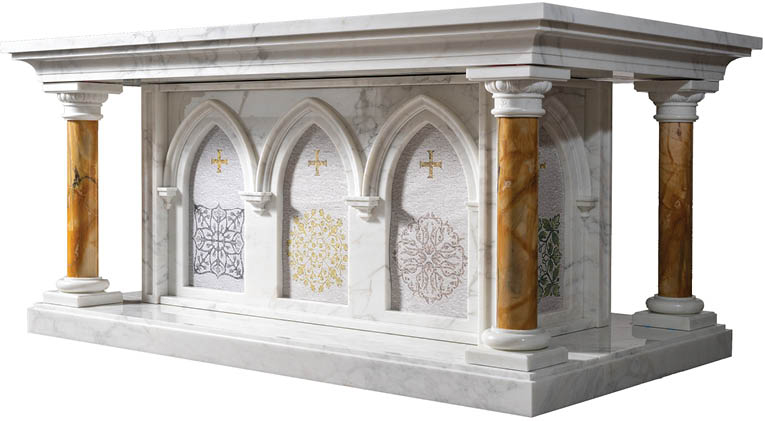
Eight mosaic panels representing Hawaii’s major islands adorn the new altar for the Cathedral Basilica of Our Lady of Peace
By Lisa Dahm
Hawaii Catholic Herald
Like a beautifully crafted Hawaiian quilt, the new altar to be installed as part of the ongoing renovation of the Cathedral Basilica of Our Lady of Peace in downtown Honolulu weaves together eight glass mosaics — one for each of the major Hawaiian islands — creating a sacred space that Catholics throughout the Diocese of Honolulu can call home.
Barbara Shideler, the local designer of record and historic architect from Mason Architects, said Bishop Emeritus Larry Silva, who has been integral in the cathedral basilica renewal project, wanted to personalize the altar, yet have it match the rear high altar with its gold-backed glass mosaics.
“He really liked the idea of having all of the islands represented in this altar because, as the seat of the Roman Catholic diocese, it really is the mother church for all the other Catholic churches in the state,” Shideler said. “It also serves as a local parish, but it is the seat of the bishop.”
Set in symmetrical arched panels across all sides of the polished Calacatta Michelangelo marble, with complementary golden yellow Giallo Siena marble columns on its four corners, the quilt-design glass mosaics attached to the altar use colors and flowers associated with each island: yellow ilima for Oahu, green pua kukui for Molokai, orange kaunaoa for Lanai, pink lokelani for Maui, white pupu (white shell) for Niihau, red ohia lehua for Hawaii island and gray hinahina for Kahoolawe.
Each panel is about the size of a rolling suitcase, roughly 14 inches wide by 20 inches tall. Rugo Stone, a company of Italian stone workers in Virginia, produced the mosaics based on artistic renderings developed in collaboration with Christian Brother William Woeger, the renewal project’s liturgical consultant who died in 2024.
The altar’s top platform, called a mensa, consists of a single solid slab measuring approximately 5 feet by 7 feet and 5-6 inches thick.
The new altar is one of the many projects that will restore and renew the historic cathedral basilica, which was dedicated Aug. 15, 1843, on land provided by King Kamehameha III.
“The overall goal is to create a cohesive liturgical space that honors both historical traditions and local Hawaiian identity,” Shideler said.
Rugo Stone shipped each completed mosaic individually to Hawaii. The panels are now being taken to parishes on the islands they represent so parishioners can see them up close before they are installed in Honolulu.
Back to its roots
The cathedral basilica’s restoration is a joint venture between local firm Mason Architects, whose project team provides expertise in local building materials and trades, and Omaha-based RDG Planning and Design, with liturgical guidance from Brother Woeger. EverGreene Architectural Arts has been mobilized to perform painstaking conservation.
The cathedral basilica has seen several renovations over its lifetime, but through careful study of historical archives, this renewal project is focused on bringing the property back to a version that someone traveling back to 1864 could identify.
“Bishop (Larry) Silva, early on in the project, determined that he wanted the church to be evocative of the time in which St. Damien (de Veuster) was ordained a priest in that church, and where St. Marianne would have celebrated her first Mass” in Hawaii Shideler said.
Prior to Vatican II, there was no sacramental altar. In the time of St. Damien and before, the church had a high altar backed by an ornately decorated screen called a reredos; the celebrant performed the service facing the high altar with his back to the congregation.
The original high altar that dates to 1927 was donated by the Filipino Catholic community and was made of marble imported from Italy.
After the Second Vatican Council in the 1960s, a sacramental altar facing the congregation was installed. That altar was documented in the Library of Congress’ Historic American Building Survey around 1967, but its current whereabouts are unknown.
The new sacramental altar is designed to mirror the proportions and aesthetics of the 1920s reredos to ensure historic continuity.
“It’s the same stone from the same Italian quarry, the same (Calacatta Michelangelo) marble,” Shideler said.
The original Calvary station, Jesus on the cross with Mary and Joseph, was originally constructed of wood but was replaced by a marble sculpture that is still used.
In the 1980s, the cathedral basilica had an altar constructed of wood that featured statues repurposed from a former central ambo. This wooden structure is currently located in the Kamiano Center next to the church.
Other new marble components include a matching octagonal baptismal font, which was hewn from the same block of marble, with Hawaiian inscriptions and gold glass mosaics.
All the marble is scheduled to ship via container in early January and to be installed by Rugo Stone masons in around February.
To donate to the Cathedral Basilica of Our Lady of Peace renewal project, visit https://honolulucathedralrenewal.org.