Problems with a decades-old pump system have forced the evacuation of the remote peninsula
By Celia K. Downes
Hawaii Catholic Herald
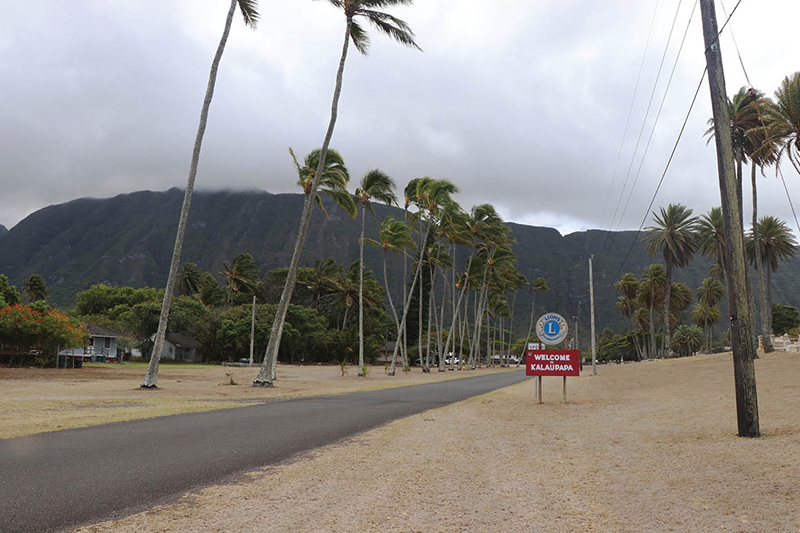
People who live and work in Kalaupapa, Molokai, are accustomed to the challenges posed by life on the remote peninsula.
Food, mail, vehicles and other supplies arrive by boat, tiny airplane or on foot via a steep hike. (In fact, so do the people.) Wireless internet connectivity became a regular feature not too long ago, and even now cellphone service is hard to come by.
The isolation once served a grim purpose — to forcibly separate people with Hansen’s disease, also known as leprosy, from the rest of the population. It’s been decades since patient-residents were sent there against their will, but several still call Kalaupapa home.
In addition to the patient-residents, workers from the state Department of Health and the National Park Service (Kalaupapa was designated a national park in 1980) are also present, as are several Catholic religious women and men — two Franciscan sisters and a Sacred Hearts priest, continuing the legacy of care that stems from Father Damien de Veuster and Mother Marianne Cope.
So when something goes awry in the settlement, many people are affected, and they can be left waiting for weeks until the problem is resolved.
Earlier this month, just such a crisis arose. The system that supplies Kalaupapa with clean water — inaugurated by Father Damien in 1873 and last updated in 1985 — suffered a “series of failures,” according to an NPS spokesperson, that resulted in unsafe conditions and the evacuation of the entire settlement.
According to NPS, the 41-year-old pump system experienced problems both in its primary and its backup components over several weeks. Kalaupapa’s available water supply declined steadily as workers diagnosed the issues and made some repairs, even with notices to conserve water.
“When water levels reached a point where residential use could no longer be reliably supported, residents were moved to preserve sufficient water during ongoing repairs,” NPS said.
The problems and diminishing water supply coincided with the long Labor Day weekend Sept. 5-7; according to a Department of Health spokesperson, people who had left Kalaupapa for the holiday were asked to remain off-site the following week as conservation efforts continued.
However, the situation continued to deteriorate, and around noon on Sept. 11, the decision was made to evacuate the settlement.
According to DOH, people in Kalaupapa faced health and safety concerns due to the shortage of potable water. While bottled water could be used for drinking and cooking, “a prolonged shortage would affect other essential activities of daily living, including bathing, toileting, laundry and watering yards,” the DOH spokesperson said.
An NPS spokesperson said that the estimated repair time is at least two weeks due to the specialized equipment that must be brought to the settlement to restore the system.
“The safety and security of Kalaupapa residents remains a top priority for the National Park Service,” the spokesperson said.
The only people currently allowed in Kalaupapa are those essential to making the repairs as well as one worker who is watching over residences and caring for pets that had to stay behind.
Sister Alicia Damien Lau and Sister Barbara Jean Wajda, both Franciscan Sisters of the Neumann Communities, were among the last residents to leave Kalaupapa due to last-minute preparations and limited flight availability. Sacred Hearts Father Pat Killilea, the pastor of St. Francis Church in Kalaupapa, flew out a day earlier, on Sept. 12.
Sister Lau said the two patient-residents who still live in Kalaupapa, as well as their nurses and healthcare workers (known as “kokua”), were the first to leave when the evacuation became official Sept. 11.
They have joined the two other remaining patient-residents at Hale Mohalu, a special care unit at Leahi Hospital in Honolulu, Sister Lau said.
If there is one good aspect to the challenging situation, Sister Lau said, it is that the evacuated patient-residents have their Kalaupapa kokua with them, minimizing their stress.
She and Sister Wajda are continuing their work, she added, while they stay with fellow sisters in Honolulu.
“Our ministry is to care for the patients and to assist where we can, and to help the DOH as volunteers (wherever) the need is,” Sister Lau said.
For example, she said, she brought socks to one patient-resident at Hale Mohalu, and was able to deliver avocados on behalf of another patient-resident to family members.
Sister Lau praised the agencies involved in addressing the water situation, including NPS — which “was very proactive to take control of the situation” — and Mokulele Airlines, which serves Kalaupapa and whose pilots were “very conscious and helpful” with the unexpected evacuation.
The sudden need to leave meant packing for an indefinite period away from home, as well as taking perishable items. For a small airplane on which every pound of luggage must be counted, that can pose a logistical challenge, but Sister Lau said she “really appreciated (the pilots’) attentiveness in working with the staff and getting everything” onto the flight.
Father Killilea, who is staying at the Congregation of the Sacred Hearts of Jesus and Mary monastery in Kaimuki, mentioned the inconvenience of visitors having to cancel trips to Kalaupapa, but also expressed gratitude for his flight out and his accommodations on Oahu.
Both Sister Lau and Father Killilea said the water crisis is “in God’s plan.”
“We have to be ready for the unexpected,” Sister Lau said, and “pray that the contractors’ hands can be guided to fix (the situation).”