Hawaii Catholic Herald
As the Catholic Church continues to observe the Jubilee Year of St. Francis of Assisi, marking 800 years since his death, key moments in the beloved saint’s life are gaining renewed notice.
On Sept. 17, the Church — especially Franciscan clergy and religious women and men — will celebrate the 802nd anniversary of St. Francis’ first experience with the stigmata, or bearing the marks of Jesus’ crucifixion wounds. He was the first known person to manifest the stigmata.
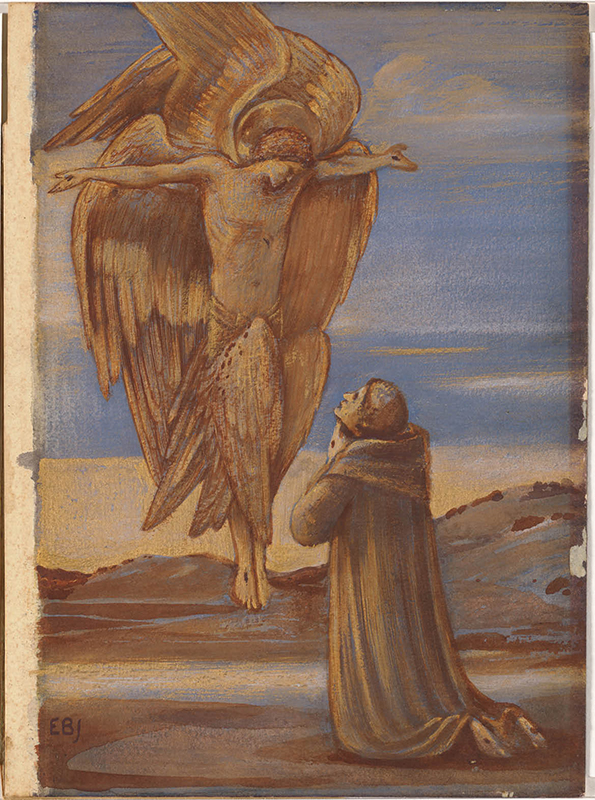
This miraculous event has been represented in many works of art over the centuries, but a special painting by an acclaimed artist that remained under the radar until just a few years ago establishes a unique link between St. Francis and Hawaii’s saints, Father Damien de Veuster and Mother Marianne Cope, who ministered to Hansen’s disease patients on Molokai’s remote Kalaupapa peninsula.
In 1887, famed English painter Edward Burne-Jones created a watercolor titled “The Vision of St. Francis” as a sign of support for Father Damien and had it delivered to the Sacred Hearts priest through the artist’s former studio assistant, who was traveling to Hawaii to research how Hansen’s disease was being managed.
Father Damien died of Hansen’s disease in 1889, only four months after receiving Burne-Jones painting. Mother Marianne, who belonged to the Sisters of St. Francis, displayed the painting in St. Damien’s chapel until her death in 1918.
“The Vision of St. Francis” was then sent to the Sisters of St. Francis convent in Syracuse, New York, and was archived there for 100 years until it was rediscovered in 2018. The Franciscan sisters donated the painting to the Metropolitan Museum of Art in New York, where it still resides.
Details and devotion
St. Francis of Assisi first manifested the stigmata of Christ in 1224 during a retreat in Mount La Verna, Italy.
The stigmata are Jesus’ crucifixion wounds — the nails in the palm of his hands and his feet, the marks from the crown of thorns and the mark from the lance that pierced his side.
Burne-Jones depicted St. Francis’ encounter with a six-winged seraph in gouache, a thick, pasty type of watercolor.
The angel’s majesty and strength are captured in muted earth pigments and gold. The angel’s arms are outstretched, exposing the crucifixion wounds, and his eyes are fixed on St. Francis, replicating Christ’s view from the cross before his death.
St. Francis kneels below, staring at the angel in awe, with signs of the stigmata on his palms and on the soles of his feet.
According to Franciscan Sister Davilyn Ah Chick, a Sister of St. Francis of the Neumann Communities, Pope Francis advocated that the stigmata for St. Francis was a call to return to what is essential.
“The celebrations of the eighth centenary (of St. Francis’ death) should be a similar call,” she said of the jubilee year.
To her, Pope Francis best summed up this call to forgiveness and humility in 2024, when he met with Franciscan friars in Rome.
Pope Francis encouraged them to “be forgiven bearers of forgiveness, healed bearers of healing, joyful and simple in fraternity; with the strength of the love that flows from the side of Christ and that is nourished in your encounter with him, to be renewed every day with a seraphic ardor that burns the heart.”
On the feast of the stigmata of St. Francis, Sister Ah Chick encourages all who have a love for the saint to meditate before a crucifix and recall St. Francis’ prayer: “Most high, glorious God, enlighten the darkness of my heart and give me true faith, certain hope, and perfect charity, sense and knowledge, Lord, that I may carry out your holy and true command.”
Looking ahead
October is dedicated to St. Francis, whose feast day is celebrated Oct. 4. Isle Franciscans and the Diocese of Honolulu will mark five weeks of “Living the Gospel,” exploring ways that people can connect with their common home.