By Celia K. Downes
Hawaii Catholic Herald
In the middle of the afternoon on Sunday, Aug. 16 — as the scope of tropical cyclone Lala’s impact across the state became clearer even as it continued to produce strong winds, heavy downpours and powerful storm surges throughout the islands — parents began receiving notifications from their children’s schools.
Classes the following day, Monday, would be canceled for both Catholic and public schools as staff and administrators assessed any storm-related damage to campuses.
While the news was probably not what moms and dads wanted to hear, especially so early in the new academic year, officials agreed that it was a necessary move in order to ensure the safety of students, their families and educators.
Llewellyn Young, superintendent of Hawaii Catholic Schools, described how events unfolded on Aug. 16 that resulted in the Diocese of Honolulu announcing school closures the next day.
Young told the Hawaii Catholic Herald that he is among the officials who attend regular Hawaii Emergency Management Agency, or HIEMA, morning meetings. During the Aug. 16 meeting, Gov. Josh Green “indicated that he was considering recommending the closure of DOE (state Department of Education) schools, primarily to keep our roads clear for emergency response crews and first responders across all islands,” Young said.
Meeting participants had the same concerns about keeping roads clear, and DOE Superintendent Keith Hayashi also shared that some public schools had already sustained damage, Young added.
“Once I heard the governor’s recommendation and his intention to close DOE schools statewide, I immediately contacted (vicar general Msgr. Gary Secor and Bishop Michael T.T. Castori, SJ) with the same recommendation for our Catholic schools,” he said. “We agreed that we needed to do our part to support emergency response efforts while also protecting our students, employees and families.”
In addition to keeping roads clear for first responders, Young said that canceling classes for a day would also “give our school administrators and pastors an opportunity to safely assess their campuses for damage and determine whether there were any issues that needed to be addressed before students and employees returned.”
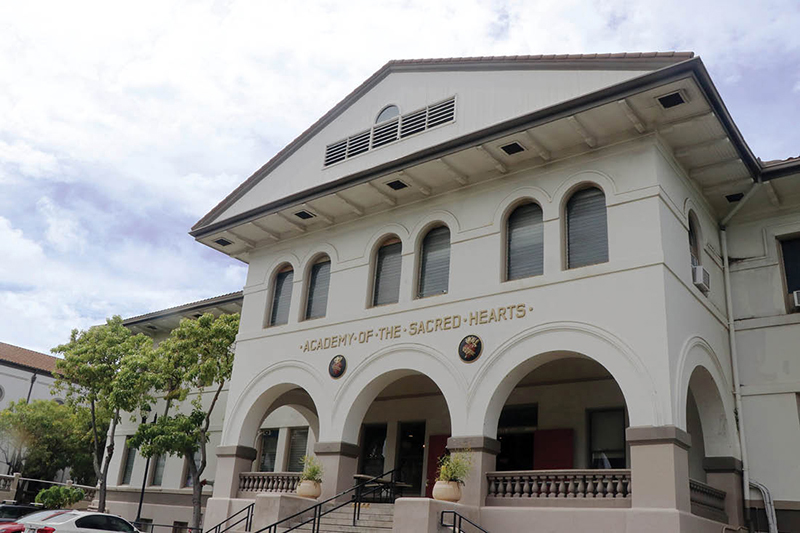
Officials at some schools — such as Sacred Hearts Academy, Saint Louis School and Maryknoll School — surveyed their campuses and made the call to close on Aug. 17 before the diocese’s formal announcement.
In Kaimuki, Saint Louis saw minimal damage but, due to the age of many buildings on campus, decided to close to allow for a full inspection of facilities, according to school President Glenn Medeiros.
Sacred Hearts, meanwhile, experienced moderate flooding in some areas and lost power for more than 24 hours, administrators said. Electricity was restored sometime Aug. 17 and the campus reopened on Tuesday, Aug. 18, along with many other schools in the diocese.
Maryknoll’s elementary and high school campuses were assessed by facilities director David Poore, according to pastor Father Ese’ese “Ace” Tui, and no damage was found. Still, the Honolulu school followed the guidance from the Diocese of Honolulu and the state government.
Damien Memorial School in Kalihi, along with other campuses, cited the safety of its students, faculty and staff as additional reasons for its daylong closure.
Assistant Principal Nicole Paishon reported downed shrubbery and palm branches throughout campus as well as minor water damage in some classrooms, but “all were fixable” in time to reopen on Aug. 18.
But it was also the school’s concerns for students whose homes still lacked power, as well as its consideration of potentially unsafe road conditions, that factored into the decision to close on Aug. 17, Paishon added.
While losing a day of instruction isn’t ideal for students, faculty or administrators, Young said the diocese’s top priority is safety.
“One or two days of interrupted instruction can be recovered,” the superintendent said. “The safety of a child, teacher, employee or family member cannot.”
“These situations can also remind us that schools are more than places where academic instruction occurs — they are communities,” Young continued. “During emergencies, we see administrators checking on families, teachers reaching out to students, parents helping one another and our schools supporting their surrounding communities.
“In that sense, difficult circumstances can actually strengthen the relationships that make our Catholic schools special.”
Challenging situations can also demonstrate how Catholic schools help the wider community, he said. Allowing first responders to do their work and checking on neighbors shows that schools “practice the kind of care for one another that is at the heart of our Catholic mission.”