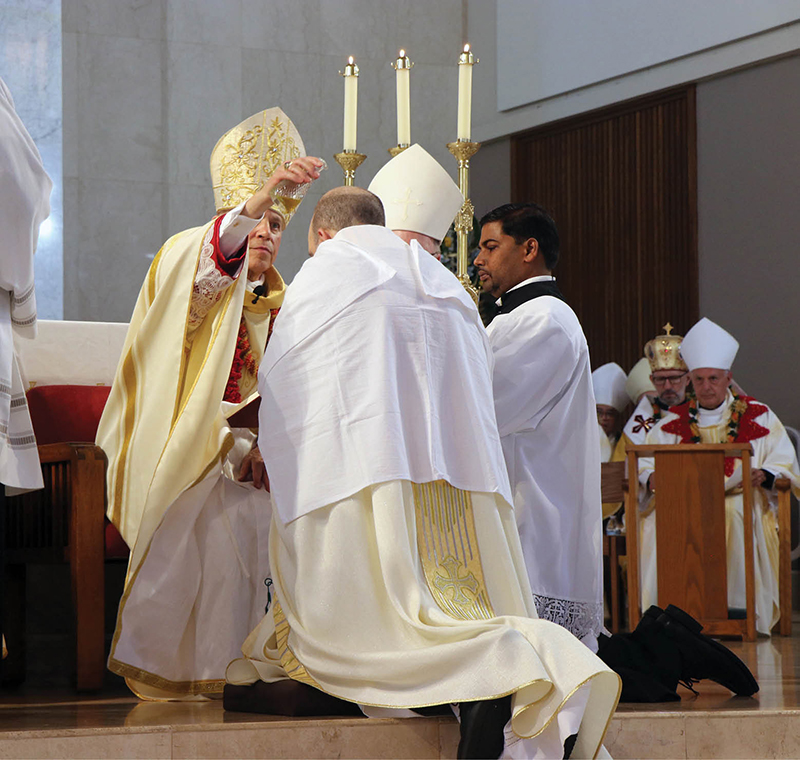
Bishop Michael Thomas Tupou Castori,SJ’s ordination and installation were a joyous blend of people, traditions and cultures
By Celia K. Downes
Hawaii Catholic Herald
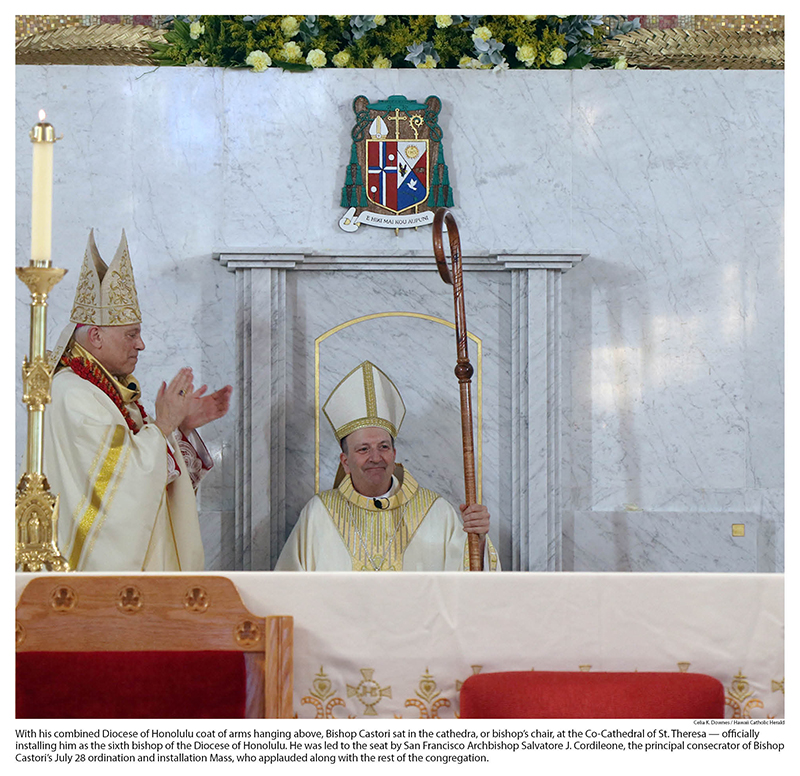
“E hiki mai kou aupuni” — “Thy kingdom come.”
The episcopal motto of Bishop Michael Thomas Tupou Castori, SJ — taken from the Our Father recited in olelo Hawaii — anchored a liturgy rich with culture and symbolism in which the Jesuit priest was ordained and installed as the sixth bishop of the Diocese of Honolulu.
The July 28 Mass at the Co-Cathedral of St. Theresa in Honolulu was a testament to joy, faith, community and steadfastness. The threat of a tropical storm passing close to Hawaii — realized somewhat with gray skies and rain that cleared up as the Mass got underway — did little to quell the enthusiasm of those in attendance.
In the isles’ true aloha spirit, the many hundreds who saw Bishop Castori’s ordination and installation in person represented a wide range of places, cultures and traditions.
Bishop Castori’s friends and families — his biological California family and his adopted Tongan family, with whom he bonded more than three decades ago during a Christmastime visit to the island kingdom in Oceania — filled the pews, as did representatives from other faiths; members of Hawaiian royal societies, who can trace their lineages back to the Hawaiian Kingdom, and various fraternal organizations; scores of priests, deacons and deacons’ wives; religious women and men representing their congregations; and laypeople representing their parishes and other organizations.
Outdoor seating beneath large tents accommodated many more faithful who were eager to witness the once-in-a-generation event. Multiple televisions displayed a simulcast of the liturgy happening inside the co-cathedral.
Michelle Tuzon, a parishioner at Mystical Rose Chapel on the Chaminade University of Honolulu campus and a former teacher at Sacred Hearts Academy in Kaimuki, said she attended Honolulu Bishop Emeritus Larry Silva’s ordination and installation 21 years ago, and she wanted to be part of the diocese’s history despite the weather and outdoor seating.
“It is important that (Bishop Castori) worked in Tonga,” she said. “The phrase on his shield is in Hawaiian. This bishop is very thoughtful in everything he does.”
Katalina “Lina” Falekaono, a recent high school graduate who is active in youth ministry at St. Theresa Church in Kihei, Maui, said from her seat outside that she was excited to attend the event with members of her community.
Building God’s kingdom
In his remarks at the conclusion of the Mass, Bishop Castori expressed gratitude for these groups and all in the Diocese of Honolulu, noting that their work and contributions to society help to “build the kingdom of God in our midst.”
“Isn’t it wonderful that, whatever our ancestry, whatever our place of origin, our first language, by virtue of our dwelling in these majestic islands, our whole way of life becomes imbued with aloha, with blessings rebounding to our families and the communities from which we come,” he said — “even as our divinely created diversity enriches the life of our diocese.”
Bishop Castori said that Hawaii’s history as a former monarchy evoked a moving connection to his days in the Jesuit novitiate in New York four decades ago, when he “found (his) heart enflamed” by a meditation during a 30-day retreat that asked participants to reflect on just such a scenario — of living under the rule of a powerful yet noble earthly king — then consider how much more ardently they would respond to the call of Christ the king.
“And so, now, 40 years after being captivated by the stirring images of that meditation, I find myself in awe that God has looked upon me in my unworthiness and called me to shepherd the only diocese in these 50 states that comprises a land that engendered kingship and nobility, and consequently is graced with people with an instinctive reverence for majesty,” he said.
Bishop Castori also highlighted the Diocese of Honolulu’s yearlong celebration of the bicentennial of Catholicism’s arrival in Hawaii in July 1827, saying that the beliefs already in place proved a sound launching pad for the first missionaries from France.
“I was struck that, in launching this year’s celebration of the bicentennial of Catholicism in Hawaii, my revered predecessor and father, His Excellency, the Most Rev. Clarence ‘Larry’ Silva, declared, ‘The missionaries who brought Christianity to these islands were not writing on a blank slate.’ Indeed, they encountered a spirituality that explains much of why their labors have borne such abundant fruit these past two centuries.
“For certainly, it is no mere coincidence that a people so interiorly disposed to receive the call of Christ the king — this same people should be animated by the luminous cultural value of aloha, which, at its heart, is selfless love,” Bishop Castori said.
Blending traditions
Indeed, the co-cathedral overflowed with aloha during the late morning liturgy, which comprised traditions that crossed distance and time.
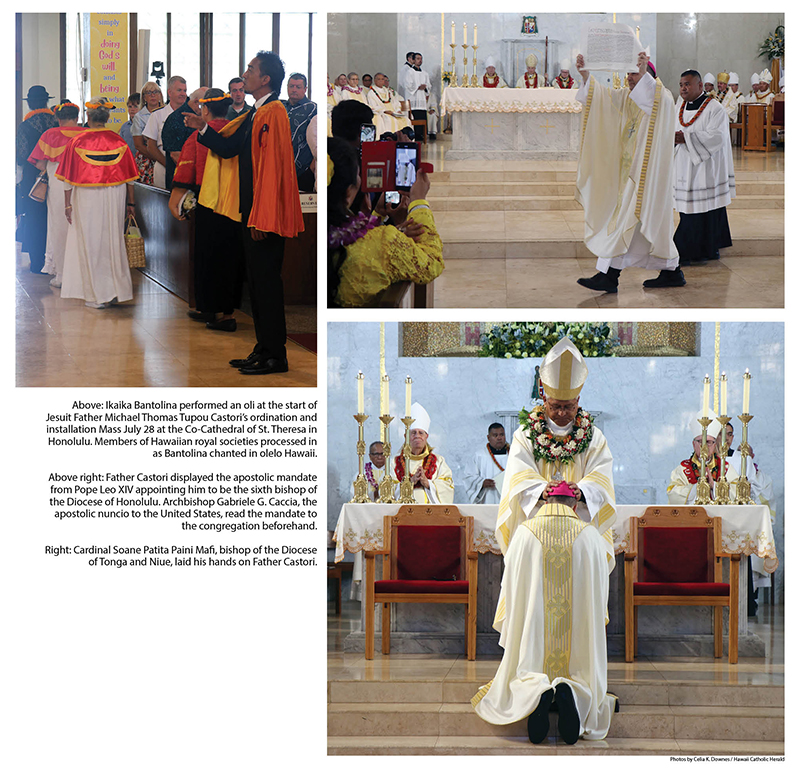
The Mass began with an oli, or chant, followed by a procession of cultural, fraternal and ecumenical representatives. After them came the deacons and priests of the Diocese of Honolulu as well as visiting clergy, then the attending bishops, archbishops and cardinals.
The main diocesan choir provided music that incorporated Hawaiian instruments and styling.
After the liturgy of the word, Archbishop Salvatore J. Cordileone of San Francisco, the principal celebrant, along with other prelates in attendance performed the ancient rites that forever linked themselves and now Bishop Castori to the line originating with Peter.
In a moving recognition of Bishop Castori’s close ties to Tonga and Oceania, during the litany of supplication — when the bishop-elect lies prostrate before the principal celebrant — Bishop Castori lay on a hand-woven fine Tongan mat layered with Hawaiian kapa cloth.
When Bishop Castori was led by Archbishop Cordileone to the cathedra, or bishop’s chair, after his relatives presented to him his miter (hat), ring and crosier (pastoral staff), and sat down, the congregation erupted in applause.
Members of groups within the diocese presented gifts to Bishop Castori immediately after he was installed as bishop; they included organizations such as Hawaii Catholic Schools and ethnicities ranging from Filipino to Vietnamese to Portuguese.
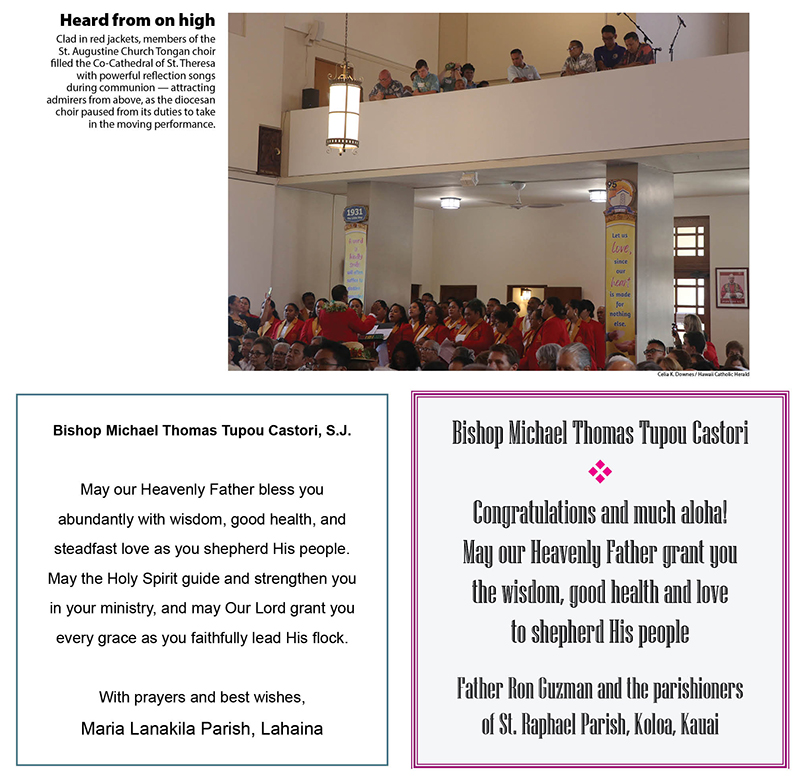
And a special Tongan choir filled the nave with powerful reflection songs during communion.
Oakland Bishop Michael C. Barber, SJ, was one of the liturgy’s co-consecrators (Honolulu Bishop Emeritus Larry Silva was the other co-consecrator) and gave the homily. He praised his fellow Jesuit for rising to the occasion, both now and throughout his priestly vocation.
Bishop Barber concluded his homily with a poignant Bible passage suggested to him during a recent Society of Jesus meeting in Rome.
“Isaiah 42:4 reads: ‘The islands put their trust in you,’” Bishop Barber said. “Yes, Father Michael, the Hawaiian Islands put their trust in you.
“Not because you are a ‘nice guy’ or have a string of degrees after your name, but because through the laying on of hands and the anointing of the Holy Spirit, you represent Jesus Christ.”
“The islands put their trust in you,” Bishop Barber continued, “and so has the Holy Father. And so do we, for ‘The spirit of the Lord is upon you.’”
At the conclusion of Mass, Bishop Castori was led by Bishop Silva and Bishop Barber to greet and bless the congregation. The trio took their time walking through the co-cathedral, and they made sure to head outside so the attendees there could also be blessed.
Darren and Duffy Okimoto were there on behalf of their church, St. Augustine Church in Waikiki.
“I’m just so blessed,” Duffy Okimoto said. “This is once in our lifetime to be able to witness such a beautiful day and to be here,”
She said they were grateful for the bishop and looked forward to his leadership.
“Whatever directions that he puts out for us we just have to go out there and sow the seeds,” she said. “That’s our faith.”
Cultural showcase
The joy that rang through the co-cathedral during the ordination and installation Mass was more than matched by the jubilation expressed afterward, at the reception in the parish hall and outside beneath the tents.
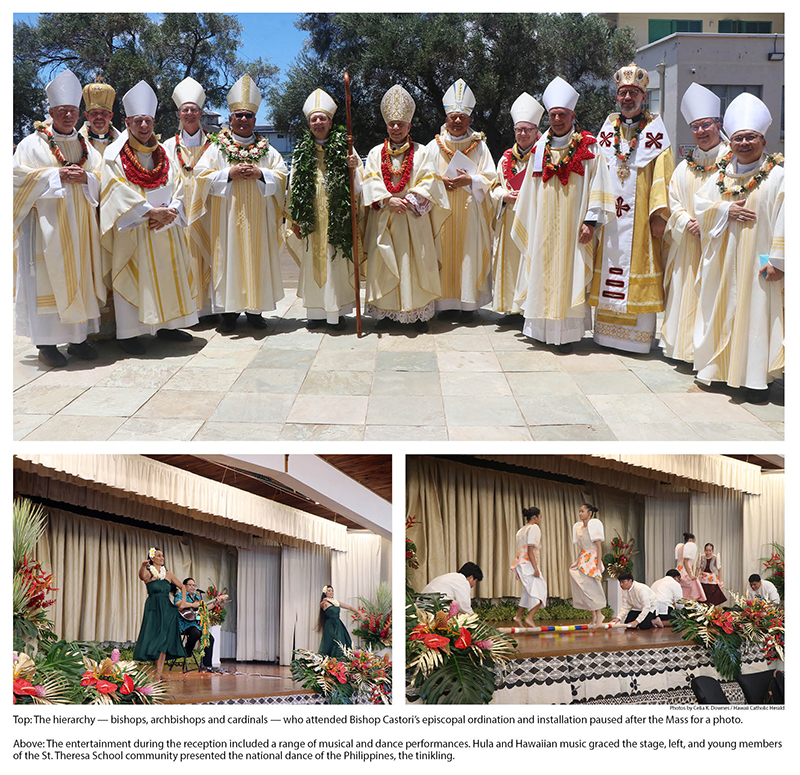
The reception featured multiple dance and musical performances by local faithful and by guests of Bishop Castori eager to share their enthusiasm and talents.
The new bishop himself joined the very first performance — a “tau’olunga,” or traditional dance, presented by his Tongan family as a way to give thanks and celebrate his ordination and installation.
Other presentations of Hawaiian, Filipino and additional Tongan dances put the diocese’s diversity on display for those in attendance, including the visiting bishops, archbishops and cardinals.
The festive spirit continued outside as well, where people who sat beneath large tents for the Mass stayed for a late lunch and fellowship.
Maimoa H. Finesaloi, who attends St. Theresa Church in Kihei, said she could not attend the ordination and installation of Bishop Silva 21 years ago, and she was grateful to share in the celebration of Bishop Castori with Catholics from throughout the diocese.
“I think it’s a reminder for us that he’s saying yes, but we’re also saying yes alongside him, and we need to do our part,” Finesaloi said. “If the rest of us are not following and not willing to participate or bear witness, then it won’t work. Individually, I think we’re also saying yes to continuing to build the kingdom and continuing the faith as laypeople.”
Herald reporter Lisa Dahm contributed to this story.