Hawaii Catholic Herald
The outlines for the solemn vespers and ordination and installation Mass described below were laid out before publication of this issue, which occurred after the joyous events. Any discrepancies between what is printed and what actually took place are unintentional. A full recap of the Mass will appear in the Aug. 14 issue of the Hawaii Catholic Herald.
Before Bishop Michael T.T. Castori, SJ, was installed in the bishop’s chair at the Co-Cathedral of St. Theresa in Honolulu July 28, he was guided through an elaborate, highly symbolic and deeply meaningful process that first elevated him from priest to bishop, then placed him in his new role as the sixth shepherd of the Diocese of Honolulu.
Prayerful prelude
The evening before his episcopal ordination and installation Mass, then-Father Castori participated in solemn vespers in honor of Our Lady of Peace, principal patroness of the Diocese of Honolulu and the Cathedral Basilica of Our Lady of Peace. He also publicly made his profession of faith and took the oath of fidelity.
The prayer service is not an official part of the installation process, but bishops-elect can opt to include it if they wish to gather people in prayer before they are elevated to lead their diocese.
Solemn vespers, also known as evening prayer, is one of five prayer times in the Liturgy of the Hours. It is usually held to give thanks for the day and to make an evening sacrifice of praise to God.
The solemn vespers was led by Bishop Emeritus Larry Silva at the Co-Cathedral of St. Theresa. The service comprised hymns, readings and prayers, as well as Father Castori’s profession of faith and oath of fidelity.
As part of his profession of faith, Father Castori recited the Nicene Creed to demonstrate his full communion with the church. In the oath of fidelity that followed, he pledged obedience and loyalty to the pope and his successors; to uphold the unity of the church; and to exercise his office with diligence, charity and faithfulness.
Father Castori’s episcopal insignia — his ring, miter and crosier (pastoral staff) — were also consecrated during solemn vespers.
The main event
The episcopal ordination and installation Mass took place the morning of July 28. The principal consecrator was Archbishop Salvatore J. Cordileone of the Archdiocese of San Francisco; the co-consecrators were Bishop Emeritus Silva and Bishop Michael C. Barber, SJ, of the Diocese of Oakland.
Representing the Vatican was Archbishop Gabriele G. Caccia, apostolic nuncio to the United States.
More than a dozen church leaders, from cardinals to archbishops to bishops, attended Father Castori’s episcopal ordination and installation Mass. (See the full list on the following page.) Scores of priests and deacons from Hawaii and beyond also witnessed the liturgy.
The rites of ordination and installation were inserted into an otherwise fairly typical Mass that began with a lengthy procession. Representatives of Hawaiian royal societies, numerous fraternal organizations and other faiths walked in, followed by clergy and those helping the Mass run smoothly.
After the introductory rites and liturgy of the word came the rite of ordination.
It began with the presentation of Father Castori by his assisting priests — Jesuit Father Eric Watson and Father Emenisilito Samisoni Tupou (his Tongan brother) — to Archbishop Cordileone, the principal consecrator.
Archbishop Cordileone was asked by the assisting priests to ordain Father Castori “to the responsibility of the episcopate”; his response was, “Have you a mandate from the Apostolic See?”
Upon receiving confirmation from the assisting priests, Archbishop Caccia, the apostolic nuncio, read the letter containing the apostolic mandate to the congregation.
Father Castori then displayed the letter to the faithful before a homily was delivered.
Following the homily, seats for Bishop Emeritus Silva, Bishop Barber and Archbishop Cordileone were set up in front of the altar for the next part of the rite. After they sat down, Father Castori came forward and stood in front of Archbishop Cordileone, who proceeded to ask him nine questions. (The questions aimed to prove Father Castori’s resolve to guard the faith.)
The litany of the supplication came next — Father Castori lay prostrate on a fine Tongan mat topped with kapa as the kneeling assembly sang the “Litany of the Saints.”
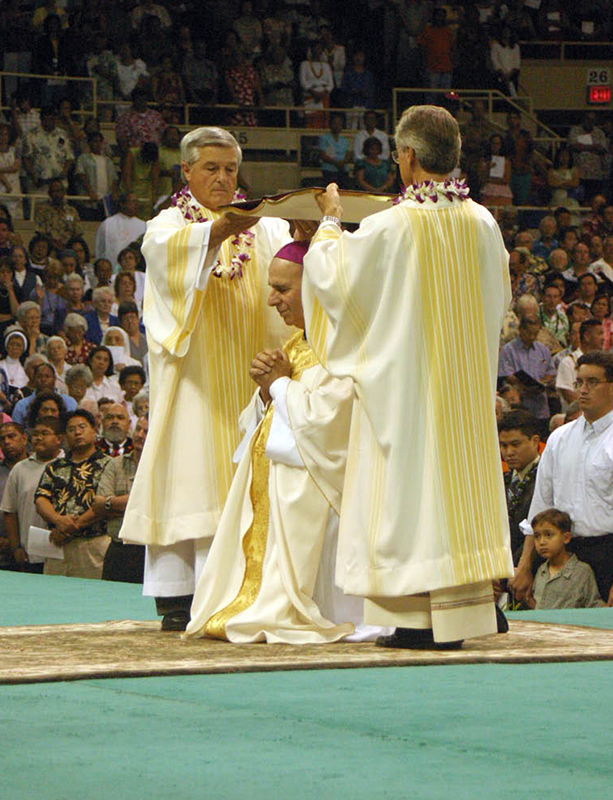
The laying on of hands and prayer of ordination followed. First, Father Castori kneeled as Archbishop Cordileone and the other bishops laid their hands on him. Then, during the prayer of ordination, the Book of the Gospels was held over Father Castori’s head as a sign that he was being placed under the authority of the Word of God and entrusted with the mission to proclaim, teach and guard the Gospel.
Father Castori, now newly ordained Bishop Castori, was then anointed with chrism by Archbishop Cordileone and presented with the Book of the Gospels. Bishop Castori also received his ring, miter and crosier.
In the final steps marking his installation, Bishop Castori was led to the cathedra (bishop’s chair) and, upon taking his seat, officially became bishop of Honolulu. After the fraternal kiss of peace was shared with the attending bishops, representatives of the many groups and cultures within the Diocese of Honolulu came up to greet Bishop Castori.
The Mass then continued with the liturgy of the Eucharist and Bishop Castori as the principal celebrant.
The final special steps came during the concluding rites: Bishop Emeritus Silva and Bishop Barber led Bishop Castori through the church to give his first episcopal blessing, and Bishop Castori then delivered his first address as bishop to the assembly.
Above: The Book of the Gospels was held over Father Larry Silva’s head during his episcopal ordination and installation Mass July 21, 2005, at the Neal S. Blaisdell Arena in Honolulu. (HCH file photo)