By Lisa Dahm
Hawaii Catholic Herald
The insignia of a Roman Catholic bishop are the same throughout the world — they each have a miter (ceremonial cap or headdress), crosier (pastoral staff), pectoral cross and episcopal ring in addition to their signature amaranth-red zucchetto, or skullcap.
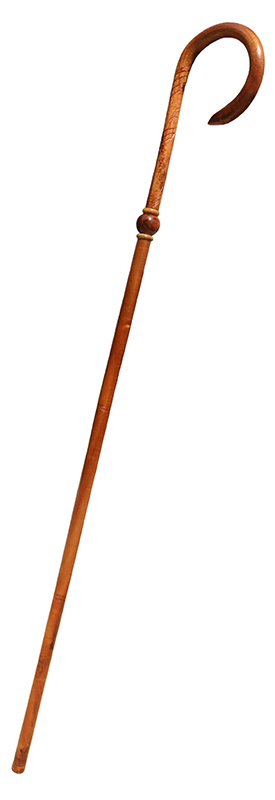
For Bishop Michael T.T. Castori, SJ, of all those symbols that mark him from now on, the one that has been highly personalized and imbued with deep cultural meaning is his newly designed, one-of-a-kind crosier.
Spiritual voyage
The bishop’s crosier is a ceremonial pastoral staff, shaped like a shepherd’s crook to symbolize his duty to pastor and protect his diocese.
Bishop Castori’s crosier was conceived, designed and crafted on Oahu. Brandon Akiona, who has served as a master of ceremony in diocesan liturgies for decades, researched all aspects of the crosier and designed each part with deep meaning specific to Hawaii.
The staff was a personal gift from Bishop Larry Silva, Akiona said, and is not simply a ceremonial item.
“Knowing the weight of a bishop’s office, and knowing the cultural importance of koa in Hawaii, he wanted the work to be done with quality and reverence,” Akiona added.
Akiona called on his good friend, Matthew Kawaiola Sproat — a Hawaiian woodworker and 11-time Na Hoku Hanohano award-winning musician — to bring the design to life.
Bishop Castori’s episcopal motto, “E hiki mai kou aupuni,” provided the direction for the crosier’s design, Akiona said. “E hiki mai kou aupuni” (“Thy kingdom come”) is taken from the Our Father in olelo Hawaii and is the first episcopal motto in the history of Catholicism in Hawaii to be written in the Hawaiian language.
According to Akiona, voyaging is the thread that ties the crosier design together.
The first Hawaiians voyaged across Moananuiakea, or the Pacific Ocean, and built a civilization rooted in the land, genealogy, faith and community. Providentially, Bishop Castori’s installation comes as the diocese celebrates 200 years of the Catholic faith in Hawaii.
“Catholic missionaries voyaged from France to bring the Gospel to Hawaii,” Akiona said. “Bishop Michael Castori voyaged through Polynesia and Micronesia as a missionary, carrying the faith across islands and cultures. And all of us, in our own way, are voyagers on the sea of faith, called to witness to Jesus.”
2 parts, 4 woods
Sproat used four types of high-grade, Hawaii-sourced wood for the crosier and its stand: koa, mango, kamani and milo.
Koa is endemic to Hawaii and highly prized; in ancient times it was used for voyaging canoes, tools and items connected to alii, Akiona said. The deep color and prized curly grain are found in mature trees that may take 80 to 150 years or more to develop.
The koa used for the crosier came from a 150-year-old tree on Hawaii island. “I outsourced this wood from another woodworker on the north shore of Hawaii, and he said he’s had it over 40 to 50 years,” Sproat said.
According to Akiona, the prized exhibition-grade koa used was donated by Sproat’s wife, Trisha Kehaulani Watson-Sproat, and his mother-in-law, Patricia Watson, in thanksgiving for Bishop Silva and in honor of his ministry as bishop of Honolulu for 21 years. It was also offered with affection for him as a fellow Portuguese.
Mango wood, lighter in color, was used for the two rings that border the node of the crosier, adding contrast and balance.
The stand comprises milo and kamani wood and resembles a pohaku kui poi, the stone pounder used to mash steamed taro with water to make poi.
“Poi is more than food — it is a foundation of Hawaiian life, tied to nourishment, ohana, ancestry and the sacred relationship between the Hawaiian people and Haloa (first ancestor to the Hawaiian people, according to legend),” Akiona said.
The milo, used to make the poi pounder form, was historically reserved for carving functional food containers such as poi bowls. The base of the stand is made of kamani, another important wood in old Hawaii that was used for voyaging canoes and calabash bowls.
Deep symbolism
“One of the things I love about both the Catholic liturgy and my Hawaiian culture is that nothing is merely what it appears to be,” Akiona said. “A gesture, a vessel, a chant, a song, a pattern, a flower, a piece of wood — each can carry layers of meaning.”
He said the crosier was designed with the same spirit.
Its crook, for example, bears a sharp point, giving it a purposeful feeling of a working shepherd’s staff.
“The very tip of this crosier reminded me of an adze, and that’s the Hawaiian tool that was used to carve these big voyaging canoes that traveled around the Pacific or between islands,” Akiona said. “I wanted that element incorporated into this crosier.”
Below the crook is the puloulou, or kapu stick. The puloulou marked the presence and authority of high-ranking alii and was placed near sacred areas such as heiau.
Although the kapu system was abolished eight years before the first Sacred Hearts missionaries arrived in Hawaii, the puloulou remained an important Hawaiian symbol. Two kapu sticks appear on the Diocese of Honolulu’s coat of arms.
On Bishop Castori’s crosier, the puloulou honors the kingship of Christ and the sacredness of the bishop’s office, according to Akiona.
The polished crosier features three simple, elegant carvings of a fish net, water and rope at different points from top to bottom. Sproat’s daughter, tattoo artist Ashleigh Kawehi Watson, contributed some of the designs.
A Hawaiian fisherman’s throw net, or upena, is carved near the crook of the crosier. According to Akiona, the upena provides food, gathers community and carries knowledge from one generation to the next.
Likewise, because bishops are successors of the apostles, they are “fishers of souls and are called to cast the nets of the Gospel,” Akiona said.
The water — wai in Hawaiian — in wave form, and the rope (“aha”) design, are carved in the lower section of the crosier.
In voyaging times, aha — braided from coconut fiber — was used to lash the canoe hull to the outrigger. Akiona said the cord’s strength and flexibility allowed the canoe to move with the waves without breaking.
“That image speaks deeply to the life of faith,” Akiona said. “We travel through calm seas and rough waters. We bend, we strain, we are tested. But in baptism, we are bound together as one body in Christ.”
Overcoming challenges
Sprout crafted several models and performed many stress tests before building Bishop Castori’s actual crosier. He also had to reconstruct the staff several times, making it stronger, better aligned, thinner and lighter.
“Everything in this piece is completely unique, which means that I had to test it (how to construct the crosier) through trial and error, off of other pieces of koa similar to the ones that I’m going to use, because the koa is so expensive that I had no level to mess up with,” Sproat said.
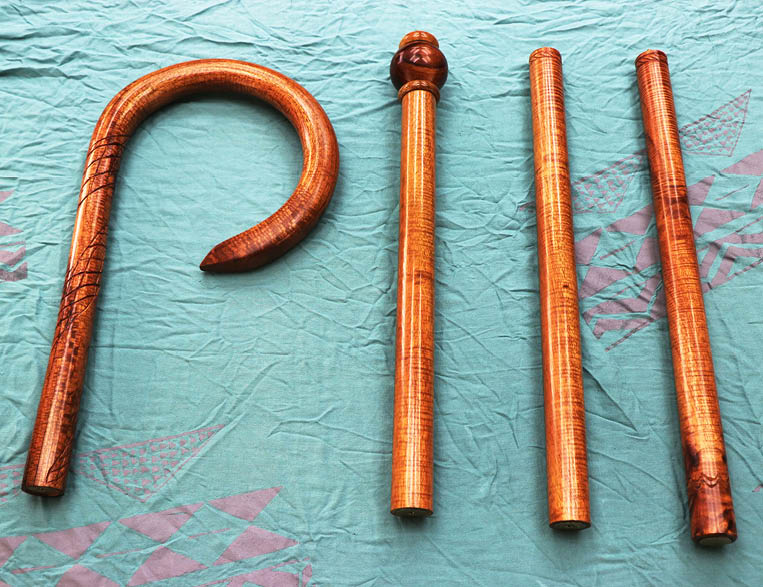
In addition to the construction hurdles, Sproat also had to make the crosier travel-friendly. In order for Bishop Castori to carry it and get it through airport security, it has to break down to fit into a 20-inch travel suitcase, yet be strong enough to withstand constant reassembly, leaning, gripping and trekking throughout the islands.
Bishop Castori’s crosier twists apart to become four smaller components.
On the day before its reveal, Sproat could not sleep, and he felt the results were not his best work. He sanded down the entire carved section and started again — recurving it and also redoing the lashing in under four hours, finishing just in time. He said he felt a peace that let him know the crosier was complete.
Despite his internal battles, he said he realized that Christ was the master carpenter, which freed him from any nagging doubts or personal criticisms that typically arise with any artist.
“I always had to remind myself, ‘This is not just a project. This is something that is going to be very, very important in the long run,’ and I had to keep that general (mindset),” Sproat said.
Hanaiakamalamalamakekumuola
To nurture, preserve, enlighten and guide the wellspring of life
“The name emerged through the manao and collaboration of Kumu Hula Leimomi Ho and Arthur Kauhane Aiu, whose insight and cultural grounding helped give voice to its deeper meaning.
“Woven into the name of the crosier is the Hawaiian name for the Southern Cross, the key constellation for voyagers to find Hawaii, tying the crosier back to the larger story of voyage, guidance, illumination and faith that shaped its design from the beginning.
“Hanaiakamalamalamakekumuola is a powerful name. It evokes a navigator whose true course is not simply across the ocean, but toward the protection, illumination and perpetuation of life itself, echoing the bishop’s role as shepherd, teacher, and guide for the people entrusted to him.
“Just as the Southern Cross shines brightly to orient the voyager, so too does the bishop bring clarity, wisdom, and hope to those seeking the path forward.”
— Brandon Akiona
Other symbols of a bishop
Miter
A miter is the traditional, tall, pointed ceremonial headdress worn by bishops, cardinals and abbots during liturgical services. When the principal consecrating bishop invests the new bishop with his miter during ordination, it signifies the new bishop’s ecclesiastical authority and role as a spiritual shepherd of his diocese.
The two points of the miter represent the bishop’s commitment to the Word of God found in the Old Testament and New Testament. The fringed streamers hanging down the back, called lappets, represent the two covenants and remind the bishop to retain the spirit of moderation and mercy.
Ring
The bishop’s ring is a symbol of his fidelity to and nuptial bond with the church, his spouse. It signifies the bishop’s symbolic marriage to the church or Christ and was first mentioned as an official part of the bishop’s insignia in the early seventh century. It is worn on the bishop’s right-hand ring finger.
Pectoral cross
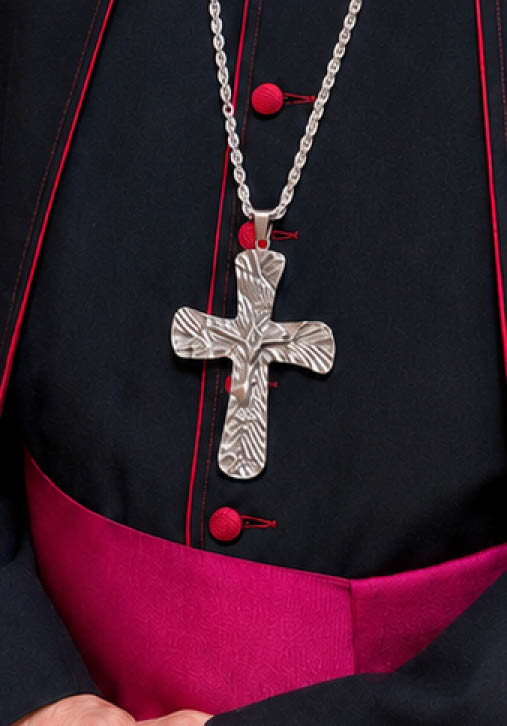
A bishop also wears a pectoral cross, which comes from the Latin word “pectus,” meaning chest. He wears the cross close to his chest as a reminder to always keep Christ close to his heart.
The pectoral cross is the latest addition to episcopal ornaments, though the custom of wearing a cross, with or without holy relics, dates to ancient times.
Top: Bishop Michael T.T. Castori, SJ’s crosier in travel format and in its fully assembled format (photos by Celia K. Downes / Hawaii Catholic Herald); above: Bishop Castori’s pectoral cross was also a gift from Bishop Larry Silva. (Courtesy Bishop Michael T.T. Castori, SJ).