Hawaii Catholic Herald
The Roman Catholic Church is the largest religious denomination in the state of Hawaii, claimed by approximately one-fifth of a population of 1.4 million people. It is a church that has grown from the roots of banishment, persecution and tragedy to produce examples of heroic sanctity in the persons of St. Damien de Veuster and St. Marianne Cope.
The Catholic Church in Hawaii was, for most of its history, a remote missionary location served by priests, sisters and brothers from Europe and the United States. It became a diocese in 1941. Today, the Diocese of Honolulu, which encompasses the entire state, is an active multiethnic community blending Native Hawaiian and American traditions with the cultures and contributions of immigrants from Asia and the South Pacific.
French connection
In 1827, 50 years after the landing of British explorer Capt. James Cook, the first Catholic missionaries arrived in Hawaii.
Before then, a few Catholic priests had passed through the islands, and some had even baptized a few native residents. But these baptisms generally took place aboard ship in the harbor; there was no established Catholic mission.
One man wanted to change that. His name was Jean Rives, a Frenchman. He had arrived in Hawaii as a cabin boy, married a Hawaiian woman and became best friends with Liholiho, the son of Kamehameha I. After Liholiho succeeded his father, he embarked on a trip to England with his wife Queen Kamamalu. Liholiho took along Rives as his translator and secretary.
They set sail in November 1823. The trip was a disaster. Liholiho and Kamamalu died of measles in England. Rives did not accompany the bodies back to Hawaii but instead went to France where he met with government and church officials to persuade them to establish political, business and religious ties with the islands.
Rives sought to benefit from trading deals between the two countries. He thought a French-based Catholic presence in Hawaii would help.
The French church was definitely interested but it was still recovering from the violent French Revolution. It did not have many priests to spare.
Church officials first asked the Jesuits but were turned down. They then turned to Father Marie-Joseph Coudrin who, 25 years earlier, in 1800, had founded the Congregation of the Sacred Hearts of Jesus and Mary.
Father Coudrin also didn’t have many priests, and none with missionary experience. But Father Coudrin himself was full of missionary zeal. He wanted this assignment for his order. He was also encouraged by Rives’ claim that the need was great and that the priests would be welcomed in Hawaii with open arms.
Father Coudrin ultimately received approval from the pope and on July 7, 1827, the French ship La Comete arrived at Honolulu Harbor with Sacred Hearts Fathers Alexis Bachelot, Patrick Short and Abraham Armand, and Sacred Hearts Brothers Theodore Boissier, Melchior Bondu and Leonore Portal. Hawaii was the Sacred Hearts Congregation’s first foreign mission.
The first recorded Mass on Hawaiian soil was celebrated in Honolulu on July 13, 1827.
When the Catholics arrived, American Protestant missionaries had already been in Hawaii for seven years. The ancient Hawaiian religion with its many idols and stone temples had been outlawed for several years. The last thing these Protestant missionaries wanted were French Catholic priests carrying crucifixes and statues intruding onto their territory.
Persecution of Catholics
Although the Catholics proceeded peacefully and were nonconfrontational, they faced opposition and disapproval.
At first, they were able to stay because they had one friend in a high place — Boki, the governor of Oahu, had been baptized Catholic years earlier on board a ship in Honolulu Harbor. But when Boki was lost at sea in 1830, the persecution began, led primarily by the powerful Queen Kaahumanu, wife of the late King Kamehameha I.
The queen deported Fathers Bachelot and Short on Christmas Eve 1831. Father Armand had left two years earlier because of illness. The Sacred Hearts brothers were allowed to stay.
Father Bachelot and Father Short kept themselves busy as missionaries in California.
The islands had to wait five years for another Catholic priest to arrive. He was Sacred Hearts Father Robert Arsenius Walsh, who came on Sept. 30, 1836. Because he was British, he was allowed to stay as long as he didn’t convert anybody. (The Hawaiian Kingdom was friendly to the British.)
When Father Bachelot and Father Short heard that Father Walsh was in Hawaii, they returned and were soon joined by another French priest — Sacred Hearts Father Louis Maigret. It didn’t work out, and they were kicked off the island again.
Father Short took one ship and Father Bachelot and Father Maigret another. Father Bachelot died at sea on Dec. 5, 1837. Father Maigret buried him on the island of Na, near Ponope, in the Caroline Islands.
Father Maigret then headed for Valparaiso, Chile, convinced that the Hawaii mission was doomed. Indeed, King Kamehameha III passed a law on Dec. 18, 1837, making it illegal to be Catholic.
Native converts were persecuted. Hundreds were imprisoned, starved and forced into hard labor. Father Walsh escaped deportation because he was a British citizen.
Back in action
The persecution stopped in 1839 only after the French threatened war. On July 9, 1839, the French warship L’Artemise dropped anchor in Honolulu Harbor. Its captain, Cyril Laplace, demanded religious freedom for the French missionaries and for Hawaii’s Catholics. If not granted, he would fire his cannons on the city of Honolulu.
It was enough to pressure the new ruler, King Kamehameha III, into a concession and he stopped the persecution.
Under the new mantle of religious liberty, the Catholic mission enjoyed a quick revival. Sacred Hearts Bishop Stephen Rouchouze, vicar apostolic of eastern Oceania, of which Hawaii was a part, arrived with other priests on May 15, 1840. He laid the cornerstone for the Cathedral of Our Lady of Peace and began to initiate missions throughout the islands.
To meet the challenge of his new mission, Bishop Rouchouze went back to France in 1841 to have a ship built, outfitted and filled with new missionaries recruited for the islands. The ship, named the Marie Joseph after Father Coudrin, on its maiden voyage to Hawaii was lost at sea in March 1843 near the Strait of Magellan, taking with it the bishop, six priests, one seminarian, seven brothers and nine sisters.
In the wake of this tragedy, Hawaii was separated from the vicariate apostolic of Eastern Oceania and became its own vicariate. Father Maigret was put in charge.
Meanwhile, it would be 16 years before another ship would bring Sacred Hearts sisters from Europe around Cape Horn to Hawaii.
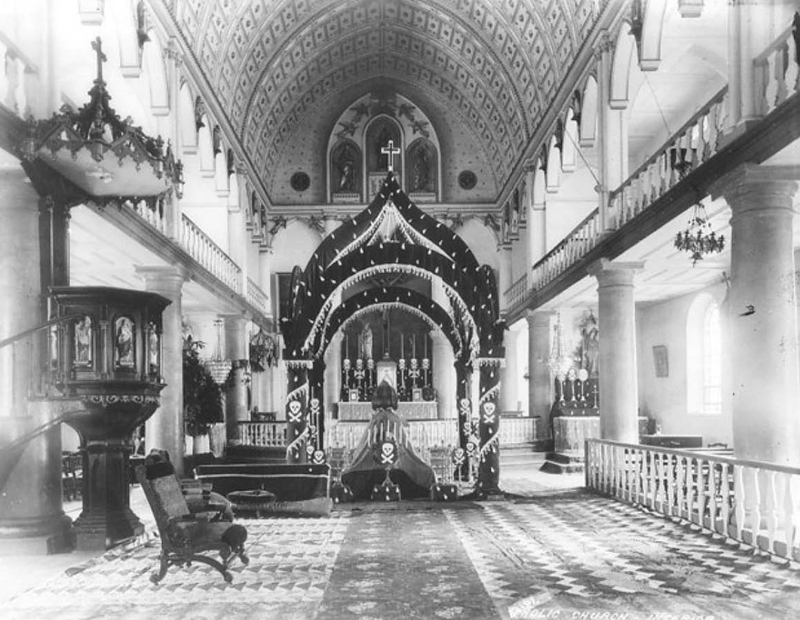
The life of the mission went on. The Cathedral of Our Lady of Peace in Honolulu was dedicated on Aug. 15, 1843, and today claims to be the oldest Catholic cathedral in continuous use in the United States.
In 1845, King Kamehameha III gave land in Kahaluu, on Oahu’s windward side, to the Catholic mission for the building of a school. The following year, Ahuimanu College, the predecessor to Saint Louis in Honolulu, began operation.
In 1847, Father Maigret was consecrated a bishop.
May 4, 1859, marked the arrival of the first nuns in Hawaii, the Sacred Hearts sisters. They established a convent school next to the cathedral, the first of several schools for girls they would eventually open.
St. Damien
Joseph de Veuster was born on Jan. 3, 1840, in the small town of Tremelo, Belgium, into a farming family. At age 18, he joined his older brother Auguste in the Congregation of the Sacred Hearts of Jesus and Mary, taking the religious name Damien after the ancient physician-saint.
Damien was still a seminarian when he arrived in Honolulu on March 19, 1864. He was ordained a priest on May 21 at the Cathedral of Our Lady of Peace. His first assignment was on Hawaii island where he worked for nine years, first in Puna, then Kohala. He endeared himself to the Hawaiian people with his friendliness, vigor and enthusiasm, learning their language, building churches, spreading the Gospel and baptizing hundreds.
During this time, Hansen’s disease, or leprosy, was ravaging the Native Hawaiian people who were particularly susceptible to its virus. King Kamehameha V decreed that anyone with leprosy would be sent to the small Kalaupapa peninsula on the island of Molokai. There hundreds of patients of all ages were left to fend for themselves and to die in often squalid and lawless conditions.
Bishop Maigret was extremely concerned about the plight of those abandoned in Kalaupapa but was reluctant to assign a priest there on any long-term basis. Father Damien was the first of four priests who volunteered to go there in rotation.
He arrived on Molokai on May 10, 1873, and soon after wrote his bishop that it was “absolutely necessary” for a priest to remain there permanently and that he would be willing to be the one.
Father Damien spent the next 16 years bringing dignity to a settlement the rest of Hawaii had abandoned. He served as priest, doctor, nurse, carpenter, plumber, gravedigger and coffin maker. Disregarding medical precautions for himself, he ate with the people, accepted them into his house and touched them.
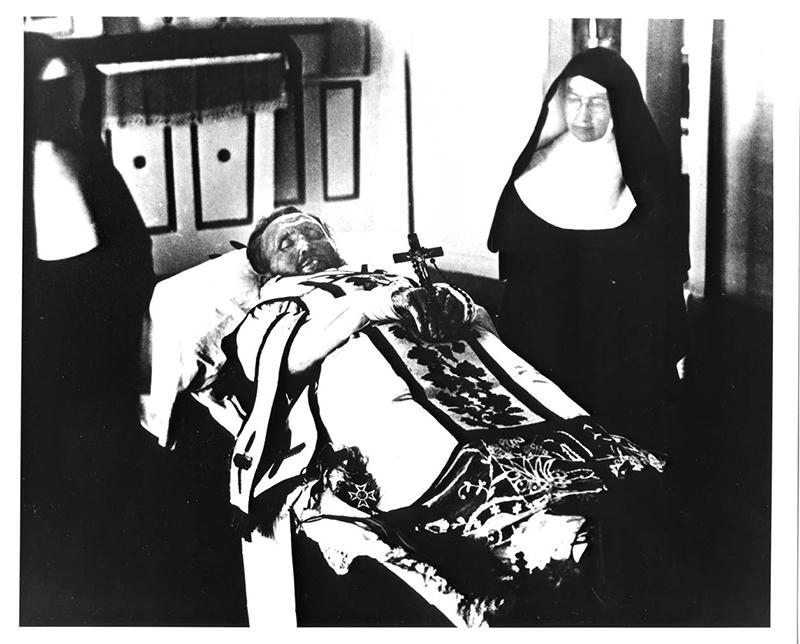
He eventually contracted the disease himself and died on April 15, 1889, the Monday of Holy Week, at age 49. He was buried beside the church he helped build, St. Philomena.
In 1936, at the request of his congregation and the Belgian government, Damien’s body was returned to his home country. He was declared “venerable” in 1977 by Pope Paul VI. Pope John Paul II beatified Father Damien in Belgium on June 4, 1995.
Pope Benedict XVI canonized him in Rome on Oct. 11, 2009.
Mission grows
Hawaii received its first major influx of Catholic immigrants with the arrival of the first Portuguese farm laborers from the Azores in 1878. Among them were the ancestors of Bishop Larry Silva, the fifth bishop of Honolulu. By the end of the 19th century, more than 18,000 would settle in Hawaii.
Bishop Maigret died on June 11, 1882, after laboring 42 years in Hawaii, 35 years as its bishop. He was succeeded by Bishop Hermann Koeckemann.
The year after Bishop Maigret’s death, 1883, saw the arrival of two religious orders that would have a tremendous effect on Hawaii.
The first, landing in September, were the educator brothers of the Society of Mary, or Marianists. They opened Catholic boys’ schools on Oahu, Maui and Hawaii island. Today they run Saint Louis School and Chaminade University of Honolulu.
Two months later, on Nov. 8, responding to a plea from King Kalakaua, six Franciscan sisters from Syracuse, New York, led by Mother Marianne Cope, arrived to assist the Hansen’s disease patients at the Kakaako Branch Hospital in Honolulu.
In 1888, five months before the death of Father Damien, she and two sisters arrived at Kalaupapa to run the settlement’s two homes for orphan boys and girls.
Mother Marianne remained in Kalaupapa. As medical professionals, she and her sisters treated the patients with compassion and without fear. She predicted that none of her sisters would ever contract leprosy, and none ever did. She died on Aug. 8, 1918, of natural causes at age 80 and was buried in Kalaupapa.
In 2004, Pope John Paul II declared Mother Marianne “venerable.” In preparation for her beatification, her body was exhumed in January 2005 and re-interred in a shrine at her motherhouse in Syracuse, New York. She was beatified in Rome on May 14, 2005, and canonized on Oct. 21, 2012.
Her remains were returned to Hawaii in 2013 and are enshrined in the cathedral.
Church comes of age
After Bishop Koeckemann, Hawaii would have three more missionary bishops — Bishop Gulstan Ropert, appointed in 1892; Bishop Libert Boeynaems in 1903; and Bishop Stephen Alencastre in 1926.
These were all men who first served as priests in the Hawaii mission.
Bishop Alencastre is the only Hawaii bishop to have grown up here, having come to the islands at age 5 from Portugal with his family.
During his administration, he established Catholic schools, launched Honolulu’s first Catholic hospital and set up a small seminary. Bishop Alencastre also invited to Hawaii a newly founded American order — the Maryknoll Fathers and Sisters — who played a large part in the shaping of the island church in the 20th century.
When he died unexpectedly on Nov. 9, 1940, the Hawaii Catholic mission era came to an end.
On Sept. 10, 1941, the Catholic Church in Hawaii, 114 years old, was elevated to the status of Diocese of Honolulu. Father James J. Sweeney, a priest of the Archdiocese of San Francisco, was consecrated as the first diocesan bishop. The new diocese had 112 churches, 17 schools, 82 priests, 78 brothers, 250 sisters and 120,000 faithful.
Diocese of Honolulu
Hawaii had been a diocese fewer than three months when the bombs fell on Pearl Harbor, dragging the United States into World War II.
For its first four years, the diocese was in “war support mode” because of Hawaii’s central role in the Pacific war effort. Bishop Sweeney took on the added responsibility of head of the military chaplaincy for the Pacific theater.
With the war’s end in 1945, the fledgling diocese came to life with energy and enthusiasm.
The 20 years after the war were the most productive the church in Hawaii has ever seen.
In 1946, St. Stephen Diocesan Minor Seminary opened.
The late 1940s and early 1950s saw the introduction of Catholic Charities and other new diocesan offices. New churches and schools were constantly being built and dedicated. New religious orders were introduced to the diocese. Lay organizations, sodalities and societies flourished.
The diocese continued to grow through the 1960s, conscientiously embracing the renewal introduced by the Second Vatican Council, even as it went through the same social and religious turmoil as the rest of the country.
Bishop Sweeney died in 1968 and was succeeded by his auxiliary, Bishop John J. Scanlan.
The church of the 1970s responded to the times, welcoming refugees from Vietnam, establishing a residence for pregnant unwed mothers, and seeing growth in such groups as the Charismatic Renewal movement, Marriage Encounter, Cursillo and the Serra Club.
During his administration, Bishop Scanlan invited to the islands a number of religious orders from Asia, including Carmelite sisters from Hong Kong and sisters from the Philippines to staff Hawaii’s schools.
A decline in vocations to the priesthood led to the closing of the seminary in the early 1980s.
Upon Bishop Scanlan’s retirement in 1982, Auxiliary Bishop Joseph A. Ferrario was named the third bishop of the Diocese of Honolulu.
As bishop, he presided over a maturing of liturgical practice in the diocese, an increase in ecumenical outreach and adult religious education, and a significant reorganization and expansion of Catholic Charities and parish social ministries.
Bishop Ferrario published pastoral letters on liturgy, social justice, AIDS and parish attendance. He convened two convocations on social justice, donated two acres of land for a city homeless shelter, and opened a diocesan communications office, family life office and youth ministry office.
During his 11 years, he ordained 22 priests and 10 permanent deacons.
Bishop Ferrario retired because of health reasons in 1993 and was succeeded by Bishop Francis X. DiLorenzo, who had been serving as auxiliary bishop of Scranton, Pennsylvania.
Bishop DiLorenzo introduced a diocese-wide parish renewal and review program called the “Welcoming Parish.”
In June 2000 DiLorenzo convened the diocese’s second synod, the first in over 40 years, in order to prepare the church in Hawaii for the 21st century. Called Synod 2000, it was the largest diocese-wide event in recent memory.
The three-day gathering at Star of the Sea Church and School brought together hundreds of delegates and resulted in 12 propositions covering youth ministry, religious education, liturgy, family life, evangelization, vocations and religious orders.
Bishop DiLorenzo strengthened the diocese’s outreach to various ethnic groups. His Office of Ethnic Ministries led to the invitation of priests from Philippine dioceses to serve in Hawaii parishes.
DiLorenzo was also the bishop in charge when the national priest sex-abuse scandal exploded. Hawaii has had its share of cases, some more visible than others. Most have been settled confidentially.
After nearly 11 years in Hawaii, Bishop DiLorenzo was installed as the bishop of Richmond, Virginia, in May 2004. Bishop Larry Silva, the fifth bishop of the Diocese of Honolulu, was ordained and installed on July 21, 2005.
He is the first Honolulu bishop to be born in Hawaii, though he did not grow up here. When he was a year old, he moved with his family to Oakland, Calif. He was a priest of the Oakland diocese for 30 years before he was picked to lead the church in Hawaii.
The centerpiece of Bishop Silva’s administration was his “Diocesan Road Map for Pastoral, Program and Facility Needs 2008-2013.” In it he addressed leadership development, faith formation, homelessness and other topics.
To finance these goals, the bishop initiated an ambitious capital campaign from 2008 to 2013, the first such major campaign in 40 years. The goal was $30 million. Island Catholics pledged more that $57 million.
He followed up his Diocesan Road Map with a second pastoral plan called “Stewards of the Gospel” for the years 2016 to 2020. It included most of the goals from the first plan plus an emphasis on strengthening marriage and family life.
One of Bishop Silva’s passions was the saintly legacy the diocese inherited in the lives of St. Damien and St. Marianne. Two of his own relatives had been sent to Kalaupapa because they had Hansen’s disease.
He was bishop of Honolulu when both Damien and Marianne were canonized and is now leading the effort for the beatification of servant of God Joseph Dutton, a layman.
Bishop Silva also successfully petitioned Rome to designate the cathedral as a minor basilica. The church is presently undergoing its most extensive restoration yet, scheduled to be completed in 2027, the 200th anniversary year of Catholicism in Hawaii.
Bishop Silva also oversaw the sale of the church property under the senior living complex Kahala Nui in Waialae-Kahala for a record $90 million, which will support a wide variety of diocesan ministries.
The sixth bishop of the Diocese of Honolulu, Bishop Michael Thomas Tupou Castori, SJ, a Jesuit with a scholarly and pastoral background, was ordained and installed on July 28, 2026, at the Co-Cathedral of St. Theresa in Honolulu.
Top: The Cathedral of Our Lady of Peace in the late 19th century (HCH file photo); above: Mother Marianne Cope beside Father Damien de Veuster as he lies in state after his death in 1889. (HCH file photo)