An episcopal heraldic achievement, commonly known as a bishop’s coat of arms, consists of three main elements: the shield with its heraldic charges (symbols), a motto displayed on a scroll, and the external ornamentation that signifies episcopal rank.
At the heart of every heraldic achievement is the shield, which serves as its central and most significant element, conveying the personal and spiritual symbolism of the bishop.
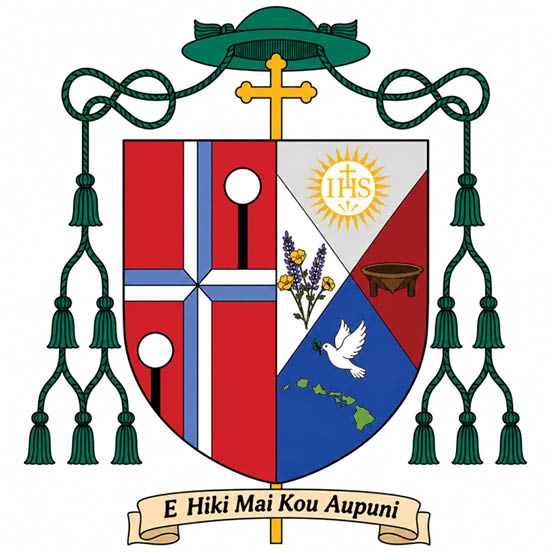
Bishop Michael T.T. Castori, SJ’s coat of arms, depicted at right and on the back page of this issue, is combined with the Diocese of Honolulu’s coat of arms to represent his leadership of the faithful in Hawaii. His coat of arms comprises four sections that represent key aspects of his life and faith.
The top quadrant includes the seal of the Society of Jesus (also known as the Jesuits), the religious congregation to which he belongs. The letters “IHS” are the first three letters of Jesus’ name in Greek; the surrounding sunrays represent Christ as the light of the world. The three nails symbolize the nails of the cross as well as the religious vows of poverty, chastity and obedience. The background color is argent, or silver, which in church heraldry conveys purity and innocence.
The bottom quadrant includes the Hawaiian islands rising from the blue Pacific Ocean and a white dove bearing an olive branch in its beak. The dove and the olive branch represent the Diocese of Honolulu’s patroness, Our Lady of Peace, the Mother of God, who protects the faithful of the diocese from harm and places them with her son. (Statues of Our Lady of Peace often depict the Blessed Mother holding a dove close to her heart.)
The golden poppies and blue lupines in the left-hand quadrant evoke Bishop Castori’s home and native state of California. When the bishop was growing up in Sacramento, his parents would take him and his sisters for weekend drives through the Central Valley to instill in them an appreciation for the beauty of the wildflowers that blanket the flatlands and surrounding foothills.
In the shield’s right-hand quadrant, Bishop Castori’s other home, in Fasi-moe-afi ’a Tungi, Tonga, is represented by the “kumete” — the large wooden bowl out of which is served kava, the ceremonial drink central to Tongan culture. The background color, red, is the national color of Tonga and, in church heraldry, symbolizes the redeeming blood of Christ.
Episcopal motto
Bishop Castori’s motto, at the bottom of the coat of arms, draws from the Our Father in olelo Hawaii: “E Hiki Mai Kou Aupuni” (“Thy Kingdom Come”). The motto raises the prayer that God’s reign be proclaimed and fully realized in this island diocese, and beyond the sea.
The coat of arms was created by Bishop Castori’s sister, Pamela Castori.
Coat of arms: From California to Tonga to Hawaii
An episcopal heraldic achievement, commonly known as a bishop’s coat of arms, consists of three main elements: the shield with its heraldic charges (symbols), a motto displayed on a scroll, and the external ornamentation that signifies episcopal rank.
At the heart of every heraldic achievement is the shield, which serves as its central and most significant element, conveying the personal and spiritual symbolism of the bishop.
Bishop Michael T.T. Castori, SJ’s coat of arms, depicted at right and on the back page of this issue, is combined with the Diocese of Honolulu’s coat of arms to represent his leadership of the faithful in Hawaii. His coat of arms comprises four sections that represent key aspects of his life and faith.
The top quadrant includes the seal of the Society of Jesus (also known as the Jesuits), the religious congregation to which he belongs. The letters “IHS” are the first three letters of Jesus’ name in Greek; the surrounding sunrays represent Christ as the light of the world. The three nails symbolize the nails of the cross as well as the religious vows of poverty, chastity and obedience. The background color is argent, or silver, which in church heraldry conveys purity and innocence.
The bottom quadrant includes the Hawaiian islands rising from the blue Pacific Ocean and a white dove bearing an olive branch in its beak. The dove and the olive branch represent the Diocese of Honolulu’s patroness, Our Lady of Peace, the Mother of God, who protects the faithful of the diocese from harm and places them with her son. (Statues of Our Lady of Peace often depict the Blessed Mother holding a dove close to her heart.)
The golden poppies and blue lupines in the left-hand quadrant evoke Bishop Castori’s home and native state of California. When the bishop was growing up in Sacramento, his parents would take him and his sisters for weekend drives through the Central Valley to instill in them an appreciation for the beauty of the wildflowers that blanket the flatlands and surrounding foothills.
In the shield’s right-hand quadrant, Bishop Castori’s other home, in Fasi-moe-afi ’a Tungi, Tonga, is represented by the “kumete” — the large wooden bowl out of which is served kava, the ceremonial drink central to Tongan culture. The background color, red, is the national color of Tonga and, in church heraldry, symbolizes the redeeming blood of Christ.
Episcopal motto
Bishop Castori’s motto, at the bottom of the coat of arms, draws from the Our Father in olelo Hawaii: “E Hiki Mai Kou Aupuni” (“Thy Kingdom Come”). The motto raises the prayer that God’s reign be proclaimed and fully realized in this island diocese, and beyond the sea.
The coat of arms was created by Bishop Castori’s sister, Pamela Castori.