By Celia K. Downes
Hawaii Catholic Herald
The role of bishop of the Diocese of Honolulu is a great challenge to fill on the rare occasions when it opens up.
Hawaii’s unique and diverse blend of ethnicities, cultures, ages and stages in life requires a compassionate and flexible leader who also brings a level head and common sense to the table.
Joyfully, the diocese has been blessed with someone who fits the bill — a missionary priest who is intimately familiar with the islands and peoples of the Pacific region, and who has spent decades in pastoral ministry, outreach and education from California to the Philippines to Micronesia.
Bishop Michael Thomas Tupou Castori, SJ, is the rare priest of the Society of Jesus, also known as the Jesuits, who has been called to shepherd a diocese or archdiocese. (The leader of his former diocese in Oakland also happens to be a Jesuit — Bishop Michael C. Barber, SJ.) Though Jesuits do not typically fill this role, they also profess obedience to go wherever the Holy Father guides them — and the pope is the one who appoints new bishops and archbishops.
Bishop Castori has said that before he was officially chosen to lead the Diocese of Honolulu, he was granted two days to pray about his decision. He centered on two prayers: “Your will be done” and St. Ignatius Loyola’s Suscipe prayer, which begins “Take, Lord, and receive all my liberty.”
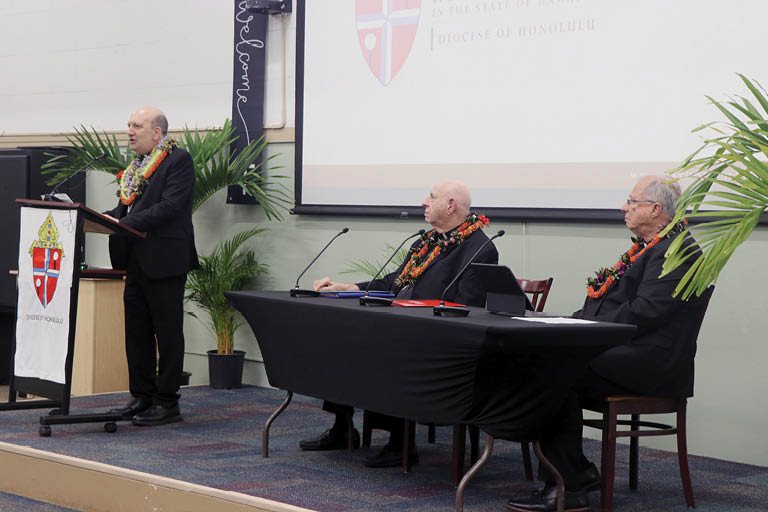
“Praying before the Blessed Sacrament during those two days, I came to a sense of peace and then a firm belief that whatever decision the Holy Father made with regard to the episcopacy of the diocese, it would be from God,” Bishop Castori said during a May 6 press conference introducing him as the bishop-elect.
The diocese is the grateful beneficiary of his acceptance of Pope Leo XIV’s appointment.
Bishop Castori is now the shepherd of a varied landscape of issues and opportunities.
On the positive side, the diocese has seen a healthy renewal of and new interest in faith, demonstrated through a rise in catechumens at Eastertime and through increased participation in parish ministries, community activities and Mass attendance.
A $90 million land sale last year next to Mary, Star of the Sea Church and School in Waialae-Kahala laid the groundwork for a more secure financial future, and a new annual appeal this year is so far proving fruitful.
At the same time, Bishop Castori will have to navigate more challenging issues. Parochial schools continue to face financial and enrollment pressures, with several forced to close their doors in just the past few years.
The future of the Catholic Church’s presence in Kalaupapa, the remote Molokai peninsula that produced two saints who cared for Hansen’s disease patients abandoned there by the state, must also be addressed as the number of patient-residents continues to dwindle.
And the clergy sex abuse scandal has not gone away, though it no longer grabs headlines in Hawaii like it did at its height years ago. (The diocese has established ways to support victims and allow them space to step forward, and also requires safe environment training for employees.)
In a June interview with the Hawaii Catholic Herald, then-Father Castori acknowledged that “the office itself is something very new and something that I require grace and prayer in order to assume.” At the same time, his resume comprises a colorful blend of ministry and missions, which hopefully will provide a baseline of experience as he embarks on his tenure in Hawaii.
His work prior to Honolulu included serving as rector of the Arrupe Jesuit Community at Seattle University. Before that he was with the Diocese of Oakland, where he served as a parish priest and held diocesan administrative roles, such as vicar for clergy.
Bishop Castori’s many years in California also included nearly two decades of pastoral ministry for Tongan Catholic communities across Northern California, as well as ministry in places as varied as a prison and a college campus.
And before the West Coast came his time in Oceania, which deepened his love for the Pacific and its people.
Bishop Emeritus Larry Silva successfully shepherded the Diocese of Honolulu for 21 years. An entire generation of Catholics has grown up with his competent and compassionate guidance through situations both challenging and successful, sorrowful and joyful.
While we won’t have the same amount of time with Bishop Castori (who is older than Bishop Emeritus Silva was when he began his episcopacy), we look forward to his leadership in the coming years, especially as the diocese marks such milestones as the bicentennial of Catholicism’s arrival in Hawaii, the reopening of the Cathedral Basilica of Our Lady of Peace after a two-year renewal project, and perhaps even the announcement of a third saint with isle ties — servant of God Joseph Dutton.
Bishop Emeritus Silva was instrumental in getting these initiatives off the ground and in building a thriving, engaged diocesan community. We are confident that the future of the Diocese of Honolulu is in good hands with Bishop Castori.
Above: Jesuit Father Michael T.T. Castori spoke May 6 during a press conference at St. Stephen Diocesan Center in Kaneohe as Bishop Larry Silva, center, and Msgr. Gary Secor looked on. (Celia K. Downes / Hawaii Catholic Herald)