By Lisa Dahm
Hawaii Catholic Herald
It has never been difficult to spot Bishop Clarence “Larry” Silva across the Diocese of Honolulu — he is always on the move, whether he is celebrating Mass, attending a parish event, visiting with schoolchildren or simply meeting parishioners where they are.
The Hawaii-born bishop’s tireless efforts to shepherd the diocese and evangelize fit his episcopal motto, “Witness to Jesus,” which centers on recognizing that Jesus Christ is alive and active now and encourages all to experience this witness and share it with others.
When he was installed as the fifth bishop of Honolulu 21 years ago, Bishop Silva’s first action was to listen not from afar, but through personal encounters.
He and his appointed representatives visited all the parishes in the state to discover their top priorities, problems and challenges.
“We came up with priorities that seemed to be the most important pastoral issues in the diocese, especially leadership development,” Bishop Silva said in an interview with the Hawaii Catholic Herald. “We (needed) people to carry on ministries and to direct them through mentorship.”
As Bishop Silva prepares for retirement from active ministry — concluding with the July 28 episcopal ordination and installation of Jesuit Father Michael Castori as the sixth bishop of Honolulu — fellow clergy and diocesan officials are united in their praise of his leadership over the past two decades with priorities including faith formation, vocations, marriage and family life, and youth and young adult ministry.
During his tenure, he has also overseen the canonization of two saints and the start of a third sainthood campaign; begun numerous fundraising and renewal initiatives, including an overhaul of the Cathedral Basilica of Our Lady of Peace; and reshaped parish boundaries and communities.
Bishop Silva is the second longest serving diocesan bishop after the first, Bishop James J. Sweeney, who served from 1941-1968.
‘Always listening’
Denise Oliveira, who has been the administrative assistant to the bishop for more than 13 years, said Bishop Silva’s busy agenda has him bustling from one meeting or event to the next, with rarely a break from early morning until late into the night. He can often be found responding to emails well after midnight.
Despite his burgeoning schedule, the bishop has an uncanny ability to focus on each person he meets with an unmatched focus reserved only for those who are the most steadfast in witnessing to Jesus, according to Oliveira.
“If he catches you in between (his meetings), he will make you feel like you’re the only person in the whole world,” Oliveira said. “He will stop, give you his undivided attention, and be so present in the moment.
“Jokingly, I say to my co-worker, ‘When I grow up, I want to be just like Bishop Larry.’ He makes people feel so important and he’s always listening.”
Oliveira said that with his deep, calm voice and relaxed demeanor, Bishop Silva creates such a comfortable atmosphere for one-on-one meetings that people feel safe sharing their thoughts and opinions with him. This allows him to assist them in solving real problems that may not surface unless the environment were supportive and nurturing.
She said the bishop is always on time or a little bit early, which is the way he serves others and respects their time.
“It is beautiful for me to witness — to see how far someone will go for someone else,” Olivera said of the bishop. “He is famous for sending cards and remembering names.”
Two saints, maybe three
While Bishop Silva is always quick to point out that other leaders began the sainthood campaigns for now-Sts. Damien de Veuster and Marianne Cope, he has spent his episcopacy amplifying their work with Hansen’s disease patients on Molokai’s remote Kalaupapa peninsula.
Bishop Silva now is championing a third sainthood cause — for servant of God Joseph Dutton, the American layman who worked with Father Damien and then continued the priest’s work after his death for many decades.
Within a year of his appointment, Bishop Silva opened the Father Damien and Mother Marianne Commission. In 2008, Pope Benedict XVI confirmed the second miracle needed for Blessed Damien to be canonized, which occurred the following year.
In 2011, the Vatican approved a second miracle attributed to the intercession of Blessed Marianne, and she was canonized in 2012.
Bishop Silva attended the canonizations of both saints, and oversaw the return of their relics to Hawaii.
In 2015, he approved the establishment of the Joseph Dutton Guild, the first formal step in the layman’s cause for sainthood. In 2022, he opened the diocesan inquiry for Dutton’s canonization cause; two years later, the local phase for the effort was completed and Dutton’s case was sent to the Vatican.
Bishop Silva is now overseeing a major renewal of the Cathedral Basilica of Our Lady of Peace in downtown Honolulu — a project that includes the construction of a reliquary chapel where people can pray with the saints, learning about their ministry.
“I would hope then that it would be a center not only for the diocese, but for the world, for visitors who come to Hawaii, as a place of pilgrimage,” the bishop said.
Of the cathedral basilica’s renewal, he said, “it’s going to be very beautiful.”
“When people walked in it before, they saw that it was very beautiful, but they didn’t necessarily notice that it was really falling apart and it was in great need of renovations.”
Vocations and youth
Bishop Silva has championed vocations throughout his episcopacy, encouraging formation for both priests and permanent deacons.
After 21 years, Bishop Silva has ordained 28 priests and 61 deacons. The diocese now counts seven men in the seminary, with several more applications in progress, and 10 men in Cohort 11 in the diocese’s permanent diaconate program, with ordination planned in 2027.
According to Father Gregorio Honorio, the bishop’s vicar for clergy, the bishop is humble and friendly.
“I’ve been to many dioceses and parishes, and this clear pastoral vision for the future is one of the things that I really appreciate of this diocese,” Father Honorio said.
Most importantly, the bishop loves and cares for his priests like true brothers, Father Honorio said. He prays for them and believes in their unique abilities, offering them opportunities to use their natural gifts.
“It is up to the priest to actually respond generously to that kind of faith that is given to them (by the bishop),” Father Honorio said.
The vicar for clergy said the bishop’s transparency and accountability are important for the growth and nurturing of his priests. He also assembles them twice a year for fellowship, prayer and continuing education opportunities.
“I had never experienced the kind of attention that Bishop Larry has shown to his priests, and the kind of vision, orientation and pastoral priorities that he has to lead the diocese,” Father Honorio said.
Bishop Silva said the priests of the diocese are the “fathers of the family” in a real way.
“They’re my closest collaborators as bishop, and so I want to know that they’re appreciated, that their work is important,” he said.
The bishop also invests time in his seminarians, making sure they are learning and discerning well.
“We’ve had a number of ordinations during his 20 years, because he’s promoted it,” said Msgr. Gary Secor. “He knows all the seminarians well and spends time with them.”
Bishop Silva also sees youth and young adults as an important part of the diocese.
“I think it’s important for them to know how important they are in the life of the church,” Bishop Silva said.
In 2009, the bishop appointed Lisa Gomes as director of the Office of Youth and Young Adult Ministry. She was already working for the diocese as the associate director for religious education and was the safe environment coordinator.
“That’s the one thing that I’ve always appreciated about (Bishop Silva) is just his willingness to always be with our young people,” Gomes said. “He’s always been very open to being with them and just sitting and chatting and answering their questions, no matter how crazy” they are.
Bishop Silva has attended numerous World Youth Days, from Sydney, Australia, to Krakow, Poland. He also established the popular “Bagels with Bishop” partnership with Hawaii’s Catholic high schools and dedicated five years to restoring the “proper order” of the sacraments of initiation — baptism, confirmation and first Communion — with confirmation for second graders by 2021.
Physical, fiscal growth
Bishop Silva also sought to “decluster” parishes — assign more pastors so churches did not have to share clergy.
In 2010, he appointed separate pastors for Blessed Sacrament Church in Pauoa and St. Stephen Church in Nuuanu after a decade of sharing one pastor. A year later, he assigned an administrator at Malia Puka O Kalani Church in Keaukaha, Hawaii island, after 11 years of the parish sharing clergy with St. Joseph Church in Hilo.
“That’s very important because in the mission that Jesus gave us, he was very clear and very explicit about that how to make disciples … and clustering — that’s a very painful process and I didn’t want that to happen here,” Bishop Silva said.
The bishop also recently finalized new parish boundaries across the diocese, redrawing a handful of regions that distinguish which church people should attend based on where they live.
As shepherd of all aspects of the diocese, Bishop Silva also oversees its financial situation. His first major capital campaign, “With Grateful Hearts,” raised $57 million pledges from 2008-2014; a new campaign, the Hawaii Catholic Ministries Annual Appeal, is currently underway.
Lisa Sakamoto, the diocese’s chief financial officer, said Bishop Silva’s three greatest accomplishments were creating a solid administrative infrastructure with human resources, real estate and finance; the $90 million sale of a 6.5-acre plot of land next to Mary, Star of the Sea Church and School in Waialae-Kahala to the Kahala Nui retirement community; and the development of a strong Hawaii Catholic Community Foundation, which manages various funds, endowments and gifts to support the Catholic Church in Hawaii.
“If Bishop Larry were sitting right in front of me, I would tell him, ‘Thank you for your leadership,’” Sakamoto said. “He has worked so hard and given his life to our diocese. I really want him to be able to just enjoy himself, because he’s carried the burden of the entire diocese for the past 20 years.”
In his retirement, Bishop Silva said he will assist Bishop Castori in any way he can, and he hopes to devote time to the completion of the Cathedral Basilica of Our Lady of Peace renewal project. The tentative completion date is next August, with a rededication to follow.
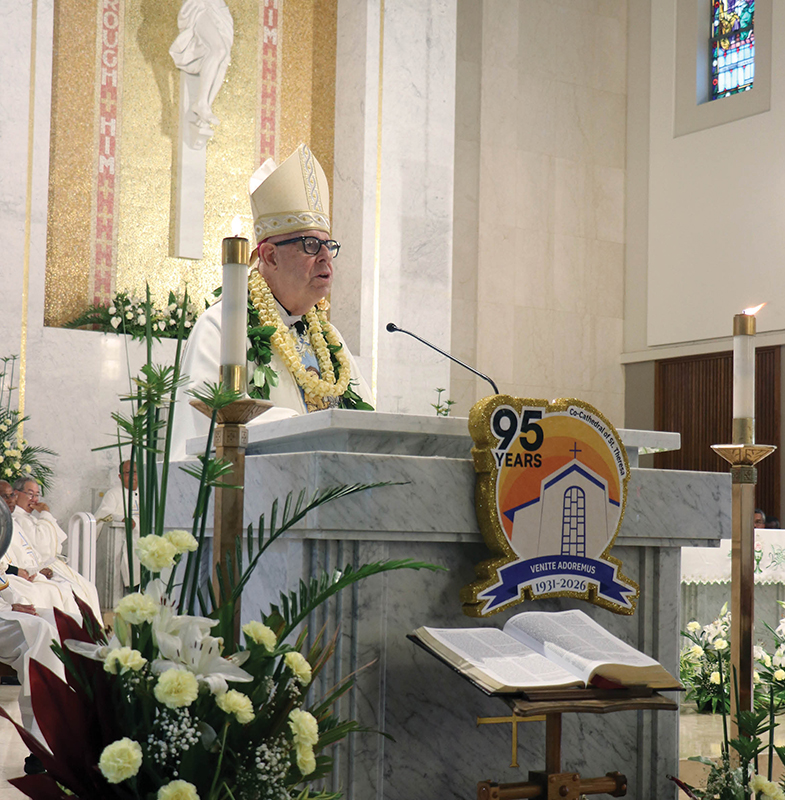
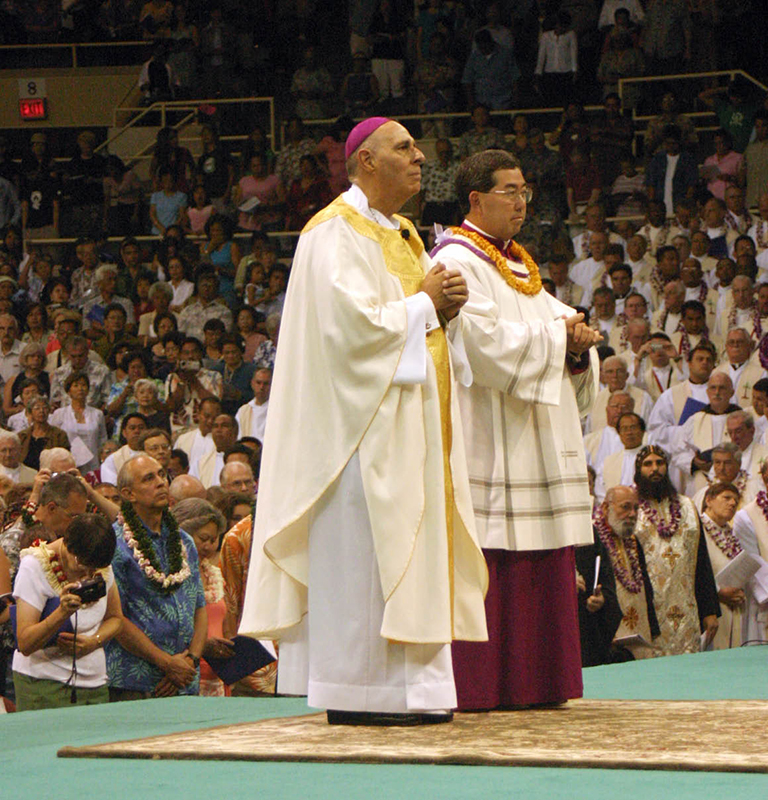
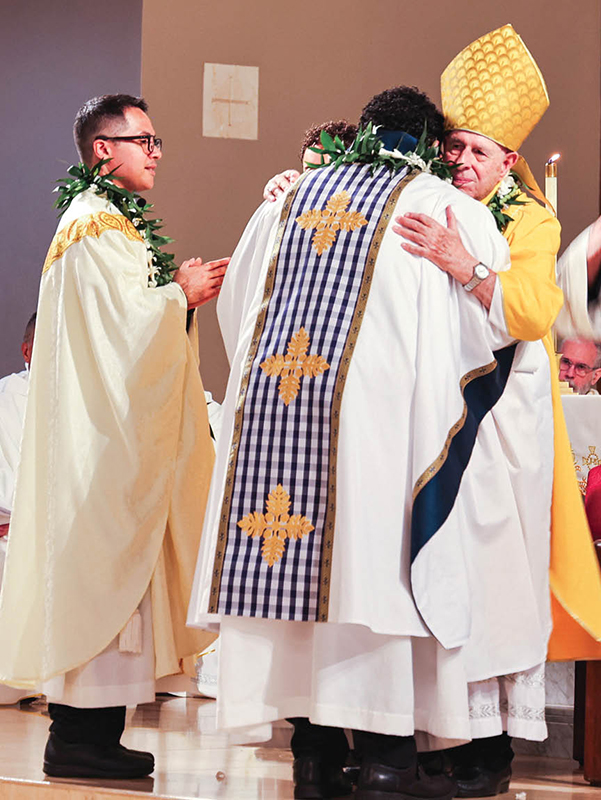
From top: Bishop Larry Silva delivered the homily July 9 during a special Mass at the Co-Cathedral of St. Theresa kicking off the diocese’s march toward the bicentennial of Catholicism in Hawaii (Celia K. Downes / Hawaii Catholic Herald); with Msgr. Terrence Watanabe standing next to him, Father Larry Silva of the Diocese of Oakland, California, prepared first to be ordained a bishop, then to be installed as the fifth bishop of the Diocese of Honolulu on July 21, 2005, at the Neal S. Blaisdell Arena in Honolulu. By the end of this month, both men will be retired from active ministry (HCH file photo / 2005); Bishop Silva embraced Father Taylor K. Mitchell as Father John Jacob Akau looked on during their presbyteral ordination Mass at the Co-Cathedral of St. Theresa in May. (Lisa Dahm / Hawaii Catholic Herald)