By Paulina Guzik
OSV News
On May 8, 2025, white smoke rose over the Sistine Chapel and the world heard “Habemus Papam.” Journalists gathered at the top of the arm of Bernini Colonnade in Rome, upon hearing from Cardinal Dominique Mamberti: “Robertum Franciscum sanctae Romanae ecclesae cardinalem Prevost,” frantically asked: “Chi e?” — or “who is” the new pope?
Today, we know a lot more about Cardinal Robert Prevost turned Pope Leo XIV. A year after his first words to the world were “Peace be with you all,” he has emerged as a pope of order for times of global chaos.
George Weigel, an American Catholic theologian and author of the iconic biography of St. John Paul II, “Witness to Hope,” reflected that “the pope is by definition a global leader. He is the head of a church of 1.4 billion members, and he represents an ancient religious tradition that has lots of things to say about the 21st century.”
But “he’s a global leader with a difference. He doesn’t operate out of a national power base. He has no real economic power,” Weigel told Polish “Tygodnik Powszechny,” or “Universal Weekly,” in a conversation with OSV News’ international editor.
“So in all of the normal registers of power, he’s not a powerful person,” Weigel said. “And yet because he speaks for that ancient tradition, and he can bring moral power to bear in a world where that still counts, as (St.) John Paul II proved during his pontificate, the world pays attention to the pope.”
Weigel added that when the pope, on the night of his election, began by quoting Jesus Christ, he was “declaring that this is going to be a pontificate centered on Christ because he understands, as John Paul II understood, that Christ reveals the truth about the human person.”
In this, Pope Leo seems to constantly remind us that his message “is the Gospel. ‘I’m not an umpire in a global soccer match. I’m not a referee. I’m the preacher of the Gospel,’” Weigel said.
In recent weeks, Pope Leo seemed to strategically remind the world about this primary mission of the successor of Peter when he answered U.S President Donald Trump, who disparaged the pontiff for criticizing leaders waging wars.
Pope Leo has been a staunch critic of warfare generally, including the combat operations initiated by the U.S. and Israel in a surprise attack against Iran on Feb. 28. He also condemned Trump’s threat to wipe out Iran’s “whole civilization” as “truly unacceptable.”
Speaking aboard the papal plane en route from Rome to Algiers, the pope said that he had seen Trump’s social media post criticizing him.
“I have no fear neither of the Trump administration nor speaking out loudly of the message of the Gospel, which is what I believe I am here to do, what the church is here to do,” the pope said during the flight in a video recorded by OSV News.
‘A pope of order’
In times of “a huge global chaos of new empires, the Vatican has remained one of the very few voices of global prudence,” Massimo Faggioli, professor in ecclesiology at the Loyola Institute at Trinity College Dublin, told OSV News’ international editor in the “Universal Weekly’s” cover story.
Faggioli underlined that Father Prevost “was trained as a lawyer,” and is a pope of order — “but not in the sense of law and order, those who want to get rid of the bad guys, but order in the sense of disposition, of control of yourself.”
“Augustinians know that it’s about getting control of your passions, of your instincts,” Faggioli said. “The order of love, or the ‘Ordo Amoris,’ is much bigger than integration.”
Pope Leo is “very much a controlled person, but not because of a psychology, but because it is a habit that comes from the foundation of the order that is about getting things in the proper order,” Faggioli explained.
“An Augustinian order is a mix between mendicant orders and monasticism. And so there is a monastic vein in him that is very different from the Jesuit (Pope) Francis,” Faggioli said.
“The priority is on meditation, on contemplation, on prayer … which leads to doing certain things. The emphasis is on internal transformation, internal conversion … and it’s different from discernment. Discernment is something that — for Francis — we do together. For Leo, I think he understands this as a very personal dimension of internal transformation.”
And that is an Augustinian within Pope Leo.
The 70-year-old Chicago native also brings to the papacy not only theological depth but also a political savvy forged in one of America’s most storied cities of politics. His understanding of modern politics derives both from his wisdom and his Chicago roots — a city where politics operates on a grand scale.
“Chicago is called the Windy City not because of its weather, but because of its political history,” said Gretchen R. Crowe, editor-in-chief for OSV News.
It is “very much in the lifeblood of the city to think and speak politics on a daily basis” — and having a Chicago-born pope, we can rest assured he understands politics, and is a wise observer of what’s occurring on a global stage around him, Crowe emphasized.
The difference he makes in world affairs also comes from the sole fact that he speaks English with an American accent.
“To hear Pope Leo speaking in English, first of all, then speaking with an American accent, speaking so clearly and articulately about the current American global political situation, shows that he is paying attention, that he isn’t afraid to speak when he feels like he could have a role to play, especially when it comes to being a peacemaker for situations of conflict around the world,” Crowe added.
Weigel stressed that facing huge global challenges it is “very important for the pope to be prudent in his deployment” of his moral power — and using his voice wisely is crucial in the world obsessed with social media spins.
“If he has an opinion on everything, it diminishes the value of his voice when speaking on matters, where he has specific authority. I don’t like the practice of the pope sending out tweets and similar messages — it risks spending down that capital. But on major issues of moral consequence, including what I consider the defining question of our time — who we are as human beings — his voice is essential.”
“This papacy, like most, is a work in progress,” Weigel concluded. “What we’ve seen over the last year is the growth of a converted Christian disciple into a new vocation, the vocation of the office of Peter.”
“I think in a world of screamers, he’s a nice, quiet, steady voice,” the American theologian emphasized, adding that Pope Leo tells the world “look at Christ. Look at the church.”
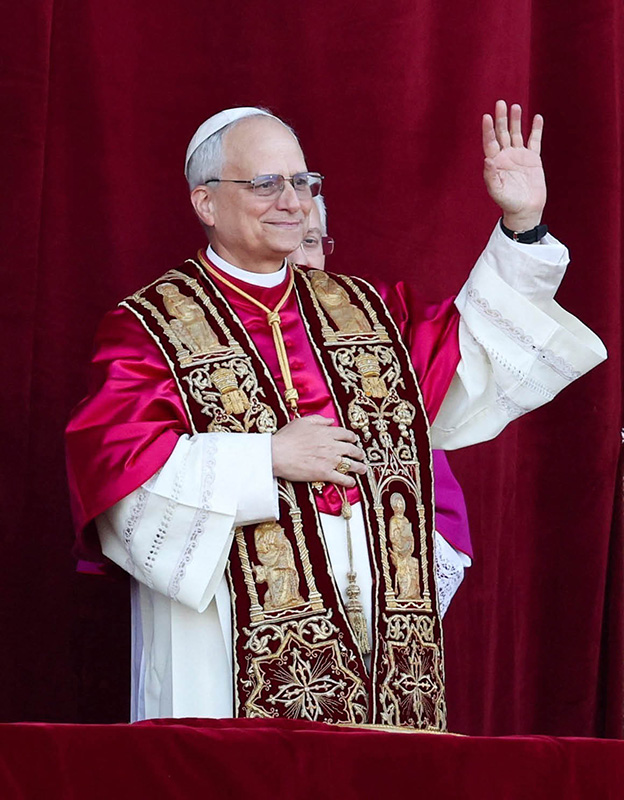
Above: Pope Leo XIV — the former Cardinal Robert Francis Prevost — appeared on the central balcony of St. Peter’s Basilica at the Vatican on May 8, 2025, following his election during the conclave. (Claudia Greco / Reuters / OSV News)