The rosary-making ministry at St. Jude Church combines artistry, fellowship and stewardship
By Lisa Dahm
Hawaii Catholic Herald
On the 25th anniversary of his pontificate in 2002, St. John Paul II released an apostolic letter titled “Rosarium Virginis Mariae” (“Rosary of the Virgin Mary”).
In it, he calls the rosary a “prayer destined to bring forth a harvest of holiness,” and his favorite prayer that he had practiced since his youth. The pontiff called the devotion “distinctly Christological” in its meditation on the life, death and resurrection of Jesus.
With the letter’s publication coming shortly after the Sept. 11, 2001, terror attacks in New York, St. John Paul II described the recitation of the rosary as “a clear commitment to advancing peace” — a message that remains applicable today.
In May, which the church dedicates to Mary, many parishes and Catholic schools throughout the Diocese of Honolulu pray the rosary more frequently.
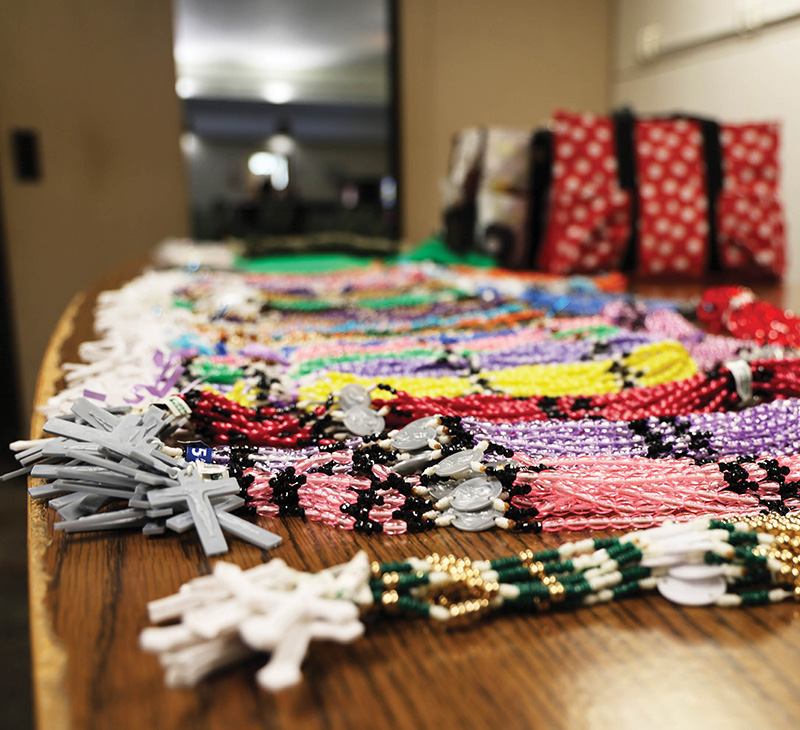
St. Jude Church in Kapolei takes the devotion a step further with its rosary-making ministry, which got its start about a decade ago and now produces hundreds of rosaries a month through regular meetings at the parish and members’ work at home.
The ministry sends its rosaries to a nonprofit organization called Our Lady’s Rosary Makers, based in Louisville, Kentucky, which then distributes the rosaries to international missionaries.
Members of the St. Jude group not only devote their time but also their treasure to the project, since they must order and pay for their own rosary-making supplies and shipping costs.
The group began in the mid-2010s through a call in the church bulletin. Though many people attended the first meetings, the ministry’s numbers dwindled to a core group of about 10 after the COVID-19 pandemic.
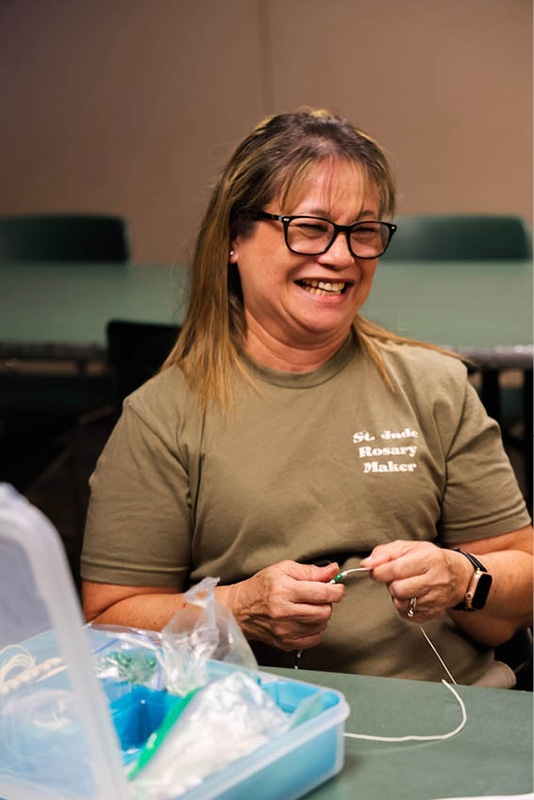
Emma Cagaoan has been a St. Jude parishioner since 1986. She joined the rosary-making ministry when it began and has faithfully attended ever since.
“In the beginning, it was hard to make the knots,” Cagaoan said. “I had to start all over again. Once you get the hang of it, it just falls into place when you guide it.”
She said she had to concentrate on her work when she first started, but she can now do other tasks simultaneously, like socializing or watching television.
“It calms me down when I have a busy day,” Cagaoan said of rosary making. “It is part of unwinding my day. It helps me, and it is something I like to do.”
Once rosary makers learn the craft, they can finish a rosary in about 15 minutes. Typically, the group tries to send a box of about 500 rosaries to Our Lady’s Rosary Makers per month.
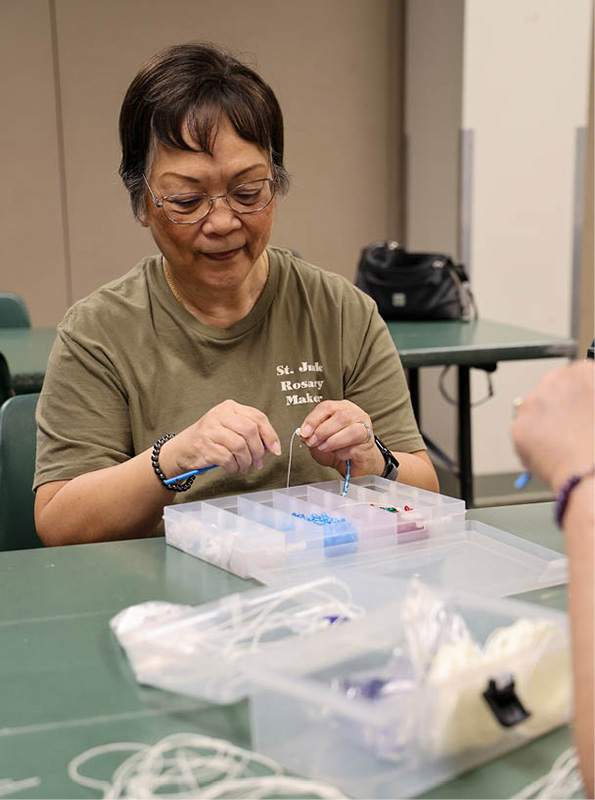
Isabelle Nobriga, who also has been part of the group since it began and is a longtime St. Jude parishioner, said that at first, a person typically begins with one color bead and keeps the design simple, without spacers.
Newcomers do not need to have a talent for crafts; still, most of the members, including Nobriga, are experienced sewers, beaders or artists in other ways.
“I enjoy the friendships we have built,” Nobriga said. “We meet once a month and share our stories and what is happening with our church. I felt like that was an opportunity to meet the different parishioners (who attend) other Masses.”
During their meetings, members drop off their homemade work on a communal table, then gather around another table in a parish meeting room to make as many rosaries as possible in two hours.
Most of the members have known each other since the meetings began, so they have grown close and look forward to seeing each other.
“I like beading and crafts,” said Winifred “Winnie” Batula, who has also been attending the meetings since they began. “When I first started, I thought I could use my talents and learn something new.”
Batula sews and also makes jewelry, so she quickly learned how to create a rosary.
“I like going to meetings and seeing all the ladies who help. It is our time to socialize, knowing that what we are making is going to a good cause. It is like a family now.”
The most important part of using their gifts is that they can assist in evangelizing others to Christ.
“One rosary at a time, we can change the lives of other people,” Cagaoan said. “Somehow, we can touch them (through the rosaries). We are praying to Jesus through holy Mary, and it helps me feel closer to God.”
How to pray the rosary
A standard rosary starts with a cross. On it, the Apostles’ Creed is prayed.
Next is a single bead for an Our Father, followed by three beads for three Hail Marys, which are typically prayed for an increase of faith, hope and charity. Another single bead is for the Glory Be.
Then, in a loop, there are 10 beads followed by a larger bead for each of the five decades. For each of the five decades, the prayers begin with the announcement of the mystery, followed by an Our Father, then 10 Hail Marys, and finally a Glory Be. After five decades, a person prays the Hail, Holy Queen.
A rosary can be prayed following four different mysteries: joyful, which are typically prayed on Mondays and Saturdays; sorrowful, which are typically prayed on Tuesdays and Fridays; luminous, which are prayed on Thursdays; and glorious, which are prayed on Sundays and Wednesdays.
To read church teachings on the rosary, learn how to pray or make a rosary, or find out how to start a parish group, visit Our Lady’s Rosary Makers at olrm.org.
Above: Top, finished rosaries lie in a bundle on a table at St. Jude Church in Kapolei during a recent rosary-making ministry meeting. Bottom, Isabelle Nobriga and Winona “Winnie” Batula have attended St. Jude’s rosary-making ministry meetings since they began. Both are seasoned crafters who also enjoy the fellowship the group provides. (Photos by Lisa Dahm / Hawaii Catholic Herald)