By Katarzyna Szalajko
OSV News
Thousands of pilgrims are expected to gather in June in the Lithuanian capital for the sixth World Apostolic Congress on Mercy, or WACOM, a five-day event that has previously been held in cities such as Rome, Krakow, Bogota and Manila.
But in Vilnius, the theme “Building the City of Mercy” is not only a slogan — it is a living heritage.
The June 7-12 congress, organized by the Vatican’s Dicastery for Evangelization, is expected to draw up to 5,000 participants from around the world. The choice of Vilnius as host city is not accidental.
It was here, in 1934, where St. Faustina Kowalska received visions that led to the painting of the first image of Divine Mercy, created by Eugeniusz Kazimirowski. Since then, numerous versions of the image have been painted by other artists, including a popular interpretation by Adolf Hyla in Krakow — both images are now found in churches across the globe.
The WACOM program will include conferences, testimonies, concerts and daily moments of prayer held across the city.
“While in Vilnius, WACOM participants can explore the Way of Mercy — a pilgrimage route linking 14 sacred sites, St. Faustina’s house and the Gate of Dawn chapel, home to a 17th-century icon of the Mother of Mercy,” said Archbishop Gintaras Grusas of Vilnius.
At the Hospice of Blessed Father Michal Sopocko — named after St. Faustina’s confessor — the message of Divine Mercy takes concrete form in daily care for the sick and dying. In fact, the hospice is an indispensable part of the Way of Mercy itself.
The building now housing the Sisters of Merciful Jesus was once the studio of painter Kazimirowski, where he created the first Divine Mercy image. It was also a place associated with Blessed Sopocko, and St. Faustina would come here often.
Sister Michaela Rak, the founder of the hospice, told OSV News ahead of Divine Mercy Sunday on April 12 that the continuity is clear: The message that began in this place is now lived out daily through care for the over 300 sick and dying patients.
The image of Merciful Jesus “came out of Vilnius and went to the whole world,” she said. “But it is not a decoration on a wall. It is a call: Experience my mercy and bring it where you are sent.”
“For many people, hospice is still something they are afraid of,” Aneta Gorniewicz, deputy director of the facility, told OSV News. “But what we try to give here first of all is a sense of safety, dignity and daily care.”
Sister Rak, a Polish nun from the Congregation of the Sisters of Merciful Jesus, arrived in Vilnius in early 2000s with the idea of creating the country’s first hospice, which opened in 2009. She built the institution from the ground up, turning it into a place that now serves both adults and children at the end of life.
Inside the hospice, mercy is often expressed in small, almost invisible moments, such as a physiotherapist helping a woman, weakened by cancer, achieve a simple goal: to sit up on her own.
“It may seem like a small thing,” Gorniewicz said, “but for that patient it was a huge success, a great achievement.” Other days bring different forms of care — reading books to patients who can no longer hold them, organizing shared moments of music, or even laughter therapy for a young woman with lung cancer.
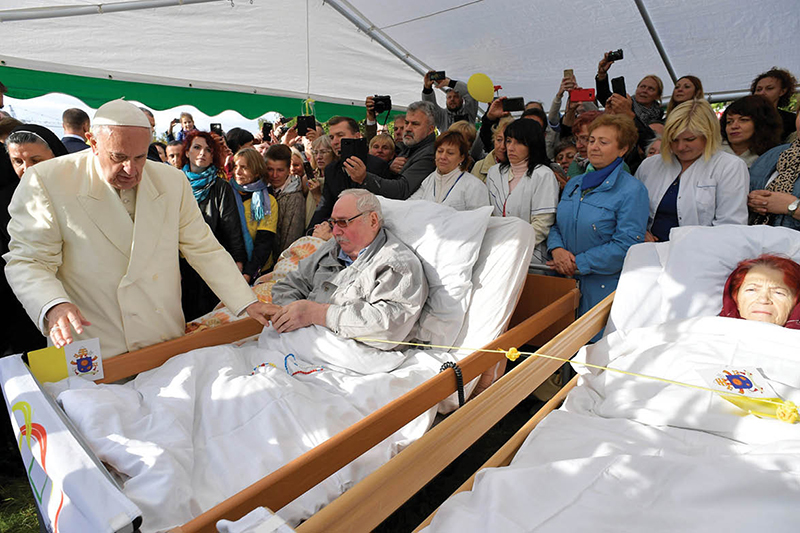
Pope Francis made a surprise stop to bless patients of the Blessed Father Sopocko hospice during his 2018 apostolic trip to Vilnius.
“We feed the body, but also care for the soul,” Sister Rak told OSV News, pointing to the role of the sacraments and spiritual support. If that dimension is lost, she warned, the consequences extend far beyond one institution. “When people lose the source of mercy, the world becomes a place of war, hatred and exploitation,” she said.
“People today need mercy — even if they don’t always realize it,” she said. “We need to return to its source.”
Above: Pope Francis comforted a patient during his stop at the hospice in Vilnius, Lithuania. (Reuters / Vatican Media / OSV News / 2018)