The historic Cathedral Basilica of Our Lady of Peace has been closed for a year as an extensive renewal continues
By Lisa Dahm
Hawaii Catholic Herald
The Cathedral Basilica of Our Lady of Peace in downtown Honolulu is in the final phase of a years-long total physical renewal — just in time to serve as a beacon of hope in a tumultuous world seeking its light.
The historic site, which has long held significance not just for the Diocese of Honolulu but for the state, has been completely closed for a year as extensive interior and exterior work is done to restore, renovate and renew the cathedral. The goal, people involved in the project say, is not to erase the past, but to ensure the building will serve the people of Hawaii for many years to come.
As the seat where the bishop of the Diocese of Honolulu presides (cathedra means “bishop’s chair”), the cathedral is the spiritual home of all Catholics in the diocese, no matter their parish.
“It’s very special to us because our saint was ordained in the cathedral,” said Msgr. Gary Secor, vicar general for the diocese and moderator of the curia, of St. Damien de Veuster, the Sacred Hearts priest who ministered to Hansen’s disease patients on the remote Kalaupapa peninsula on Molokai.
The cathedral basilica has the rare distinction of being home to the remains of two saints — St. Damien and St. Marianne Cope — and could possibly accommodate a third, if Servant of God Joseph Dutton’s sainthood cause leads to his canonization.
Mother Marianne, a Sister of St. Francis, and Dutton, a layman, worked alongside Father Damien and continued after his death to serve patients with Hansen’s disease in the 19th and early 20th centuries.
“The cathedral really represents our foundations as a Catholic Church and the history of our presence here,” Msgr. Secor said.
Msgr. Secor said the goal of the renewal goes far beyond the cathedral — the diocese hopes to spark a renaissance in downtown Honolulu.
“We are restoring this church, but we also believe that we want to be part of the restoration of this community,” he added. “We don’t just want to be restoring a building; we want to be helping to restore people’s lives.”
Grass hut to coral church
The first Catholic missionaries, priests and brothers from the Congregation of the Sacred Hearts of Jesus and Mary, arrived in Hawaii in 1827. They found a spot on Fort Street to establish their first church, a grass hut, on the land the Cathedral Basilica of Our Lady of Peace now occupies, and they celebrated the first Catholic Mass on July 14 that year.
From 1829 to 1839, Catholics were persecuted in Hawaii and were imprisoned or exiled. Priests were permitted to return in 1839, when King Kamehameha III issued the Edict of Toleration, allowing the establishment of the Catholic Church in Hawaii.
King Kamehameha III would later attend the laying of the cathedral’s cornerstone.
Sacred Hearts Bishop Louis Maigret oversaw the construction of the cathedral, which was hand-hewn from coral blocks harvested from Honolulu Harbor. It was dedicated on Aug. 15, 1843; two decades later, in May 1864, Bishop Maigret ordained then-Brother Damien in the cathedral just months after his arrival from Belgium.
Bishop Maigret was entombed in the crypt below the cathedral’s sanctuary after his death.
Many years, many hands
When Scott and Julia Ruppel began attending Mass at the cathedral more than 20 years ago, they saw that the building was showing its age. They were eventually asked to join the parish planning committee to work on the renewal project for the Cathedral of Our Lady of Peace, as the cathedral was known then.
“I was a daily communicant here in the morning, before I went to work at Hawaiian Electric,” Julia Ruppel said. “I was seeing how it was just slowly, gracefully showing its age. So, it’s exciting to bring it up to the standards (required) for the next 100 years.”
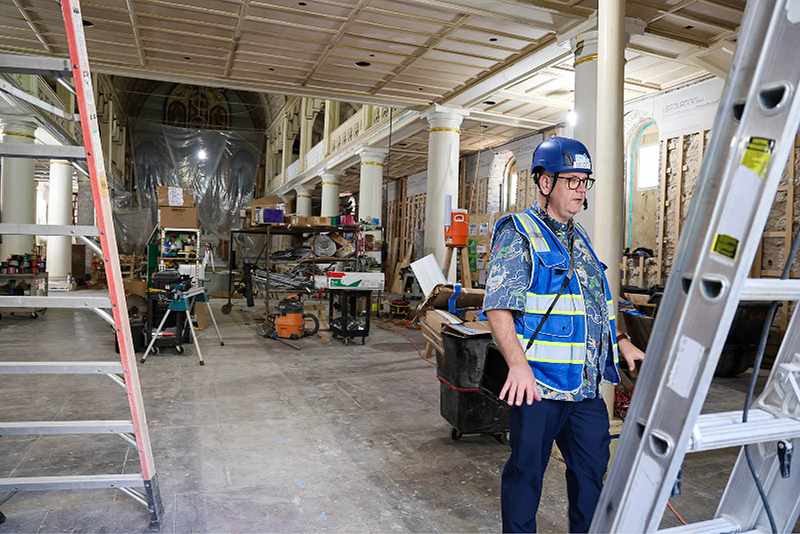
The Ruppels are now officially on the renewal project with Koa Project Management — Scott is the company’s president, and Julia is its vice president and chief technology officer. They are “excited to see the project through to its completion,” according to Julia Ruppel, who anticipates that the bulk of it will be finished prior to the Diocese of Honolulu’s bicentennial celebration next summer.
“It’s a hybrid between restoration, new (demolition) and everything else,” Scott Ruppel said. “I love it because it’s incorporating the old, like that in the time of Damien, the history and renewing it.”
After an intensive interview process, Koa Project Management selected a mix of local and nonlocal companies to work on the renewal project. The team includes isle architecture firm Mason Architects and isle contractor Constructors Hawaii Inc.; Omaha, Nebraska, company RDG Planning and Design; and several other engineering firms that are working on different aspects of the project.
Koa Project Management has been working with Mason Architects’ historic architect Barbara Shideler, and RDG Planning and Design’s historic architect Bob Krupa, as the renewal project has progressed.
Christian Brother William Woeger, a nationally recognized liturgical consultant, advised on the internal worship space until his unexpected death in August 2024.
Ongoing evolution
The cathedral has experienced several major overhauls over the decades, according to Shideler, who has been working on the renovation for more than half of her 35-year career.
Her firm contributed to a renovation in the early 1990s in which the pews were reconfigured, so she was able to start with some of the historical research already completed.
Shideler said that before work began, her firm also spoke to clergy, staff and volunteers who use the liturgical space to ensure that the architecture plans were functional for them and for the congregation.
“It’s looked quite different on the exterior throughout its history,” Shideler said. “We have photos of the church in the 1860s from that period. It had a wood shingle roof, and exposed coral on the outside.”
In the 1870s, a renovation included changes to the tower, and the cathedral’s exterior was plastered with locally produced lime.The roof was also raised and enhanced with corrugated metal roofing, and inside the ceiling was adorned with hand-painted artwork.
“(The ceiling is) painted with tempera paint, actually hand-stenciled with tempera, which is made from egg white and pigment,” Shideler said. “It’s very fragile, and it’s on linen.”
In the 1920s, the cathedral was renovated in the Spanish Mission Revival style by architect C.W. Dickey. Much of the neoclassical detailing was removed, the portico was extended and classic Doric columns were added on the cathedral’s exterior.
“They Spanish ‘missionized’ it, which is very much in keeping with the territorial period buildings, Honolulu Hale and the others that were of that vintage,” Shideler said.
During this renovation, the cathedral was given the look that most people recognize today. A terra-cotta tile roof was installed, the lime plaster was replaced with harder Portland cement plaster, and the floor inside was finished in polished concrete.
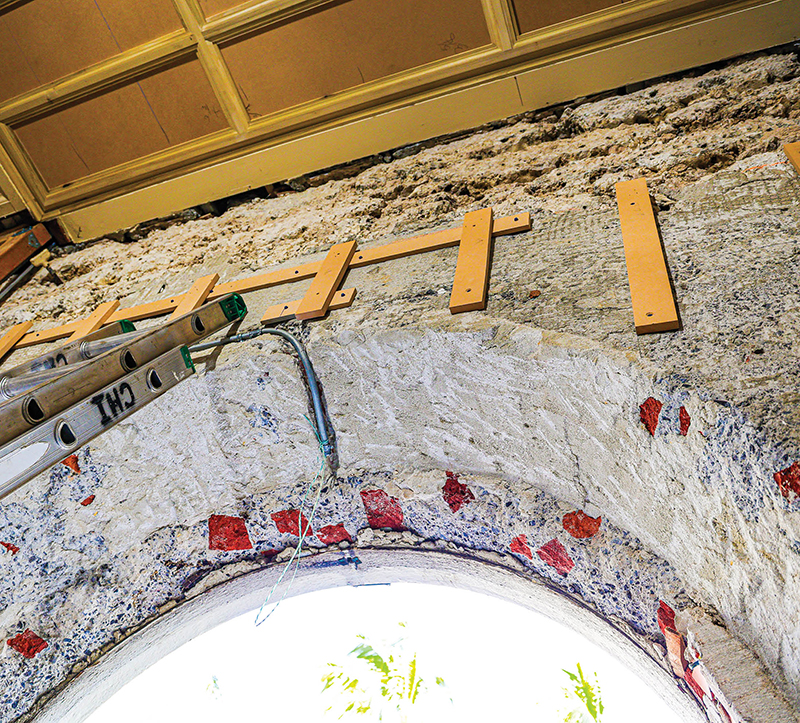
Unfortunately, these changes led to dampness issues due to the combination of the building’s coral walls and the hard plaster, Shideler explained.
“The coral walls are very, very porous,” she said. “It’s like a sponge. The building suffered serious rising damp issues. The interior columns, where the plaster was exposed, began to fail.”
To cover up the damage, workers added interior wainscoting while maintaining the 1870s vaulted ceiling.
Then the cathedral’s walls began to warp outward under the heavier tile roof, requiring the addition of rectangular piers and metal ties in the 1940s to hold them together.
Finish line in sight
The current renovation and renewal project has been active for more than a decade — since the Ruppels and others on the planning committee began their efforts in 2013.
The first phase involved repairing termite, water and other damage, particularly in the second-floor gallery. The work was finished in November 2015.
(A year earlier, Pope Francis elevated the cathedral to the distinction of minor basilica, leading to its new name — Cathedral Basilica of Our Lady of Peace.)
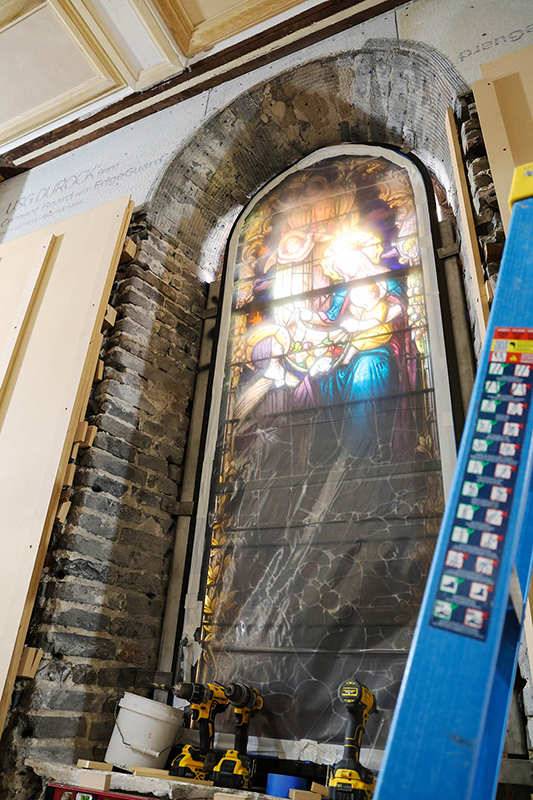
The bell tower was repaired in March 2017. Over the next two years, renovations included expanding the sanctuary floor, restoring four stained-glass windows, installing a new burial vault for bishops, cleaning the high altar’s marble, refinishing surfaces and improving the security system.
Portraits of St. Damien and St. Marianne by EverGreene Architectural Arts, now flanking each side of the altar, were also completed and installed by the end of 2019.
The current phase — the final and most intensive one — includes constructing a reliquary chapel and installing many new interior elements: a full-immersion baptismal font, pews, confessionals, artwork (including restored pieces), a tile floor, lighting, an audio/video system, and electrical and mechanical upgrades.
The pulpit and ambo will also be new and will include decorative canopies. Another decorative touch will pay tribute to the state’s eight major islands — glass mosaics featuring each island’s color and flower will be inset in the arched panels of the new high altar.
The vaulted ceilings will be restored and the exterior will be returned to its original appearance: In addition to the reintroduction of a dark base color, landscaping and better lighting will be installed.
To combat moisture, workers are replacing damaged plaster on the interior columns with a salt-tolerant plaster from Germany. New wood paneling on the walls will not sit directly on the original coral in order to allow air to circulate and stave off dampness.
Other features
- Windows: Dozens of stained-glass windows have been removed and shipped to Lambrecht Glass Studio in Omaha, Nebraska, except for the four windows that were completed in an earlier phase.
- “The windows are just gorgeous,” Shideler said. “(The studio is) taking them completely apart, cleaning every surface of the glass and re-leading them all with the lead cames that go between the individual glass pieces, and then putting them back in the frames that are being restored at the lower floor. It’s quite a major effort.”
- Stations of the cross: Along the walls will be 14 re-mastered stations of the cross portraits based on the original, much larger stations, which currently reside at St. Stephen Diocesan Center in Kaneohe.
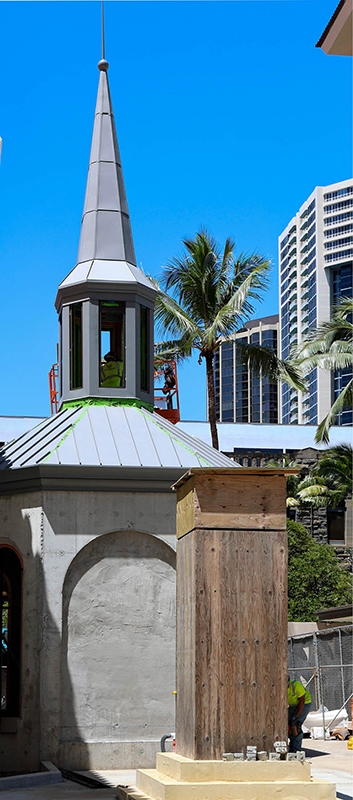
- Reliquary chapel: The new reliquary chapel is aimed at promoting veneration of St. Damien and St. Marianne, and is being built as an attachment to the cathedral on its northeast corner. The octagonal structure’s design mimics the cathedral, with a steeple matching the original bell tower.
- The remains of St. Marianne will be interred in the floor, and a reliquary stand will display a first-class relic of St. Damien. Symbols representing the saints’ religious congregations — a St. Francis tau cross for St. Marianne, and the Sacred Hearts of Jesus and Mary for St. Damien — will be etched into the reliquary’s windows.
- Pipe organ: The huge organ that had been located in the cathedral’s loft has already been dismantled and shipped to the Los Angeles area, where its more than 3,000 pipes are being cleaned and recorked.
- “In the last couple of years, the organ was really limping along, with only about 30% of the pipes and the keys on the organ actually functioning,” Shideler said. “When it comes back, it’s going to be at 100%.”
Funding the project
Though the work is ongoing, funding is not yet complete.
Bishop Larry Silva and Msgr. Secor are working with a team of cathedral and diocesan staff and volunteers to lead the fundraising effort. To donate to the Cathedral Renewal Campaign, go to www.honolulucathedralrenewal.org/make-a-gift.
Photos, from top: Scott Ruppel with Koa Project Management describes the work being done in the cathedral basilica at the front of the church facing Fort Street Mall — with the construction-filled sanctuary behind him; the Cathedral Basilica of Our Lady of Peace’s original coral walls are visible inside the entrance fronting Fort Street Mall in downtown Honolulu; one of the stained-glass windows that was removed and refurbished on the mainland was returned and reinstalled in the Cathedral Basilica of Our Lady of Peace; the statue of Mary that stands outside the Cathedral Basilica of Our Lady of Peace is protected by wooden boxes as the renewal project, including the construction of a new reliquary, proceeds around it. (Photos by Lisa Dahm / Hawaii Catholic Herald)