Question corner
Q: Is it acceptable in the eyes of God to have an alcoholic drink at a bar that was once an altar? My diocese has deconsecrated said altar.
A: I of course can’t speak directly for God, but I know I personally would not feel comfortable consuming any kind of ordinary food and drink served off of a once-consecrated altar, even if the altar in question was no longer actively in use as part of a church.
While I don’t know all the details of this specific situation in your diocese, in the big picture the general understanding among canon lawyers is that an altar cannot be “deconsecrated” in such a way that would ever allow it to be legitimately used for some other purpose.
This is different from church buildings, which in some cases might indeed be, in rough colloquial parlance, “deconsecrated.”
To use the actual canonical terminology, Canon 1222 of the Code of Canon Law tells us that if there is some grave reason why a church building can no longer be used for divine worship, as a solution of last resort the diocesan bishop can allow it to be — as the American English translation of the original, official Latin version of the Code puts it — “relegated to profane but not sordid use.”
We often popularly use the term “profane” to mean wicked or morally bad, such as how we might employ the expression “profanity” to describe the use of bad language or swear words. Yet keep in mind that in the context of theology or canon law, “profane” simply means “not sacred,” i.e. describing anything that isn’t exclusively dedicated to God’s service in a special way.
As an illustration, the chalice that is used at Mass is meant to hold the wine that becomes the blood of Christ; it is a sacred object because it is dedicated entirely to this divine purpose. An ordinary wine glass that’s meant to hold regular table wine, or a favorite coffee mug, would be “profane” by contrast.
Something “profane” in this sense might even be basically good in and of itself; a glass of wine at a holiday dinner or a cup of coffee in the morning can be a wholesome, legitimate pleasure. But these cups are still distinct from a vessel that is set aside for God alone.
However, while a church building that could no longer be used for its original purpose might in some cases lawfully be sold and repurposed as something like a museum or private residence, this relegation or repurposing would not affect the status of the altar it once contained.
As we read further on in the Code, in Canon 1238, 2: “Altars, whether fixed or movable, do not lose their dedication or blessing if the church or other sacred place is relegated to profane uses.”
The same canon also notes that “An altar loses its dedication or blessing according to the norm of can. 1212.” Canon 1212 in turn tells us: “Sacred places lose their dedication or blessing if they have been destroyed in large part, or have been turned over permanently to profane use by decree of the competent ordinary or in fact.”
Since we know that an altar is not regulated to profane use when the church building is, and since it is church buildings which are related by a document called a “decree,” it would seem to follow that since an altar is different from a church building, an altar cannot be likewise “un-consecrated” with the stroke of a pen. Thus, the only option remaining for “deconsecrating” an altar is for the altar to be destroyed.
The understanding that an altar can only lose its consecration through destruction was further supported in an April 30, 2013, letter to diocesan bishops from the Vatican’s then-Congregation (now Dicastery) for the Clergy, which stated plainly that “altars can never be turned over to profane use for any reason.”
Jenna Marie Cooper, who holds a licentiate in canon law, is a consecrated virgin and a canonist whose column appears weekly at OSV News. Send your questions to CatholicQA@osv.com.
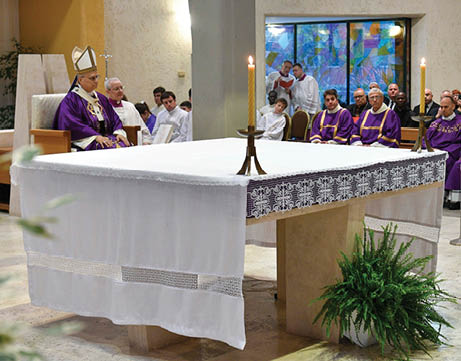
Above: Pope Leo XIV celebrated Mass March 8 in the Church of St. Mary of the Presentation in Rome. (Vatican Media / CNS)