View from the pew
Last week was the rare opportunity to come out in public as a Catholic as you combed your hair back to display a cross of ashes on your forehead. Immature though it was, I would enjoy it as a “ta-da!” moment in my workplace, usually inspiring someone’s advice that I might want to wash my face. How mature of me, right?
It’s rare to see a crucifix displayed around a neck; if it’s a tattoo, ugh, who wants to look. Bumper stickers and T-shirt mottos can be confrontational. How often do you even say “Thank God” in public company?
Anyway, it should be our conduct — living out the Beatitudes, following in the good Samaritan’s footsteps — that identifies us by our faith.
I thought it was a win for civility and humility as well as faith to hear University of Hawaii football coach Timmy Chang’s remarks on Christmas Eve after the Warriors’ moment of glory as winners of the Sheraton Hawaii Bowl game. Instead of beating his chest and taking credit, like the man whose midnight online rants dominate our national news these days, Chang thanked God.
The coach’s reference to his Christian beliefs enraged some folks, notably a Mililani man who sent off a chain of letters to the daily newspaper. He was irate because Chang works for a state university and thus, he thinks, the coach’s personal opinion would violate the U.S. Constitution’s separation of church and state clause.
“This issue is vital to our national culture and demands attention,” the man wrote in a second letter that appeared a couple weeks ago.
He was also upset because some other guys disagreed with him in print. Another letter writer, who identified himself as “agnostic with a strong attraction to atheism,” said Chang’s comments were protected by the Constitution’s First Amendment guarantee of citizens’ freedom of speech. He wrote, “Thomas Jefferson said it well: ‘It does me no injury for my neighbor to say there are 20 gods or no God. It neither picks my pocket, nor breaks my leg.’”
Dozens of people posted support of Chang on social media. One person pointed to the references “In God We Trust” on U.S. currency and “one nation under God” in the Pledge of Allegiance.
University of Hawaii officialdom has been silent on the subject.
Chang’s reference to his “personal God and savior” identifies him as an evangelical Christian. We Christians sort ourselves out by language. A Catholic contribution to the faith-based common lingo is a favorite expression in sports competition, the “Hail Mary” moment of an unlikely scoring success. No one censures a sports reporter for using that Catholic prayer reference, do they?
Holiday hullabaloo
I wonder what the indignant letter writer might have had to say if he’d read a story at Christmas time about the holiday greetings from the White House and various federal departments. Stories appeared in The New York Times and The Washington Post, but the local news outlets didn’t find space or time for that.
Secretary of War Pete Hegseth posted this message: “Today we celebrate the birth of Our Lord and Savior, Jesus Christ. May his light bring peace, hope and joy to you and your families.” This from a guy who is leading U.S. engagement in aggressive actions against other countries.
The Department of Homeland Security’s message was “Rejoice America, Christ is born. We are blessed to share a nation and a Savior,” with a video featuring the manger scene. The department didn’t take a holiday break in its aggressive roundup of people who share the Christian sentiment but are no longer allowed within our boundaries.
The Department of Labor posted: “Let Earth Receive Her King.” Hmmm, was that about someone in Washington, D.C.?
Secretary of State Marco Rubio’s official post was: “The joyous message of Christmas is the hope of Eternal Life through Christ.”
President Donald Trump’s official White House message was wordier, describing Jesus as “our Lord and Savior, the Son of God” and the “source of eternal salvation.”
The Freedom From Religion Foundation waxed indignant on its website: “These posts crossed a clear constitutional line by using the authority and platforms of federal government to promote Christianity and specific Christian doctrine.”
The organization pointed out it was a sharp departure from the longstanding White House practice of issuing neutral, inclusive holiday greetings focused on peace and goodwill. The foundation’s website identifies itself as a nonprofit organization dedicated to defending the separation between state and church.
The White House tradition of lighting a ceremonial Christmas tree was started by President Calvin Coolidge in 1923. The Easter egg hunt on the White House lawn was launched in 1878 by President Rutherford Hayes.
Display debate
The Christian season of peace on earth, goodwill toward men occurs at a time when Jewish people celebrate Hanukkah, which marks an event about 200 years before Christ was born. After decades of rule by conquerors, a band of Israelite warriors overthrew a Syrian-Greek regime which attempted to convert them to Greek culture which involved the worship of multiple Greek gods. So Hanukkah is considered a historical victory for freedom of religion.
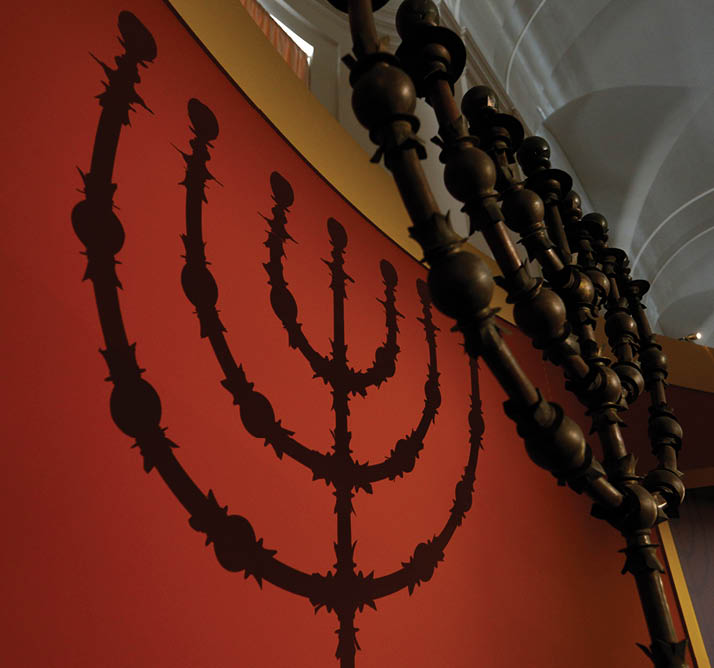
Since 1974, the Honolulu city administration has permitted Chabad of Hawaii, an Orthodox Jewish community, to use a public park to display a menorah, a seven-branch candelabra, the symbol of the Jewish Festival of Lights.
With the current warfare between Israel and Islamic militants, concern for Palestinian people killed and trapped in the crossfire has fueled anti-Semitic demonstrations around the globe. In Hawaii, it aroused opposition to the menorah displayed at a Waikiki park for a week. It went beyond antagonistic opinions in writing; local and federal law enforcement were involved as threats made against Jewish synagogues were taken seriously.
“‘Conflating local Jewish worship with international politics places an unfair and dangerous burden on Jews simply trying to live their lives,” said Rabbi CJ Mays of Temple Emanu-El in a commentary column in the Honolulu Star-Advertiser. “Hawaii prides itself on aloha, a love that honors the dignity of others, even in disagreement. Aloha means allowing communities to celebrate their traditions without fear. I hope … for a Hawaii that makes room for all its people … to celebrate who they are, openly and without apology.”
One of the letter writers did a double header of bigotry. She harked back to 1988, when a lawsuit brought down a large cross at Camp Smith Army base. She wrote, “An offensive cross on a hillside near Tripler Hospital was finally removed and so should this menorah.” The lawsuit brought by the American Civil Liberties Union and the Jewish War Veterans led a judge to find the cross violated separation of church and state.
Meanwhile, Muslims you may know or work with, or watch as players on professional sports teams, are fasting from dawn to dusk, without public display, during Ramadan.
Above: A menorah and its shadow are seen in one part of an exhibition on the menorah at the Vatican. (CNS file photo / 2017)