By Lisa Dahm and Celia K. Downes
Hawaii Catholic Herald
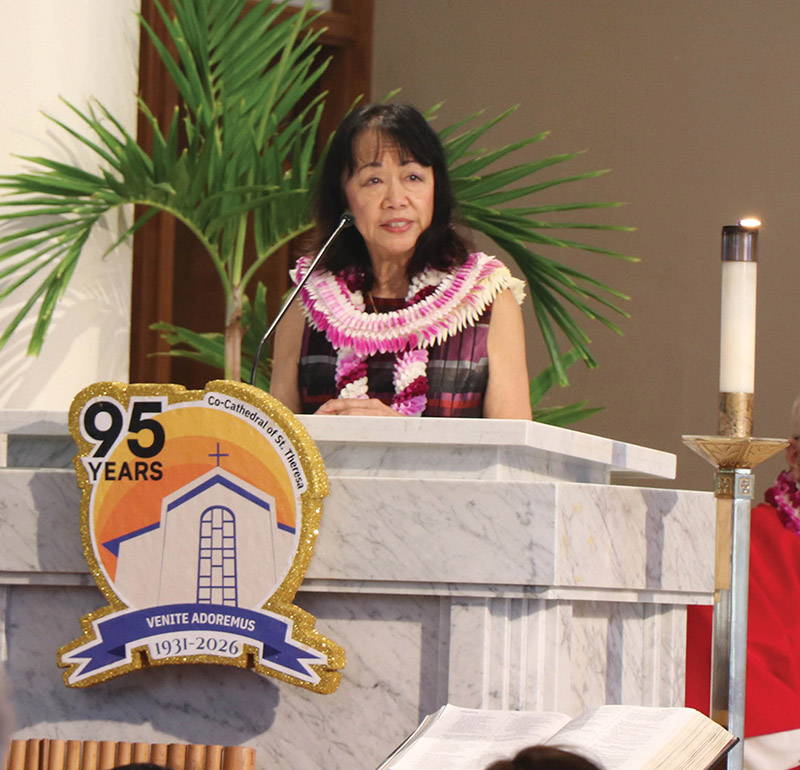
In her keynote address at the Diocese of Honolulu’s Red Mass Jan. 14, Institute for Human Services Executive Director Connie Mitchell called for “radical justice” and greater government accountability in addressing homelessness, particularly for people struggling with mental illness and addiction.
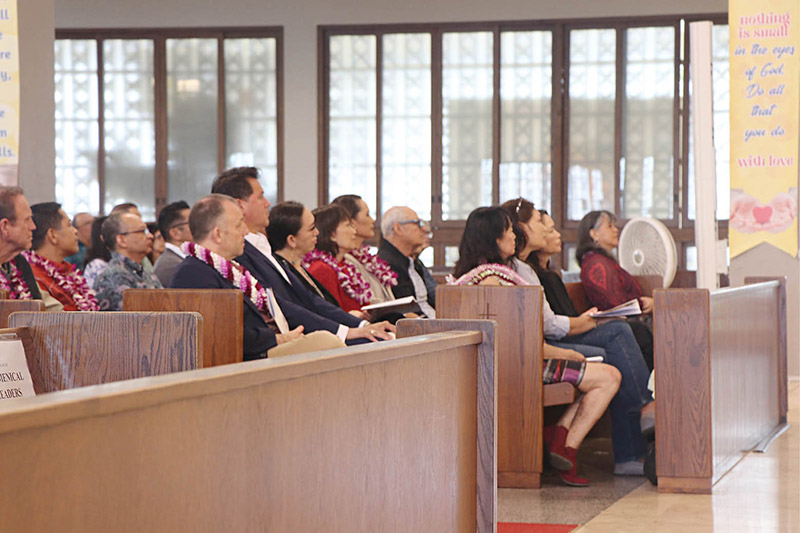
Mitchell spoke about “Radical Justice for Tumultuous Times” before a small congregation at the Co-Cathedral of St. Theresa in Honolulu that included civic leaders like Gov. Josh Green; state Sens. Mike Gabbard and Donna Mercado Kim; and from the Honolulu Police Department, Interim Deputy Chief Ryan Nishibun and Maj. Parker Bode.
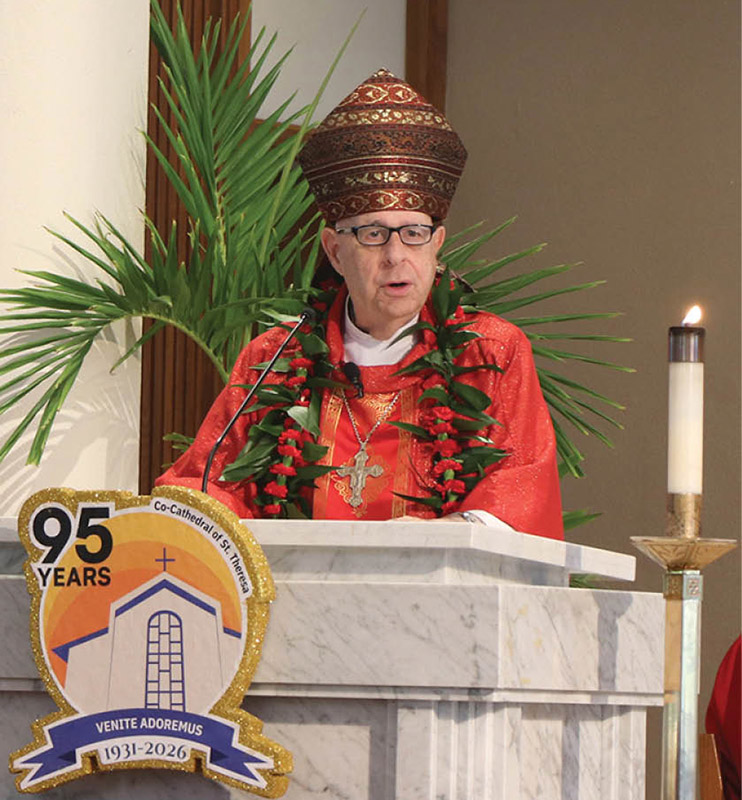
Bishop Larry Silva was the main celebrant at the annual Red Mass, during which the church prays to the Holy Spirit for wisdom and guidance for public servants (red is the vestment color that represents the Holy Spirit). The liturgy precedes the opening of the state Legislature each January.
More than a dozen other priests and several deacons also concelebrated the Mass, which featured music by the St. Theresa School choir as well as students serving as altar servers and sitting with the congregation.
Mitchell said she felt “truly honored” to receive the invitation from Bishop Silva to speak, “particularly because while I am a follower of Jesus Christ, I cannot claim membership in the Catholic Church.” She said his request “seemed to reflect a desire on his part to create common ground” amid a culture of conflict.
Her work and background show her deep ties to Hawaii’s diverse culture and the community’s challenges and opportunities.
Mitchell, born in Hawaii to immigrant Chinese parents, attended Mun Lun School, Hawaii’s oldest Chinese school, to preserve her cultural roots. She went to McKinley High School and earned bachelor’s and master’s degrees in nursing from the University of Hawaii at Manoa.
Prior to joining IHS two decades ago, her career was largely in the health care and nursing industries — but always with an eye toward helping those who are most in need.
Community is key
Mitchell said that while housing is the first thing many people cite as a solution to the homelessness crisis, what is really needed is community.
“People — all of us — need to feel that we belong somewhere,” she said.
She said that in her work with the nonprofit organization, she tries to “heed the words of our Creator who … in Micah 6:8 reminds us: ‘And what does the Lord require of you? To do justice, to love mercy and to walk humbly with your God.’”
“These words offer wisdom for all of us, when heard again in these times of tumultuous conflict, unrestrained violence, the dissipation of basic civility and an imposing culture of ‘me,’” Mitchell said.
She stressed the need for integrity, self-reflection and accountability in serving people experiencing homelessness. To do this, she relies on the third part of Micah 6:8, walking humbly with God.
“What it means for me is realizing I can’t do what needs to be done by myself,” she said. “It doesn’t mean I take a back seat to everyone else and make myself small, but it does mean linking arms with others to create a system, a community, that can serve a homeless person more effectively.”
This collaboration would address the lack of coordination between the legal and health care systems in Hawaii, which has also contributed to people being unable to access the mental health or substance abuse treatment they need.
“We’ve been wrestling with how to help mentally ill and substance-addicted persons who are dying on our streets and on our beaches,” Mitchell said. “There are people for whom there exists effective treatment, but such treatment is not accessible to them because of their own lack of mental capacity to choose wisely, or the addictions that have taken their will captive and robbed them of their ability to choose wisely.”
“Whatever happened to ‘parens patriae’ — the concept that the state or government acts as the ultimate guardian for individuals unable to care for themselves, stepping in to protect their welfare when all others in their lives fail?” Mitchell asked. “I’m actually super thankful I live in Hawaii, because here I believe our government still hangs on to that to a large degree.”
She said radical justice might require a return to even more determined and assertive acts by the government to “boldly ensure that genuine care for those who need help and treatment is provided.”
Mitchell added, however, that genuine compassion doesn’t simply mean giving to those in need without limits, as that can create dependency and undermine motivation for change. Instead of unlimited charity, she advocates for adequate, thoughtful support that helps people without fostering dependency.
“Sometimes it’s only when people are given the opportunity to identify their deepest motivations or are held accountable for not making changes to avoid getting into the same situation of need that they themselves then realize their ‘why’ for making changes in their lives,” she said.
She said people should follow Jesus’s example by leaving judgment behind and pursuing compassion and understanding for those facing homelessness and hardship.
Praying for leaders
Before Mitchell’s talk, which she delivered near the end of Mass, Bishop Silva in his homily said that Hawaii is faced with many complex challenges today — in addition to a dearth of homes and quality health care, there are also fear and anxiety among immigrants, wars and a civil discourse that “has become anything but civil.” Creating an effective response requires improving and developing laws and policies to address these issues.
“Our public servants, whom we pray for today, have a great burden in leading us all to find solutions to these persistent and thorny issues,” he said.
Bishop Silva said that while laws and policies are essential, real change comes from human interaction and bringing compassion and “salt and light” to others.
A sense of belonging requires an attitude toward others that is “poor in spirit, that truly mourns people’s struggles and losses, that is meek and hungry for righteousness, merciful, clean of heart,” and dedicated to peacemaking, he said.
Bishop Silva called for public servants to seek wisdom and compassion in developing solutions to persistent problems. He concluded that prayer, worship and clinging to Christ are essential for bringing justice and compassion to the world.
At the end of the liturgy, he blessed the civic leaders present, with the faithful in the congregation raising their hands to join him.
From top: Connie Mitchell, who has led the Institute for Human Services for two decades, gave the keynote address during the Red Mass Jan. 14 at the Co-Cathedral of St. Theresa in Honolulu; Gov. Josh Green, second from left in foreground, and Mitchell, third from left in foreground, listened to Bishop Larry Silva as he delivered his homily during the Red Mass; Bishop Silva spoke about the burden and responsibility that public leaders have in seeking solutions to “persistent and thorny issues.” (photos by Celia K. Downes / Hawaii Catholic Herald)