By Lisa Dahm
Hawaii Catholic Herald
For most of his 20 years as leader of the Diocese of Honolulu, Bishop Larry Silva, his staff and a dedicated Presbyteral Council have been reviewing parish boundaries across the islands to keep pace with Hawaii’s changing population and other demographic shifts.
“I have seen a change from sugar plantations to housing, especially in West Oahu and Maui,” Bishop Silva said of the importance of the boundary reviews.
Parish boundaries ensure that every Catholic has an official spiritual home for records and sacraments, as well as access to pastoral care, regardless of whether they are active in the church.
Beginning Jan. 1, new boundaries will take effect for nine parishes on Oahu, Maui and Hawaii island and be accessible to all on the diocese’s website, www.catholichawaii.org.
Former diocesan real estate director Marlene DeCosta was an integral part of the parish boundary delineation effort on all islands. Now retired, she joined the Diocese of Honolulu in 2009, bringing 24 years of experience in commercial real estate.
“When I came to the diocese in March 2009, Bishop (Silva) had a few things on his to-do list that he wanted to accomplish,” DeCosta said. “What he was most concerned about was that, as it relates to the boundaries, whether the current boundaries for the parishes were in keeping with the population growth.”
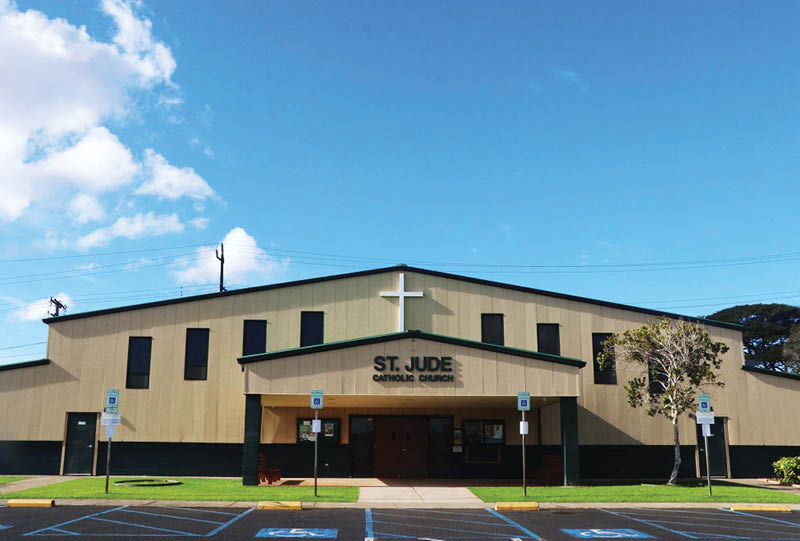
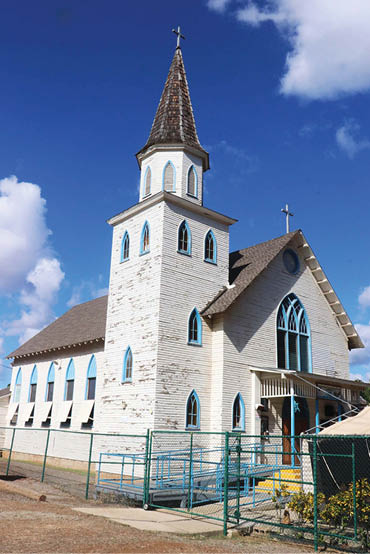
The two parishes that will experience the most significant boundary changes are St. Jude in Kapolei and Immaculate Conception in Ewa.
“That area of West Oahu has experienced tremendous growth over the past 20 years,” DeCosta explained.
More than a decade ago, the diocese acquired an 11-acre parcel of land in Kapolei on the Leihano property, a few minutes from St. Jude’s current location — enabling the parish to eventually construct a significantly larger church to accommodate the growing congregation.
The boundary revisions effective Jan. 1 reflect St. Jude’s larger property as well as efforts to ease population pressure on Immaculate Conception, a smaller church in a historic plantation area in Ewa.
Residents of the Hoopili division in Kapolei will now be included in St. Jude’s area. Immaculate Conception, meanwhile, will experience a “right-sizing,” according to a letter sent by Bishop Silva to the parish’s pastor, Father Siegfried Dosdos, that will be a better fit for the more intimate church.
Seven other parishes will experience slight changes not due to population growth, but due to other factors such as correcting confusing boundaries.
For example, in Kailua on Oahu, approximately a quarter of the residents in the Maunawili subdivision fell within the boundaries of St. John Vianney, while the rest were within the limits of St. Anthony of Padua about two miles away. Yet, parishioners who live in the St. John Vianney section had to travel through the St. Anthony section to exit the subdivision. Now, the entire subdivision will be in St. Anthony Parish.
Two more pairs of adjacent parishes are also seeing boundary adjustments — Our Lady of the Mount and St. John the Baptist in Kalihi; and on Maui, St. Anthony of Padua in Wailuku and St. Ann in Waihee.
Meanwhile, Immaculate Heart of Mary in Papaikou, Hawaii island, will be the central church of a parish boundary that now includes St. Anthony Mission in Papaaloa and Good Shepherd Mission in Honomu.
Importance of parishes
“There is a certain wisdom in the Catholic Church that recognizes the importance of smaller geographical areas,” Bishop Silva said. “Each country is divided into dioceses, and each diocese is divided into parishes. This way, the pastor and parishioners know that they are responsible for evangelization and pastoral care of the people who live in their neighborhoods.”
Bishop Silva said that although the diocese does not restrict anyone from going to a parish other than the one in which they reside, it encourages people to attend their local parishes.
“It is important to work together with neighbors on pastoral, spiritual and civic needs common to the area,” Bishop Silva said. “In addition, it challenges us to not always shop around for what pleases us the most, but to work with those with whom we live in greatest proximity so that our neighborhoods can be transformed by the light of the Gospel.”
Father Mark Gantley, judicial vicar for the diocese, was actively involved in drafting parish boundaries during the early stages of the process, from 2008 to 2009. He said that the creation of parishes “guarantees that all the faithful have a proper pastor who has the care of their souls,” which is established in Canon Law 519.
“This is true even if people are not registered with the parish or rarely attend Mass,” Father Gantley said. “Everyone should know that there is a priest designated for their pastoral care.”
Other institutions that might be present in a parish’s territory include prisons, schools or hospitals, which give parishes a special responsibility for pastoral care in those locations.
History of the project
The examination of the diocese’s parish boundaries began several years after Bishop Silva’s installation in 2005.
The diocesan Land Asset Management Team was established in 2009 and comprised about 10 individuals from various sectors of the real estate industry, including appraisers, real estate agents and real estate developers. They met quarterly for about three years.
“They all focused on real estate, so that they would have an on-the-ground knowledge,” DeCosta said.
Before any work began, the diocese underwent a thorough research process. DeCosta interviewed pastors from all 65 parishes to understand their populations and the parishes’ needs.
To determine projected growth, planners examined population trends, future development and general population numbers.
DeCosta said the earlier maps had not been amended for many years and included nebulous descriptions that included markers such as gullies and streams.
“It was pretty archaic in the descriptions; it had to be, because that’s all they had. There wasn’t even Google Earth when they were done last time,” she said.
Once all decisions were finalized, HHF Planners mapped out the entire state with new boundary lines.
“It is electronically done and will be able to go on to our website, so that if you are visiting, or even if you’re in an area you’ve just moved to, or if you’re just curious what boundary is where you are at any given point, it will show you which parish you’re in,” DeCosta said.
Bishop Silva said he is very grateful for the many people who have contributed to the success of this enormous project.
“I would especially like to commend Marlene DeCosta, our former (retired) diocesan real estate director, and her Land Asset Management Team for their hard work on this issue over many years,” the bishop said.
Working together
Father Khanh Hoang, priest-secretary to the bishop and former longtime pastor of St. Jude, has continued the project after DeCosta’s retirement, with about 90% of the work completed.
Father Hoang said the diocese’s vicars forane — pastors appointed by the bishop to oversee the parishes in their districts across the state — were instrumental in the process, thanks to their on-the-ground experience and knowledge of how physical boundaries and new developments have had an impact.
Father Konelio “Lio” Faletoi is vicar forane for the West Hawaii vicariate and pastor of St. Michael the Archangel Church in Kailua-Kona. His parish, with 1,400 households, includes four historic mission churches: Immaculate Conception in Holualoa, St. Paul’s in Honalo, St. Peter by-the-Sea in Kahaluu and Holy Rosary in Kalaoa.
His parish offers an example of how parishioners from multiple churches can work together as one community. The mission churches are still open and used regularly, and “major gatherings are all at St. Michael’s, which is the largest of our facilities,” he said.
“It really has built a clear understanding that we are one family.”
According to Father Hoang, parish boundaries are not only relevant for emergencies and establishing jurisdictions, but also for evangelization.
“(…) You’re talking about catechism, worship, blessing, celebration, the sacraments, even Christian burial,” Father Hoang said. “That’s one of the things that we deal with all the time, people who call who are not practicing.”
Above, from top: St. Jude Church in Kapolei and Immaculate Conception Church in Ewa are among the nine parishes whose boundaries have been revised effective Jan. 1. (Photos by Celia K. Downes / Hawaii Catholic Herald)