By Lisa Dahm
Hawaii Catholic Herald
In light of recent federal action regarding fertility treatments, including in vitro fertilization, the diocesan Respect Life Office invited people to hear two experts discuss the processes and ethics of reproductive medicine Nov. 8 in an event hosted by St. John Apostle and Evangelist Church in Mililani.
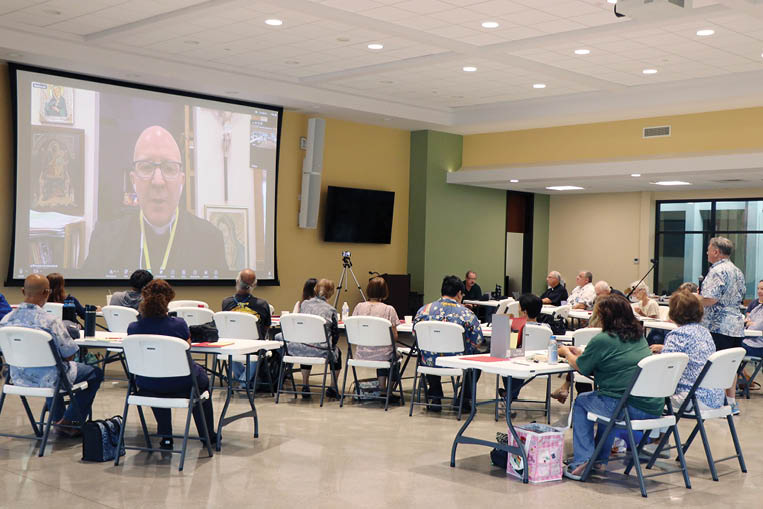
About four dozen participants observed the Zoom discussion — most gathered in-person in the parish hall, while others logged on remotely.
Speaking one after the other from the East Coast were Father Shenan Boquet, president of Human Life International and a leading expert on the international pro-life and family movement; and Jozef Zalot, director of ethics at the National Catholic Bioethics Center in Philadelphia.
The speakers explained how fertility treatments work and how restorative reproductive medicine — endorsed by the Catholic Church — is safer, more effective and less expensive than IVF.
“IVF is not pro-life,” Zalot said plainly.
In October, the Trump administration announced actions to lower costs and expand access to IVF and other forms of fertility care, including an agreement with a pharmaceutical manufacturer to reduce the price of several common fertility medications.
Zalot said IVF is incompatible with Catholic teachings due to its artificial nature and its objectification of embryos, which are treated as a commodity. It also breaks what the church calls the inseparable connection between procreation and union.
For a reproductive procedure to be permissible, it must only involve the husband and wife, and the intervention must assist rather than substitute for intercourse in achieving pregnancy, he said. An example of permissible assistance he gave was removing a fallopian tube blockage for a female or taking medicine to increase sperm count in a man.
The National Catholic Bioethics Center follows a document issued by the U.S. Conference of Catholic Bishops titled “Ethical and Religious Directives for Catholic Health Care Services.” According to the document’s sixth edition, life is defined as “from the moment of conception until death.”
“(IVF) it objectifies human life, because that’s what embryos are,” Zalot said. “These are human beings in the very earliest time of their existence. Every one of us was an embryo.”
How IVF works
At the start of the in vitro fertilization process, a woman takes medication to stimulate ovulation, which typically causes her to ovulate multiple eggs. The eggs are retrieved through a minimally invasive procedure, then combined in a petri dish (“in vitro”) with sperm obtained from a man, resulting in fertilization.
Multiple embryos are incubated and allowed to develop for about a week; they are then tested for characteristics such as sex and screened for genetic defects and other abnormalities.
The best embryo candidates, which Zalot described as the “A” team, are transferred surgically into either the biological mother’s uterus or the uterus of a surrogate, where one or more ideally will implant. The rest of the embryos are either destroyed or cryogenically preserved for possible use later.
Zalot noted that for every child born through IVF, eight embryos are destroyed. He also discussed the legal and ethical implications of frozen embryos and reviewed the church’s stance on embryo adoption.
“Cryopreservation — from the church’s perspective and others as well — it’s a grave violation of our human dignity because we’re taking human beings and we’re suspending their development. We’re maintaining them in this frozen state,” Zalot said.
Approved alternatives
In restorative reproductive medicine, on the other hand, couples work with a physician to restore fertility by addressing medical issues such as endometriosis, polycystic ovarian syndrome and miscarriage.
Restorative reproductive medicine is now done primarily through an innovative technique called Natural Procreative Technology, often shortened to NaPro or NaProTechnology.
NaPro uses the Creighton Model FertilityCare System and works directly with gynecological and menstrual cycles.
Other restorative reproductive medicine options include Fertility Education and Medical Management, or FEMM, and NeoFertility.
Father Boquet noted that the lower cost of helping couples conceive naturally actually makes it less financially attractive than IVF for many non-Catholic providers.
“RRM (restorative reproductive medicine) offers real, ethical care by diagnosing and healing the underlying conditions that prevent conception, rather than bypassing the body through an expensive, low-success, morally unacceptable procedure like IVF,” he said.
“We must call upon President (Donald) Trump to reconsider this approach and instead fully commit to the far better path addressing the root causes of infertility.”
According to Val Streff, director of the Respect Life Office with her husband, Deacon Gary Streff, the office hopes to hold a second restorative reproductive medicine session in December. Father Boquet will visit Hawaii in January to give talks and attend the local March for Life rally at the state Capitol.
Streff said she and Deacon Streff are working to ensure that parishioners are educated on the Catholic Church’s doctrine concerning all life issues.
“We thank those who attended in person or listened at home via Zoom to the presentations by Father Shenan Boquet and Dr. Jozef Zalot,” Streff said. “We hope it inspires all of us to take an active role in promoting the culture of life in Hawaii.”
For more information
- NaProTechnology: Visit the Saint Paul VI Institute for the Study of Human Reproduction at saintpaulvi.com.
- Fertility Education and Medical Management: femmhealth.org
- NeoFertility: neofertility.ie
- National Catholic Bioethics Center: www.ncbcenter.org
Deacon Gary Streff, standing at right, asked Father Shenan Boquet a question during the event at St. John Apostle and Evangelist Church. (Celia K. Downes / Hawaii Catholic Herald)