View from the pew
Our hot autumn weather and distressing lack of rainfall has put me in a mental state that’s “for the birds.”
Compared to some rude and raw 21st-century put-downs, that old American idiom which dismisses something as being “worthless, nonsensical” is a pretty mild criticism. But I don’t consider being for the birds a negative thing. Especially in this month of October, my concern is an inspiration, a challenge, a biblical concept.
I’m worried about the birds that are a part of my life — the cardinals, doves, bulbuls, even those noisy, pushy mynahs I expect to hear when I’m waking up, and watch hunting and pecking for food in the yard.
Where are the kolea, the golden plover that is the rare species that annually migrates thousands of miles between the arctic and sunny Hawaii? They are also scarce as we seek to spot them on jaunts around the island.
We saw a shama thrush briefly take a shower at the sprinkler that’s keeping the lemon tree alive. But he didn’t respond to attempts at a whistling conversation and flew away.
I hope it’s the seasonal climate that’s driven them up the slopes into trees and that it’s temporary. A dried-out land means fewer bugs, seeds and fruit to feed on.
Birds are about the only wild animals we encounter in this limited island environment. Feral chickens — which are domestic animals gone viral — are not an acceptable substitute for backyard winged serenaders.
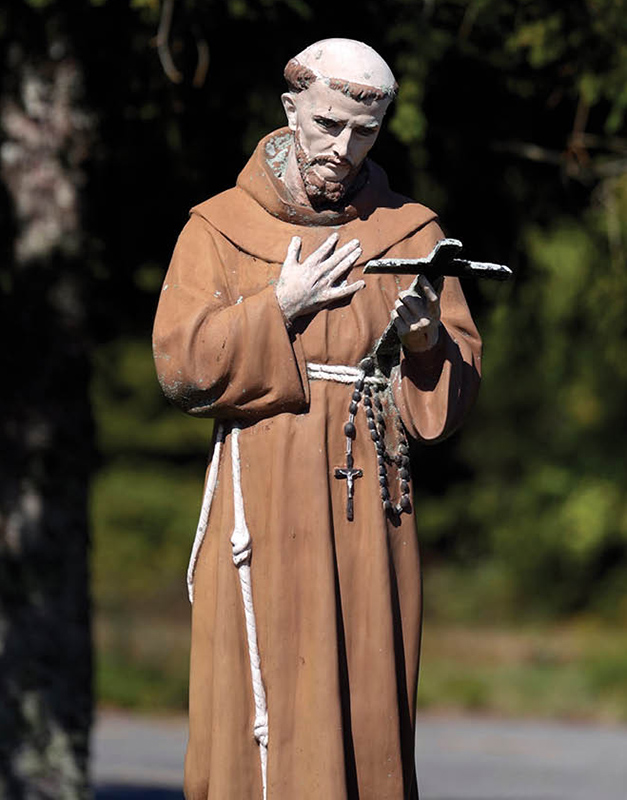
Lifetime memories of encounters with creatures large and small are on my mind and in thanksgiving prayers as this month we marked the feast day of St. Francis of Assisi, whose love for God’s creation is legendary. He is always depicted in the company of birds and animals.
Other Christians, as well as secular people devoted to conservation of our planet, observe Oct. 4 as an important day to take stock of ourselves and our relationship with nature.
The 13th-century man who turned away from his wealthy upbringing to choose a life of poverty has become “the symbol of a loving relationship with nature,” Larry A. Nielsen, author and retired professor, wrote on Oct. 4 for his daily online column called “Today in Conservation” (todayinconservation.com).
He pointed out that Oct. 4 was also chosen as World Animal Day in 1931 when the International Animal Protection Congress chose it “to raise the status of animals (wild and domestic) in order to improve welfare standards around the globe.” Nielsen wrote that more than 1,000 Animal Day events are held in more than 100 countries annually.
In 1979, Pope John Paul II declared St. Francis the patron saint of ecology. And in 1982, he said that St. Francis’ love and care for creation was a challenge for contemporary Catholics and a reminder “not to behave like dissident predators where nature is concerned, but to assume responsibility for it.”
Taking responsibility
Pope Francis, who took the saint’s name, was inspired by St. Francis’ famous prayer and named his 2015 encyclical, “Laudato Si’,” in honor of it. The encyclical has inspired the Laudato Si’ Movement, a global network of 1,000 organizations promoting the Franciscan approach to ecology.
That famous prayer, “Canticle of the Sun,” is a wonderful poetic view of us in our natural world.
The unique relationship that Francis had with nature “cannot be written off as naive romanticism,” his namesake wrote in “Laudato Si’.” “If we feel intimately united with all that exists, then sobriety and care will well up spontaneously. The poverty and austerity of St. Francis were no mere veneer of asceticism, but something much more radical: a refusal to turn reality into an object simply to be used and controlled.”
I recommend that you take time to read Pope Francis’ “A prayer for our earth” in that encyclical, in which he calls on God to “bring healing to our lives that we may protect the world and not prey on it, that we may sow beauty, not pollution and destruction.”
It seems to me that the life and wisdom of St. Francis would have made a prime and meaningful choice for homilies in our churches this month. Even if the feast day was not on a Sunday, it is such a clear, uncomplicated message about stewardship that needs to be preached and taught to us as Christians and citizens of the earth.
“God wants us to act as stewards, not owners. Everything we have has been entrusted to us only for a time,” was wisdom I found in an article in the October “Word Among Us” — daily meditations on the liturgy. “The more aware we are that the people in our lives and the natural world are gifts, the more grateful we become and the more likely we are to view them as precious treasures give to us by a gracious God.”
The author is a professor of religious studies at Holy Family University in Philadelphia, Joseph Stoutzenberger, who also wrote that “much of the environmental damage done to the earth comes when humans act as if the resources of the earth are limitless, or if certain technologies and practices won’t result in lasting damage.
“God doesn’t want us to mistreat or dominate those under our authority. Neither does he want us to exploit people or things for our own selfish use.”
The idea of mankind taking responsibility as a steward is to be found in the Old Testament writings about creation. We’re told in Genesis that God gave mankind “dominion over the fish of the sea, the birds of the air, the tame animals, all the wild animals and all the creatures that crawl on the earth.”
Psalm 8:6-7, addressing God’s challenging role for us mere humans, says: “You have made him little less than a god, crowned him with glory and honor, and have given him rule over the work of your hands, put all things at his feet.”
Professor Stoutzenberger said: “God wants us to grow in attentiveness to the people and things he has asked us to care for. It’s easy to be wrapped up in our own desires and cares.”
As for my personal worries about my feathery friends, Hawaii biologist and author Susan Scott told me there is no government or other agency that keeps track of our wild birds, or whether they might be missing or in trouble.
“No one cares about introduced species,” she said. All official focus is on the endangered Indigenous species which mostly inhabit high altitudes and few of us ever see. Scott, former nature columnist for Honolulu’s daily newspaper, is president of the Hawaii Audubon Society and a participant in ongoing research on the kolea. Her writing can be found on the Kolea Count and Audubon websites.
Dozens of organizations have a mission to protect the environment, to “malama the aina,” not necessarily with a faith-based theme but as serious stewards.
They work to restore the environment which humans have damaged, from bird habitats that fell victims to development, to reef damaged by human devices, to ocean tangled with debris, to overfishing of ocean waters, and are pushing back as government agencies with environment protective roles have been dismantled.
Rather than listening to a brief homily about St. Francis as role model, our best way to follow in his footsteps may be to join an activist group and get involved in action. Time to get out of the pews and into the fray.
At top: A statue of St. Francis of Assisi is seen on the grounds of Our Lady of Ostrabrama Church in Cutchogue, New York. (Gregory A. Shemitz / OSV News)