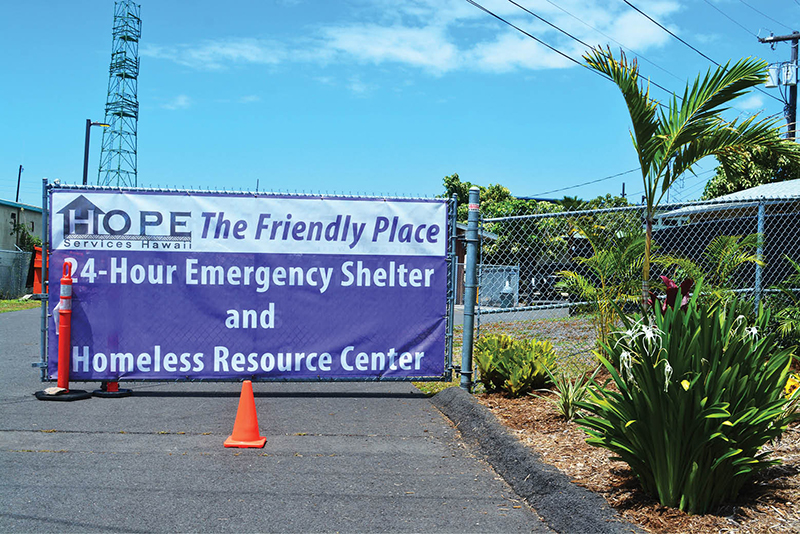
The Friendly Place, located in Kailua-Kona, includes several initiatives ranging from emergency shelter to permanent supportive housing. (Lisa Dahm / Hawaii Catholic Herald)
By Lisa Dahm
Hawaii Catholic Herald
Since 2010, Hope Services Hawaii has worked to house people who are unsheltered across Hawaii island — from kupuna to families and everyone in between. Not only is the agency helping people in bigger towns of Hilo and Kona, it is also filling housing needs in quiet areas, like Honokaa and Pahoa.
Now, Hope Services, which is a nonprofit organization of the Catholic Church in Hawaii, has about 130 staff members working across Hawaii island. Its seven established sites include shelters, emergency housing, integrated care hubs and even an assisted community treatment program for people who do not know they are a danger to themselves but need to access treatment.
According to Blessed Sacrament Father Robert Stark, director of the diocesan Office for Social Ministry — the original home of Hope Services where it began life as another program — fundamental to Hope Services’ mission is the challenge of Jesus in the Gospel of Matthew, Chapter 25: “Whatever you do to the least of these persons, you do to me.”
“Hope Services has always taken that to heart,” Father Stark said. “That’s how they got their motto, ‘Inspiring hope and changing lives.’”
In 2023, Hope Services began to include parishes in its housing initiatives, beginning with the Sacred Heart Affordable Housing Program in Pahoa, which offers permanent affordable housing for kupuna 62 years and older. This year, the agency converted a convent at Our Lady of Lourdes Church in Honokaa into affordable housing for seniors.
“It is amazing to see this, this true transformation of affordable housing for our community in North Hawaii,” said Kristen Alice, director of community relations for Hope Services, during the kupuna housing blessing at Our Lady of Lourdes in late August.
Beginning the legacy
The seed for Hope Services was planted in the mid-1980s with the work of Carol Ignacio, who was then the director of the Office for Social Ministry. Ignacio made regular trips to Oahu from Honokaa, and worked out of a small “closet” at St. Joseph Church in Hilo while on Hawaii island.
“When I was hired, my boss (at the time) told me, ‘Carol, don’t plan anything for at least six months,’” she said. “‘Listen to what’s needed, not what we think.’ And so, I did that.”
Ignacio talked to the governor’s office and to people on the street. At the end of six months, she knew what the community needed. She began delivering food out of her car, created food banks in both Hilo and Kona, and established the Care-A-Van mobile care program.
Her work grew beyond anything she could have imagined.
“It wasn’t something that I thought about,” Ignacio said. “Everything I did after that, I realized it’s not about what we want to do, you cannot chase money. What I realized early on is that you must listen.”
Care-A-Van became Hope Services Hawaii in 2010, expanding its visibility across the state while remaining committed to its work on Hawaii island. Ignacio stepped down from her leadership role and Brandee Menino, who had been a key member of the Care-A-Van team since 2001, was named CEO.
Committed to community
Under Menino’s guidance, Hope Services has flourished across Hawaii island. She said what keeps her going is being able to help, often with a hot shower and a comfortable bed, when she sees someone without any hope, who thinks they have an insurmountable problem.
“When you put (them) into housing and they have a place that’s truly theirs, that’s when healing begins,” she said. “Then they can start to feel normal again, when there’s no fighting for basic things that people need to survive.”
Menino said that once people get to the point of consistency and of feeling safe, they become empowered and confident enough to share their story with others, which allows them to grow even stronger.
“Just giving them those kinds of opportunities; I’ve seen that over and over,” Menino said. “You must be there for the long term to see that growth. That’s truly a blessing to see.”
Menino also said the nonprofit operates effectively because of its collaborations, especially with government partners and other organizations that fill needs for programming Hope Services may not have.
“We can work together, and not just us as Hope Services, but even other partners with community-based organizations,” Menino said.
Menino said the goal is for homelessness to be rare, brief and non-recurring, especially in families or with people who are elderly.
“We want to get them into housing as quickly as possible, so they’re not prolonged in the trauma of homelessness because we don’t want generational homelessness,” she said. “For seniors, if we don’t intervene, they can be victimized.”
Anne Harpham, who was a Hope Services board member from 2010 to 2024, said Ignacio invited her to be on the board at its start, and she joined because she liked the work that they do.
“It is a privilege to be part of it and to have watched how Hope has grown over the years and all the wonderful work they’ve done on the Big Island,” Harpham said.
Range of services
Hope Services’ seven sites include 168 beds and 128 housing units across Hawaii island. They provide outreach, street medicine, behavioral health, housing, prevention, diversion, case management, senior housing and more.
In 2023, the organization performed 11,417 unique instances of service, moved 566 people into permanent housing and helped 1,378 people avoid or overcome homelessness. This summer, it opened a medical respite and behavioral health care facility, Kahua Kahe Malie Integrated Care Hub, in Ainaloa, near Pahoa.
In Hilo, Hope Services operates a family shelter, women’s and men’s shelters, and medical respite.
In Kailua-Kona, the organization operates The Friendly Place Resource Center, whose campus includes three sections — the West Hawaii Emergency Housing Program, a day drop-in center and the Hale Kikaha permanent supportive housing area.
Gideon Ramos, Hope Services’ West Hawaii director, said that homelessness is a very complex issue because each individual has their own journey.
“I’ll tell folks that come through our doors all the time, ‘We respect your journey. Everyone has their own unique journey. Respect theirs also,’” Ramos said.
Leader in street medicine
In 2019, Hope Services began a street medicine program for unhoused people in Hilo with a team of case managers, nurses and sometimes volunteers, therapists or psychiatrists.
D. Michiko Fried has been the director of health services for the organization since 2023, when she transitioned from private practice to Hope Services focusing on medical respite, street medicine and shelter medicine.
Fried said that helping unsheltered individuals requires addressing the social determinants of health — such as transportation, education, safe neighborhoods, affordable nutritious foods, and proper housing and support networks — while working with nonjudgmental love, compassionate care, dignity and equity.
“We’re all at a different place in our lives in this world, and we have to adjust our care plans, our interactions and our expectations as professionals,” Fried said.
“When you’re working with a person, the person’s not a problem — they’re a person with problems,” she said.
Fried also mentioned plans to expand Hope Services’ programs, including the addition of psychiatric services and case management. The agency recently acquired an apartment building in Kailua-Kona for affordable housing — 12 two-bedroom, one-bath units that will serve families and individuals experiencing homelessness in the community.
New kupuna housing
On Aug. 27, Hope Services blessed its new kupuna housing program at Our Lady of Lourdes Church in Honokaa. Parishioners not only welcomed the project, they collaborated to sponsor rooms, supplying all the accessories in each one.
“It (is) nice because we can serve people from this community,” said Father Anselmo “Jun” Bobier, pastor of Our Lady of Lourdes.
According to JJ Andrade, one of the parishioners who assisted with the project, the parish will supplement Hope Services’ programs with support of its own: “We also offer (the kupuna) an opportunity to participate in church events. We will invite them to go to Mass. We have coffee hours and things like that, and we will invite them to come.”
Our Lady of Lourdes is Ignacio’s home parish, and she has had the opportunity to see her work come full circle.
“It’s just not a parish, it’s family,” she said.
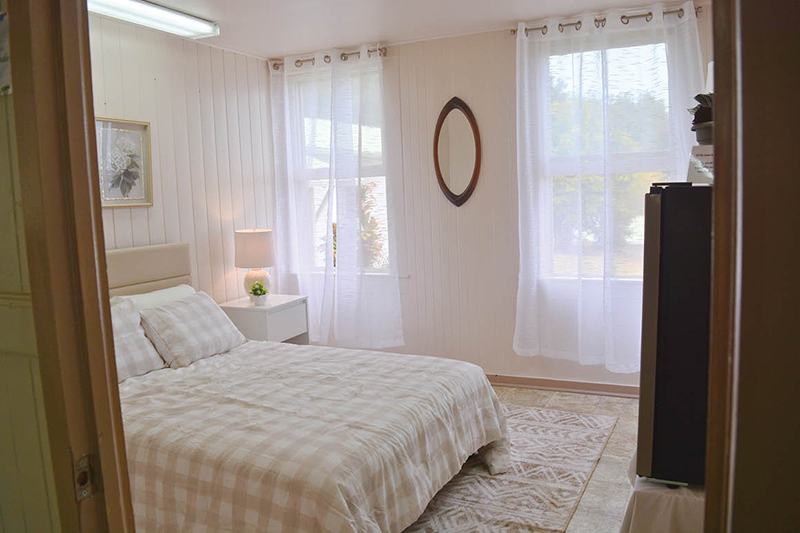
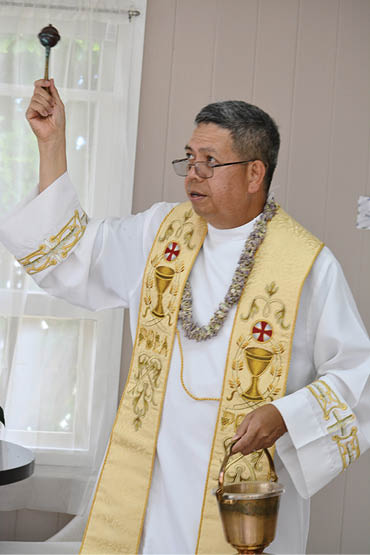
Top: A bedroom in the new kupuna housing project at Our Lady of Lourdes Church in Honokaa. Blessed in August, the rooms were furnished and decorated by parishioners. Above: Father Anselmo “Jun” Bobier, pastor of Our Lady of Lourdes, blesses the facility. (Photos by Lisa Dahm / Hawaii Catholic Herald)