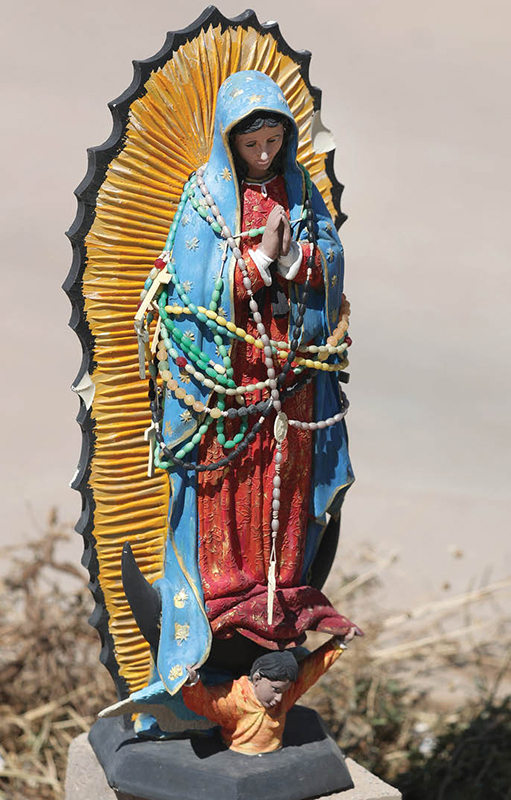
A statue of Our Lady of Guadalupe is seen on the grounds of St. Peter Indian Mission Catholic School on the Gila River Indian Reservation in Bapchule, Arizona. (Bob Roller / OSV News / 2024)
View from the pew
I’m back from a sojourn into a different part of our country and immersion in a totally different culture. I just couldn’t wait to talk about the School Sisters of St. Francis turning the grounds of their St. Joseph Center in Milwaukee into a beer garden.
Craft beers and German wine flowed at the nuns’ Sept. 13 Oktoberfest celebration. People danced to the “oompah” music of polka bands and sang along with country and pop music groups. German bratwursts and large baked pretzels were among the food items being sold by vendors.
It’s Oktoberfest, a cultural tradition celebrating German heritage and the fall harvest, the success of the agriculture business which feeds the nation after a summer of hard labor. It is underway right now around the country and globally, embraced by rural and urban communities and people of other ethnicities.
You might even find a local eatery offering an Oktoberfest menu choice. (Food, by the way, is definitely a way to mark another ethnic celebration underway in Hawaii. I’ll get to that later.)
The preview about Oktoberfest in the Milwaukee Journal Sentinel also listed beer garden plans for Our Lady of Lourdes and St. Augustine of Hippo parishes, a predictably profitable fundraising event.
Many towns have their own events topped by a two-day-long Oktoberfest where craft sales and cultural exhibits are a choice beyond the tuba-and-accordion polka bands and country music.
Wherever it may be, the menu always includes beer, which is a product of some of the most successful agricultural industries in Wisconsin. It is sold in public parks — it’s not banned at beaches as it is here.
I guess my point in focusing on the cultural aspect of a mug of beer is that it’s not a sin to drink and not a crime, either, unless the imbiber overdoes it and endangers others.
I have good memories of reuniting with certain regulars at the beer tent at the St. Ann Church annual carnival back in the day. A few years ago my parish had a catered dinner complete with wine as a fundraiser, a one-time thing. I just can’t visit island parishes for their special events, but I doubt many would have alcohol sales at their fundraising events these days.
I would guess it’s just not worth jumping through the hoops required by Hawaii liquor laws.
The state government’s limits and bans on public alcohol consumption actually have religious roots in the first Christian missionaries from New England. They imposed their stern attitude on the subject with the so-called “blue laws” which were still in effect 100 years later when I arrived in the 1960s.
It was illegal for stores to sell alcohol on the Sabbath. You could order a drink at a restaurant or bar, but not bring a six-pack home on a Sunday. The burgeoning tourist industry prevailed to ease some of the missionary zeal.
But each county liquor commission has the task of policing sales. Each island requires sales to cease at certain hours in retail stores and in restaurants, bars and nightclubs. Businesses are fined and can lose licenses to sell.
I was uplifted and envious reading about a fantastic concert at the Waikiki Shell earlier this month, with dozens of Hawaii musicians entertaining thousands of people as a way to commemorate the musical legacy of the late singer Fiji.
But as news media reported, it was heavily policed with officers intent on stopping folks from imbibing alcohol in the amphitheater and in the surrounding dark park space. Thankfully, it didn’t seem to cast a pall on the crowd, but it also made me sad.
The German concept of “gemutlichkeit” — warmth or friendliness — took root in a different way than “hoomaha a hauoli” (“rest and relaxation”). I know friendliness, respect for others and a feeling of social belonging and contentment don’t need an alcohol (or drug) stimulus.
Music, dancing, food and drink are part of the festivities during Hispanic Heritage Month, which ends Oct. 15. There are no parades in Hawaii, and the only public event I could find is an Oct. 11 festival at the West Oahu Veterans Center at 5001 Iroquois Blvd., Ewa Beach.
In our political climate of the day, it’s not surprising that Hispanic groups would stay out of the limelight rather than attract the attention of government hunters of illegal immigrants.
A national Hispanic Heritage Week was instituted by President Lyndon B. Johnson in 1968. In 1987, the White House was behind the establishment of the nonprofit Hispanic Heritage Foundation, which continues in its mission to bolster education, workforce opportunity and social impact of the people from many Spanish-speaking nations who came to America.
Republican President Ronald Reagan made it a month-long event and in 1989 Republican President George H.W. Bush made a proclamation applauding Hispanic people’s contributions to our society.
In sad commentary, we cannot expect their current Republican successor to affirm those sentiments.
According to the 2023 U.S. Census, Hispanic people in the United States numbered 65.2 million. That’s 19.5% of the total population, the largest racial minority in our country. People identifying with the ethnic group made up 11% of Hawaii’s population.
The celebratory month’s beginning is intentionally set on Sept. 15, which was Independence Day for several South American countries freed from Spanish control. It also includes Columbus Day, which was set by Congress in 1937 to mark the day in 1492 when the explorer for Spain first found land in the Western Hemisphere. Or, as they used to say, “discovered America.”
To honor old Christopher Columbus is oh-so-politically incorrect now, because of how Spanish colonization of South and Central America led to slavery and mistreatment of the people who were there first.
Oct. 13 is now called Indigenous Peoples’ Day in most of the United States.
In Hawaii, legislators tweaked it to Discoverers’ Day to include the Polynesians who discovered Hawaii. It was deleted as a state holiday in exchange for Martin Luther King Jr. Day in January.
“Preservation of one’s culture does not require contempt or disrespect for other cultures,” said the late civil rights activist and labor leader Cesar Chavez. The White House presented a posthumous Presidential Medal of Freedom in 1994 to the controversial man who organized Hispanic farm workers into what became the national Farm Workers Union.
“You are not ‘lucky to be here.’ The world needs your perspective. They are lucky to have you” — the words to bolster Hispanic Americans from Jose Antonio Tijerino, president of the Hispanic Heritage Foundation, are an inspiration for all of us whose ancestors came and brought the best of many cultures that made America great.