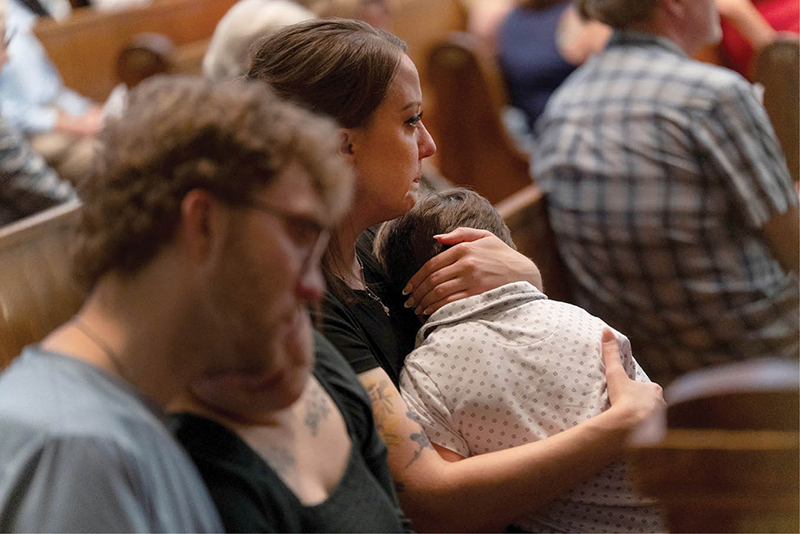
Mary Perez embraced her son, Felix, a first grader at Annunciation Catholic School in Minneapolis, during an interfaith prayer service Aug. 28 at the Basilica of St. Mary in Minneapolis. The previous day, a shooter opened fire through the windows of the school’s mother parish, Annunciation Church, during an all-school Mass, killing two children and wounding multiple other victims. (Tim Evans / Reuters / OSV News)
By Celia K. Downes
Hawaii Catholic Herald
Last month, the nation was shaken yet again by a mass shooting targeting a school community. Two students were killed by a lone gunman, and nearly two dozen other individuals — mostly students, and some adults — were injured.
But the Aug. 27 attack was not exactly like previous tragic incidents.
The community was Annunciation Catholic School in Minneapolis, Minnesota. The entire school, prekindergarten to eighth grade, was attending a back-to-school Mass at Annunciation Church, its mother parish, when the shooter opened fire from outside, through the windows.
The shooter, who had attended Annunciation Catholic School, later died of a self-inflicted gunshot wound, leaving behind much evidence of conspiring to commit such a horrific act but no clear motive.
Shock, sorrow and fear reverberated across the country as news of the tragedy unfolded. Parents once again were on high alert for their own children’s safety. That the shooting took place at a church, not on campus, added a new dimension to school security measures.
In an interview with the Hawaii Catholic Herald, Hawaii Catholic Schools Superintendent Llewellyn Young emphasized that all Catholic schools in the state have safety and emergency plans “for all kinds of emergencies, including active shooters or intruders.”
The Diocese of Honolulu mandates that such policies be in place, Young said, and they are customized as needed by individual campuses. Schools are also required to practice their emergency protocols, he added.
“For most of our parochial schools, the church and school share the same property, so emergency protocols are always active,” he said. And “if students and faculty are on a sanctioned field trip or attending Mass elsewhere, protocols for safety should be in place.”
Young said the diocese partners with agencies at the local, state and federal levels to ensure that emergency policies meet or exceed standards. Schools are also participating in behavior intervention and threat assessment training, which aims to teach personnel “to recognize potential threats before anything tragic happens.”
While Young acknowledged that nothing is foolproof, “I firmly believe that our schools are doing all they reasonably can and beyond to keep our campus communities safe.”
Young said that when he heard of the shooting in Minneapolis, “my heart sank, and I immediately said a quiet prayer for those affected.” He contacted school administrators and shared a message from Archbishop Bernard Hebda of Saint Paul and Minneapolis that addressed the deadly violence. (Later in the day, Bishop Larry Silva sent a letter to Archbishop Hebda assuring him of the Diocese of Honolulu’s support and prayers.)
Focus on safety, readiness
The Diocese of Honolulu has numerous parochial schools, which all hold weekly or regular all-school Masses at their mother parishes. Administrators at several of these campuses confirmed their commitment to safety and ongoing training for educators, as well as teaching students the importance of compassion and respect for life.
Jennifer Bryson, principal of St. Anthony School in Kailua, said her campus’ Safety Committee “works to assess and evaluate the safety needs on campus and also participates in professional development activities to strengthen our knowledge of identifying and responding to threats.”
“Community partnerships and staff response trainings are essential to school safety,” she added.
At Mary, Star of the Sea School in Waialae-Kahala, emergency drills are scheduled throughout the school year, according to Principal Margaret Rufo. There is also constant vigilance during school liturgies, she said.
Rufo said she sent an email to students’ families at the end of the day Aug. 27 that sought to reassure them of the school’s safety protocols, offered counseling services if needed and asked for prayers for all affected by the tragedy.
This year Mary, Star of the Sea launched a fundraising campaign to boost security, Rufo said. The goal is to install new cameras and build an iron and stone fence to establish a solid boundary along the street fronting the campus.
Bernie Gora, principal of St. Theresa School in Kalihi, said faculty and staff have worked with the safety coordinator at its mother parish, the Co-Cathedral of St. Theresa, to address security during school Masses.
The safety coordinator, who is retired from the Honolulu Police Department, has reviewed with educators scenarios inside the church, Gora said, and there are plans to conduct more reviews in the wake of the Aug. 27 shooting.
Gora sent a letter to the school community, which is also posted on the school’s website, a day after the tragedy, asking people to keep the victims and survivors in their prayers and reassuring families of educators’ commitment to providing a safe, supportive environment for students.
“We have been proactive in utilizing advancement in communication and surveillance to give us forewarning of potential threats,” Gora told the Herald. “At the same time, the Gospel calls us to be peacemakers.
“We are entrusted with the sacred responsibility of forming young hearts and minds, teaching them not only academics but also compassion, respect and the value of human life.”