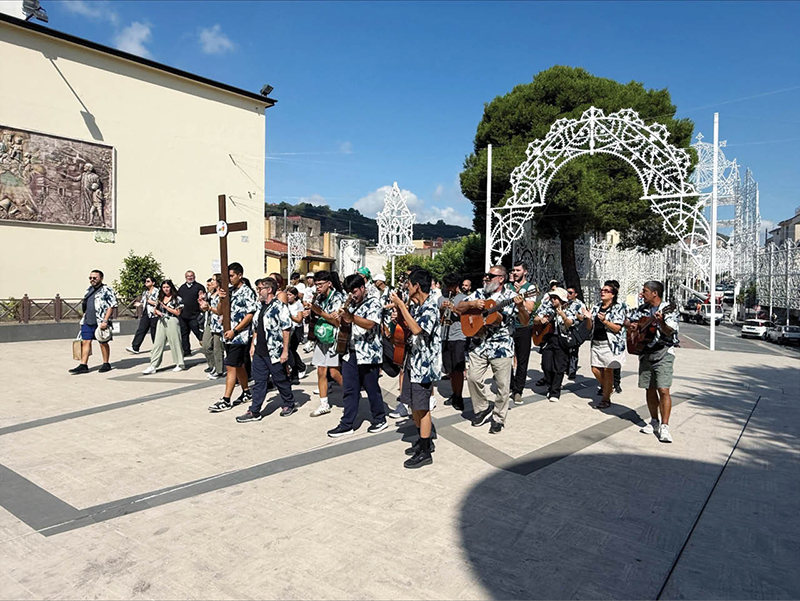
The Pacific island pilgrims sang “A Grandiose Sign” Aug. 2 as they entered the Basilica of Our Lady of Consolation in Visciano, Italy. (Courtesy Father Jaroslaw Z. Skrzypek)
By Father Jaroslaw Z. Skrzypek
Special to the Herald
In a world often characterized by rapid change and digital distraction, a group of 230 young people from several Pacific islands recently embarked on a pilgrimage that grounded them in ancient traditions and pointed them toward a hopeful future.
Hailing from Chuuk, Hawaii, Guam, Saipan, Samoa and Kiribati, these youth of the Neocatechumenal Way journeyed to Italy and Germany for the Jubilee 2025, an experience that, as a priest accompanying them, I can describe as a powerful testament to the transformative power of faith.
The pilgrimage began in the south of Italy, a land steeped in history and faith. The young pilgrims were warmly welcomed into the homes of families in Taranto, where they experienced firsthand the hospitality that is a hallmark of Christian community.
This personal connection with local families provided a sense of belonging and kinship, bridging the vast geographical distance between the Pacific islands and the Italian peninsula.
Their journey through southern Italy was a blend of historical exploration and spiritual devotion. They visited the crypt of Saint Nicholas of Bari, a site venerated by Christians for centuries, and prayed in the Basilica of San Nicola in Trani.
Each stop was not merely a tour but a moment of reflection, connecting their personal faith to the universal history of the church. The group also visited Otranto, a city with its own rich history of faith and martyrdom.
As the pilgrimage turned toward Rome, the Eternal City, a significant stop was made in Naples. Here, the youth visited the monastery of the Sisters of Perpetual Adoration, a place of constant prayer and contemplation.
This encounter with a community dedicated to a life of prayer provided a powerful example of the profound commitment to God that lies at the heart of the Christian faith. It was a quiet moment of grace before the monumental events that awaited them in Rome.
The core of the pilgrimage was the Youth Jubilee in Rome, a global gathering that brought together young Catholics from every corner of the world.
The Pacific island pilgrims were among more than 1 million young people who participated in the vigil with Pope Leo XIV at Tor Vergata. This massive assembly, united in prayer and song, was a vivid demonstration of the church’s vitality and global reach.
The Youth Jubilee concluded with a Mass presided over by Pope Leo, a moment of profound spiritual communion that left an indelible mark on the young pilgrims.
The following day, the Pacific island youth joined a massive gathering of their fellow Neocatechumenal Way members. Over 125,000 pilgrims from across the globe met with the International Team — Kiko Arguello, Maria Ascension and Father Mario Pezzi — at Tor Vergata.
This meeting was a pivotal moment of vocational discernment, where the youth were invited to consider God’s call for their lives. The response was astonishing: More than 5,000 young men declared their openness to the priesthood or itinerancy, and over 5,000 young women made a similar declaration. This outpouring of faith and commitment was a powerful sign of hope for the future of the church.
The pilgrims’ time in Rome concluded with a series of deeply moving experiences. They entered through the Holy Door at St. John Lateran, a ritual of pilgrimage that signifies a passage from sin to grace.
As they processed toward the main altar, they sang with joyful hearts, culminating in the final song, “Shema Israel.” They also took time to appreciate the ancient wonders of Rome bridging their modern faith with the ancient roots of Christian history.
The journey did not end in Rome. The pilgrims embarked on a bus ride to Altotting, Germany, a renowned pilgrimage site. Here, they were joined by 11,000 pilgrims from the United States for a solemn Eucharist in Kapellplatz.
The Mass was made even more poignant by the presence of a daughter and two granddaughters of Blessed Franz Jagerstatter, a powerful symbol of faith in the face of persecution. The vocational calls continued, with 500 boys and 800 girls from this assembly also declaring their desire to be open to God’s call.
Beyond the grand events and famous sites, the heart of the pilgrimage was in the quiet, personal moments.
Initially, I had reservations about joining the group, but as I accompanied them, I returned with a renewed sense of joy and hope. I was particularly moved by the sight of the young people sharing their personal struggles and triumphs, reflecting on Gospel readings and seeing how God was actively working in their lives.
The pilgrimage was not just a series of events; it was a testament to how God really talks to and changes young hearts, showing them his love, mercy and forgiveness in the midst of their ups and downs, their strengths and struggles.
The pilgrimage was a holistic experience, blending prayer and reflection with “popular mission.” The youth spent their time singing, dancing and joyfully inviting others to join them, sharing the hope and joy they had found. This mission-oriented approach turned the pilgrimage into a living testament of faith, a beacon of light from the Pacific islands to the heart of Europe.
The journey of these 230 young pilgrims was more than just a trip; it was a spiritual awakening, a profound encounter with God and with a global community of faith, that promises to bear fruit for years to come.
Father Jaroslaw Z. Skrzypek is the parish administrator at St. John the Baptist Church in Kalihi.
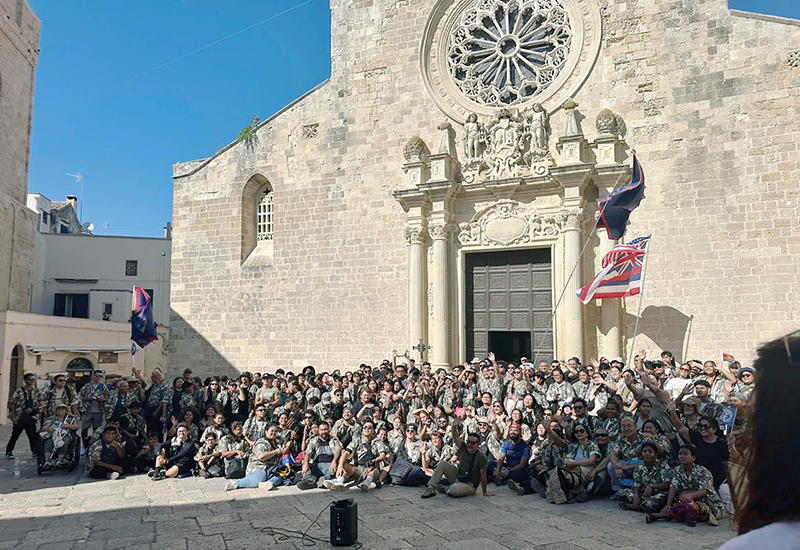
The entire group of pilgrims crowded in close for a photo July 31 outside the cathedral in Otranto, Italy. (Courtesy Jonathan Stenger)