By Catherine M. Odell
OSV News
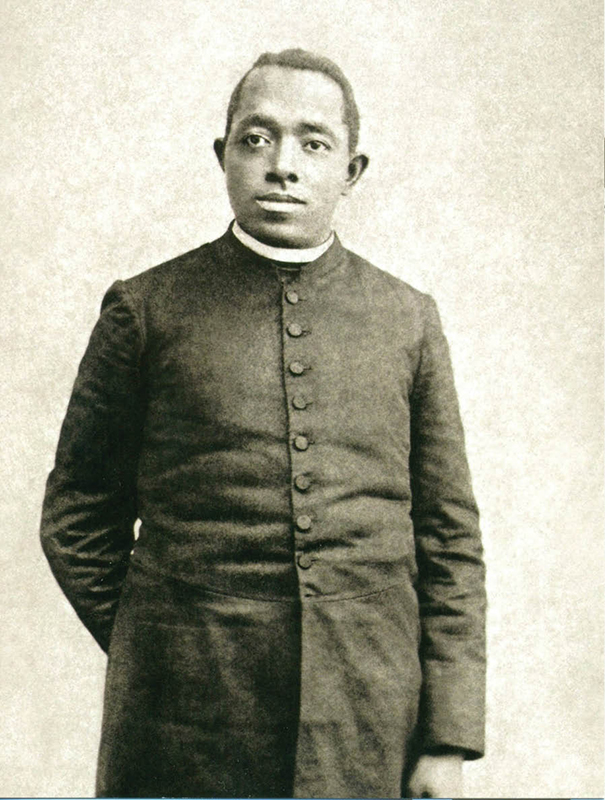
SOUTH BEND, Indiana — Near the anniversary of his sudden and early death from a heat stroke on a hot, steamy Chicago street in July 1897, supporters of Venerable Augustus Tolton (1854-1897) gathered in South Bend to pray, discuss and recommit to promoting his cause for sainthood.
This was the third National Convocation of the Tolton Ambassadors Corps, co-sponsored by the University of Notre Dame’s Cushwa Center for the Study of American Catholicism. It drew an exceptionally committed Catholic group of 30 Tolton ambassadors from around the country to Indiana.
Appropriately, the convocation’s opening Mass was celebrated at St. Augustine Church, the city’s only historically Black Catholic church, founded in the 1920s.
Bishop Joseph N. Perry, who served as an auxiliary bishop of the Archdiocese of Chicago until his 2023 retirement and is vice postulator of the Tolton cause, came to South Bend to greet and encourage the ambassadors.
Bishop Perry reminded the group that the Tolton cause was opened in 2010 after the late Cardinal Francis E. George of Chicago read a biography of Father Tolton published in 1973, giving the priest the title of “Servant of God.” Archives of the archdiocese were then scoured for documents and correspondence connected with Father Tolton’s life and ministry. They were sent to Rome — 3,000 to 4,000 pages.
On June 12, 2019, Pope Francis promulgated a decree recognizing Father Tolton lived a life of heroic virtue, advancing his cause and granting him the title of “Venerable.”
Father Tolton is one of the “Saintly Seven” — seven African American Catholics who are up for sainthood.
He was born into a family enslaved under a white Catholic family in Brush Creek, Missouri. In 1862, in the midst of the Civil War, his mother escaped with him and two other children, crossing the Mississippi River to freedom in Illinois. The Toltons settled in Quincy, Illinois.
Though in a free state, Augustus, a loving and extremely intelligent child, endured the racist rejection and belittlement of his day — in Catholic schools, and in and outside of the Catholic Church.
As he grew up, it seemed clear to his pastor that he had a vocation and exceptional gifts. Since no American seminary would accept him, he entered a seminary in Rome and was ordained in 1886.
The cardinal prefect of the seminary decided to send the young priest home to the U.S. and what was then the Diocese of Alton (now the Diocese of Springfield), Illinois.
Father Tolton would become the first publicly recognized Black priest ordained for the Catholic Church in the U.S., although everyone knew that his priesthood wouldn’t be easy.
Back in Quincy, the city where he’d grown up, it was soon clear that Father Tolton’s pastoral gifts and homilies were exceptional. He was assigned to St. Joseph’s Church, a small, desperately poor Black community.
Soon, white Catholics from around the city were also attending St. Joseph’s, raving about Father Tolton’s sermons and his gift of welcoming everyone. Some fellow Catholic priests, however, grew jealous. Their complaints to the local bishop eventually forced Father Tolton to transfer to the Chicago Archdiocese in 1889.
Father Tolton started over and became the founding pastor of St. Monica Parish on Chicago’s South Side and an active evangelizing apostolate to Black Americans in the city. It was a time of grievous racial discrimination, with even the trains segregated in Chicago.
Personal exhaustion, the poverty of his parish perpetuated by systemic denial of opportunity for Black families on account of their race, and failing to care for his own health were likely factors behind Father Tolton’s tragic death on July 9, 1897. He was just 43, but his virtue and example were remembered by many in his own era and beyond.