
The Diocese of Honolulu’s traveling relics of St. Damien, right, and St. Marianne, left, were displayed June 15 at the Basilica of the National Shrine of the Immaculate Conception in Washington, D.C. They were joined by a fragment of a tree planted by St. Damien on topside Molokai. (Timothy Dias / Basilica of the National Shrine of the Immaculate Conception)
Catholics across the country get to view and venerate first-class relics of St. Damien and St. Marianne
By Celia K. Downes
Hawaii Catholic Herald
St. Damien de Veuster and St. Marianne Cope have touched countless lives as their legacies of selfless ministry, compassion and faith in Kalaupapa, Molokai, have been shared across the globe.
A county jail, an abbey and the capital of the United States are among the most recent places where the saints have been celebrated and venerated, thanks to the efforts of an Arkansas man whose life was changed by St. Damien eight years ago.
Since May, Mark Jechura has brought relics of St. Damien and St. Marianne, as well as a piece of wood from a tree planted on topside Molokai by St. Damien, to sites across the mainland — from Arkansas to Washington, D.C. — on what he has named the Tree of Hope Tour.
In this Jubilee Year of Hope, Jechura told the Hawaii Catholic Herald, “the church is inviting us to become pilgrims of hope in a world that desperately needs it. Saints Damien and Marianne — who served the most forgotten in Molokai — embody that message.”
“Their legacy deserves to be carried across the country,” he continued. “The tour is not about spectacle; it’s about planting hope in parishes large and small, one stop at a time.”
Healing and hope
Jechura, 59, a resident of Bentonville, Arkansas, who works for Walmart at the corporate level, told the Herald he had no direct ties to Hawaii until 2017, when he met a couple from Molokai while on pilgrimage in Fatima, Portugal.
The couple gave Jechura the tree fragment (which has since been authenticated). They did not know that Jechura was seriously ill at the time with an undiagnosed condition.
“I prayed for St. Damien’s intercession and began to recover,” Jechura said. “That healing opened the door to everything that followed.”
“After that healing, I knew I had received something sacred — not just physically, but spiritually,” he said.
Jechura — who is deeply involved in his home parish and local community — wanted to share the tree fragment and devotion, but his desire did not coalesce into the Tree of Hope Tour until he experienced a second serious illness and subsequent recovery.
This year, declared the Jubilee Year of Hope by the late Pope Francis, “felt providential,” Jechura said. He cited the “wisdom and encouragement” of his spiritual advisers, including clergy and laypeople, as helping him shape the Tree of Hope Tour’s spirit and mission.
Origins of the journey
Jechura obtained permission from the Diocese of Honolulu to take the relics on a national tour. Arrangements were made through Father Alfred Omar B. Guerrero, director of the Office of Worship, as well as other diocesan offices “to ensure proper handling and reverence,” Jechura said.
Bishop Larry Silva explained that the ability to transport the relics for veneration outside Hawaii stems from an initiative conceived by the Father Damien-Mother Marianne Commission, which seeks to promote devotion to St. Damien and St. Marianne across the U.S. and the world.
The permanent home of the first-class relics (meaning they are from the bodies of St. Damien and St. Marianne, bone fragments in both cases) is the Cathedral Basilica of Our Lady of Peace in downtown Honolulu, though for now they reside at the Co-Cathedral of St. Theresa in Honolulu while the cathedral basilica undergoes major renovations.
The relics have been taken to places on the mainland before, Bishop Silva said.
“We are grateful for the Tree of Hope Tour organizers for helping promote devotion to these two wonderful saints,” he told the Hawaii Catholic Herald. “We thank (Mark Jechura) and encourage others to do the same.”
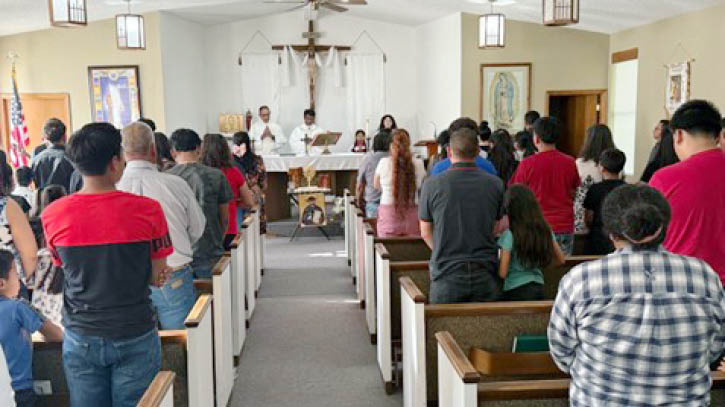
The relics were placed in front of the altar in Blessed Stanley Rother Church in Decatur, Arkansas, as Mass was celebrated. Parishioners also stayed afterward to venerate the relics. (Courtesy Mark Jechura)
The tour begins
Jechura kicked off the Tree of Hope Tour on the feast day of St. Damien, May 10, on Molokai. Ambitious plans to inaugurate the trip with a swim across the Kaiwi Channel to Oahu were thwarted, but the tour still got underway with stops in Arkansas and Oklahoma.
The relics are each housed in their own reliquaries — a wooden box for St. Damien, and a wooden Tau cross (the symbol of the Franciscan order) for St. Marianne. The tree fragment’s stand resembles a monstrance. A book of prayers in which people can write their intentions is also traveling with the relics and will be returned to Molokai when the tour ends this month.
Jechura is not conducting the tour by himself, he said. He has support from clergy, spiritual advisers, parish staff and lay volunteers at each stop: “This is not my project alone — it’s a shared offering of faith by many hands and hearts.”
Jechura said the response at each location “has been deeply moving,” regardless of how large or small the site and number of visitors.
One stop of note was the Benton County Jail in Benton, Arkansas, where seven incarcerated men were able to view the relics and tree fragment.
Jechura described the May 24 visit in an email dispatch sent to people following the Tree of Hope Tour virtually: After reflecting on the saints’ lives, “the men held the tree relic with care, passing it reverently from one to another, and offered handwritten intentions that will return to Molokai with the relics.”
The day also included a stop at Blessed Stanley Rother Church in Decatur, Arkansas, where Jechura reported that dozens of people attended Mass and then stayed to venerate the relics.
“These moments affirm what this journey is all about: planting hope, even in quiet or unexpected places,” Jechura wrote in the email update.
‘Quiet reverence’
In June, the relics continued their journey across the South and made a memorable stop in Washington, D.C., at the Basilica of the National Shrine of the Immaculate Conception — the largest Catholic church in North America and designated by the U.S. Conference of Catholic Bishops as an official “national sanctuary of prayer and pilgrimage.”
The relics spent June 15, the solemnity of the Most Holy Trinity, on display in the basilica’s lower-level Crypt Church. Jechura wrote in a June 18 email update that “a quiet reverence filled the Crypt Church” as hundreds of people visited the relics throughout the day, with many writing in the book of prayers.
Tim Dias, a communications associate for the basilica, said that the timing of the visit was notable because both St. Damien and St. Marianne are depicted in the basilica’s Trinity Dome — the “crowning jewel” of the national shrine which portrays the Trinity and a procession of saints through a mosaic of millions of pieces of colored glass.
The relics’ visit was “a great reminder for all of us that God can choose ordinary people to do extraordinary things, and be examples of virtue and holiness,” Dias said.
Another period of quiet reverence came at Our Lady of Clear Creek Abbey in Hulbert, Oklahoma, where the relics were honored with an overnight vigil that saw participation from hundreds of lay faithful and dozens of monks.
“The monastery’s novices faithfully kept vigil from 9 a.m. to 5 a.m., a moving testimony of young monastic devotion,” Jechura wrote in a June 24 dispatch.
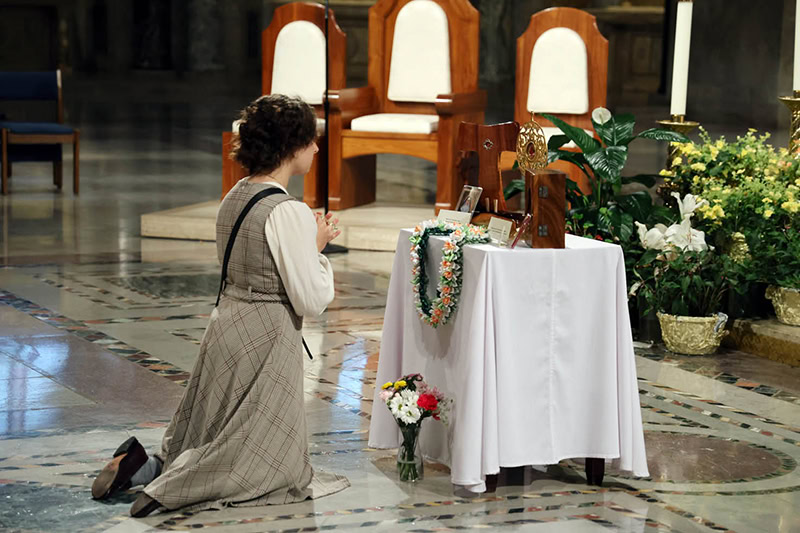
A woman kneeled before the relics of St. Damien and St. Marianne and a fragment of St. Damien’s tree June 15 at the Basilica of the National Shrine of the Immaculate Conception in Washington, D.C. (Timothy Dias / Basilica of the National Shrine of the Immaculate Conception)
Saints ‘walk with us’
One of the Tree of Hope Tour’s last stops in June was at St. Mary Catholic Church in Siloam Springs, Arkansas.
On the solemnity of the Body and Blood of Christ, June 22, the relics were viewed and venerated at four Masses — one in English, another in Vietnamese and two in Spanish.
Father Salvador Marquez-Munoz, pastor of St. Mary, told the Hawaii Catholic Herald that the relics’ visit on the solemnity of the Body and Blood of Christ was not a minor detail.
“The fact that Our Lord keeps offering himself to the Father through his most holy Eucharist on our behalf was an excellent reminder to all of us to offer our lives in the service of others, especially for those who live on the margins of our society, and Father Damien and (Mother) Marianne were a great example of that,” Father Marquez-Munoz said.
“Our congregation in St. Mary’s (is approximately) 80% of immigrant people, and the fact that these saints were immigrants like them made it so special and personal,” he added. (See sidebar for brief details of the saints’ lives in Hawaii.)
The Tree of Hope Tour’s July itinerary includes visits to several churches in Arkansas and proposed stops at churches in California, Minnesota and Wisconsin. Jechura said the relics are scheduled to return to Hawaii by month’s end.
Jechura told the Herald that his goal for the tour is for “people to encounter hope.”
“Sts. Damien and Marianne didn’t just serve the poor — they became one with them. They brought dignity, love and healing to people society had abandoned,” Jechura said. “My hope is that this tour will plant seeds — of compassion, of vocation, of reconciliation — and help people realize the church still has living witnesses of radical love.
“The saints are not distant. They walk with us.”
Sidebar: More on the legacies of St. Damien and St. Marianne
The work of St. Damien and St. Marianne — who were canonized in 2009 and 2012, respectively — is well known across Hawaii.
Damien de Veuster arrived in Hawaii from Belgium in 1864 as a missionary of his religious order, the Congregation of the Sacred Hearts of Jesus and Mary.
He was ordained a priest in Honolulu, and after nine years on Hawaii island, volunteered to minister to people with leprosy (now also called Hansen’s disease) on the remote Molokai peninsula of Kalaupapa, where patients with Hansen’s disease had been quarantined.
Father Damien contracted the disease himself, dying on Molokai in 1889.
Mother Marianne Cope was already a skilled health care administrator in New York when she arrived in Hawaii in 1883, answering a plea from the Hawaiian monarchy to help care for Hansen’s disease patients.
Mother Marianne and other Sisters of St. Francis were based on Oahu, ministering to Hansen’s disease patients and their healthy children, until sailing to Kalaupapa shortly before Father Damien’s death. She died there in 1918.
The Franciscan sisters remained on Molokai, continuing Father Damien’s work and establishing their own legacy of care.
To this day, a Sacred Hearts priest and two Franciscan sisters remain in Kalaupapa, maintaining the orders’ dedication to the settlement.