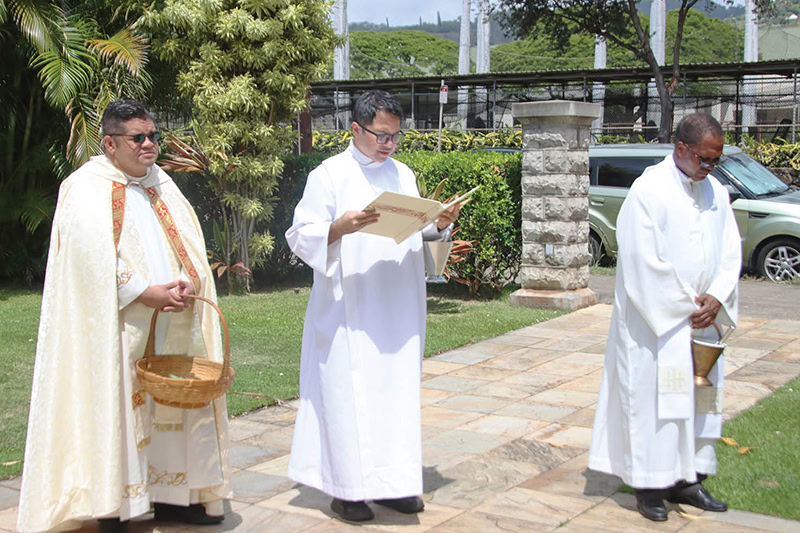
John Jacob Akau stands between Father EJ Resinto, left, and Father Lazarus Anondee outside Sacred Heart Church in Honolulu as they bless animals in honor of St. Francis of Assisi. Akau spent a year at Sacred Heart as part of his formation. (Courtesy John Jacob Akau)
By Celia K. Downes
Hawaii Catholic Herald
John Jacob Akau can trace his “long and winding” journey to becoming a priest back to his childhood in Pahala, on Hawaii island.
Akau, 39, would celebrate pretend Mass — “playing priest with sandwich bread,” he said, a towel tied around his neck to resemble a vestment. And while he doesn’t recall saying so, he said his grade-school CCD teachers recently reminded him that he also told them he wanted to be a priest.
The call to priesthood faded in his teenage years, when he was a student at Kamehameha Schools-Kapalama on Oahu, and returned when he was a young adult, only to be tamped down as he sought to “experience life as a working adult” after earning a bachelor’s degree in nursing from the University of Hawaii-Hilo.
Then, when Akau was in his late 20s and working as a nurse, he was invited by a friend to Eucharistic adoration at St. Joseph Church in Hilo.
“Until this point in my life,” he said, “I did not know about Eucharistic adoration. Beginning to do Eucharistic adoration was the turning point in my vocational journey.
“The more I went to adoration, the more the thoughts of priesthood persisted and grew. (Father Apolinario ‘Poli’ Ty), an associate priest at that time, helped me to further discern these thoughts,” which took more than a year, Akau said.
Now, after years of formation and study, he will be ordained to the transitional diaconate. Bishop Larry Silva will preside at Akau’s ordination Mass, which will take place at 9 a.m. July 12 at St. Joseph Church.
Akau grew up in a busy, faith-filled household, one of six children — four boys and two girls. The family parish was Holy Rosary Church in Pahala, where Akau was an altar server for pastor Father Stephen Macedo.
In addition to weekly Mass, the family prayed the rosary every night. Akau recalled balking at praying on Sunday nights — the television beckoned — but said he, his siblings and his parents “still made time to pray as a family.”
Akau specifically noted that his dad “took his faith seriously, and this seriousness became a model for me to emulate.”
Though he and his siblings were baptized as infants and were regular churchgoers, Akau drifted away from Mass while in high school.
He found his way back as a student at UH-Hilo: “In the process of searching for myself, I returned to God for the answers.”
Akau entered an RCIA program and was confirmed. Thoughts of the priesthood resurfaced in 2009, after he graduated from UH-Hilo — “I even went to a discernment retreat where many of the current priests for our diocese were also discerning a priestly vocation,” he said.
But it wasn’t the right time. Akau said he wanted to make use of the nursing degree he had just earned and thus did not apply to be a seminarian for the Diocese of Honolulu.
Finally, after years in the nursing profession, Akau had his first encounter with Eucharistic adoration — the catalyst to his discernment and ultimate decision to become a priest.
Challenges, joys
He’s spent the past six years as a seminarian and is currently completing his master’s degree in theology at Sacred Heart Seminary and School of Theology in Franklin, Wisconsin.
The years of study have been “a time of further discernment, both for me discerning this vocation and the church, the Diocese of Honolulu, discerning me,” he said.
Akau cited two big challenges in his formation.
“First, I had to learn to let go of my past life,” he said. “I had to humble myself and realize that the gift of a priestly vocation is invaluable. … I had to let go of my ego and realize that priests are here to serve God’s people.”
The second challenge, Akau continued, is the amount of time seminarians dedicate to their studies and to formation — “oftentimes we feel inadequate,” lacking certain skills or knowledge.
“Not every seminarian can sing well, or speak multiple languages, or quote the Bible or (Catechism of the Catholic Church) from memory,” he said.
In times like these, Akau said he recalls the words of some older priest friends that offer consolation.
“No priest is worthy of the priesthood or merits the priesthood; rather, the priesthood is a gift,” one mentor told him. Another pointed out: “It was God’s graces that have brought you here to this point, to the brink of ordination, and it is God’s graces that will strengthen you in your future ministry.”
Despite the challenges he’s faced in his priesthood journey, Akau said he finds joy in serving God’s people.
“They open themselves up to me … I am honored to know that they trust me, an imperfect instrument of God’s mercy,” he said.
Another practice that brings Akau peace and “reinvigorates” him is Eucharistic adoration, or even just visiting a tabernacle where Jesus is present.
“When I visit Jesus in adoration or in the tabernacle, I can bring all my worries, troubles, hardships, inadequacies and insecurities to him,” he said. “I am reminded that he loves me unconditionally.”
Akau said he is grateful for his father, Adrian Akau, who was the first person to inspire him in his faith, as well as for his entire family’s support and patience.
He also expressed gratitude for the priests who have played a role in his life, from those who inspired him to pursue a priestly vocation to those who promote Eucharistic adoration to the many priests in between.
Finally, Akau cited everyday folks who “have helped form me and kept me humble.”
“They are the ones that have taught me to be confident, patient, forgiving and loving.”