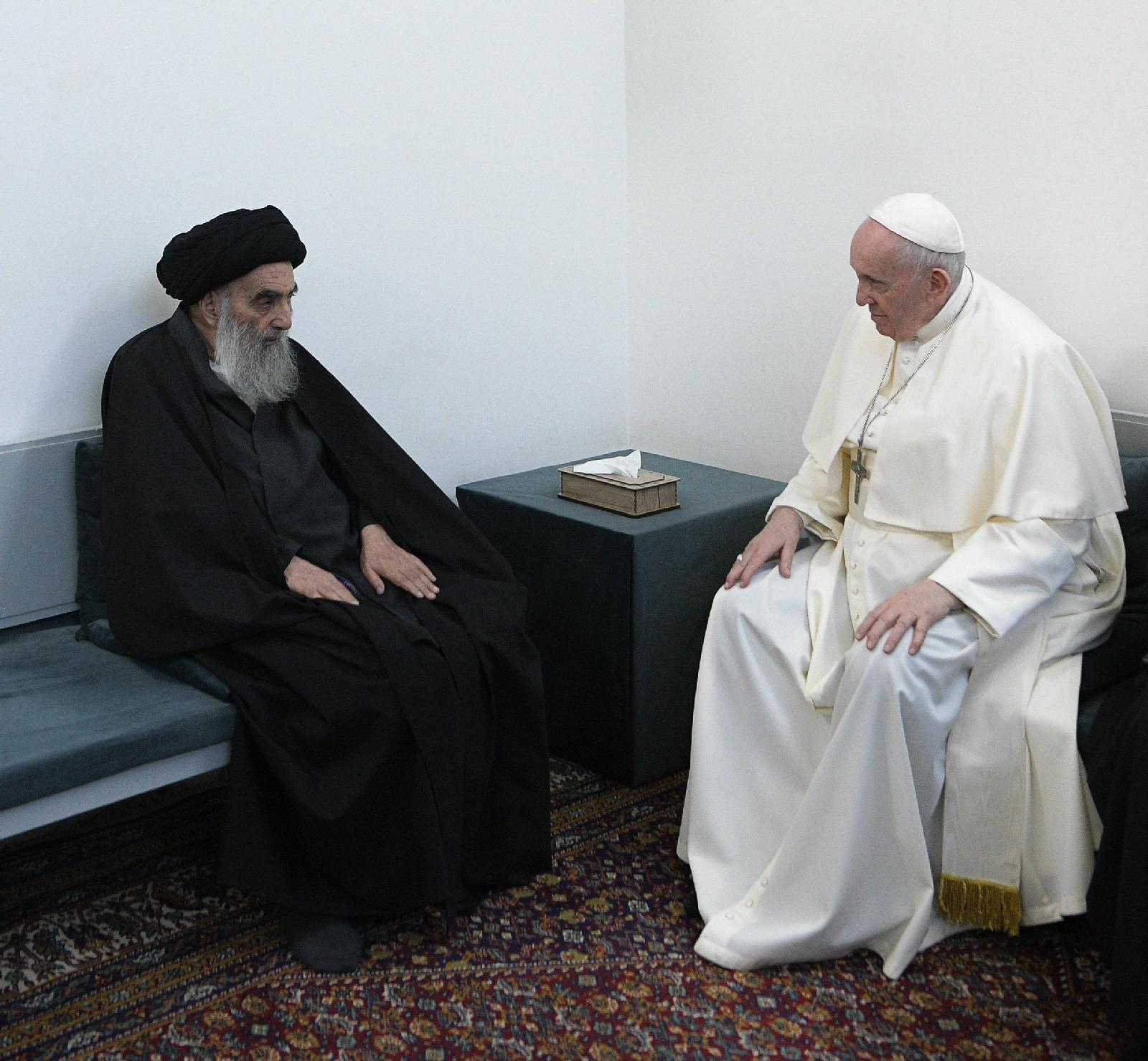
Pope Francis and Ayatollah Ali al-Sistani, one of Shiite Islam’s most authoritative figures, meet during a courtesy visit in Najaf, Iraq, March 6, 2021. (CNS photo/Vatican Media)
QUESTION CORNER
Q: When the Holy Father and Ayatollah al-Sistani met recently, at the end they stood facing each other and seemed to be talking without an interpreter. What language did they use in order to communicate? (Powhatan, Virginia)
A: According to the website of the Jesuit magazine America there was, in fact, an interpreter present. America said in its report on the March 6 meeting that “the two leaders of Christianity and Shia Islam sat beside a small wooden table and spoke with the assistance of the pope’s Palestinian-born translator.”
I am happy, though, that you have called our readers’ attention to this important meeting in the cause of peace.
The 90-year-old grand ayatollah is a revered and highly influential leader in Iraq, where more than 60% of Muslims are Shiites.
The Vatican noted that the meeting had given Pope Francis a chance to thank the ayatollah and the Iraqi Shiite community, which “raised their voices in defense of the weakest and the persecuted, affirming the sacredness of human life and the importance of the unity of the Iraqi people” during the 2014-17 offensive of the Islamic State militants in which Christians suffered heavily.
After meeting with Pope Francis, the ayatollah said that the meeting served as an example of the importance of world leaders holding powerful nations to account and calling on them “to give priority to reason and wisdom (and) to reject the language of war.”
Is a feeding tube required?
Q: My 83-year-old sister has had dementia for many years. Now she is not eating regularly and seems to have no appetite. I was told that this is a sign that the end of life is nearing. As we are both Catholics, am I obligated to have her on life support and to begin tube feeding? I don’t believe she would want this, and neither do I. (Long Island, New York)
A: Whether a feeding tube is required depends on the patient’s circumstances. The Catechism of the Catholic Church reflects that teaching: “Discontinuing medical procedures that are burdensome, dangerous, extraordinary or disproportionate to the expected outcome can be legitimate” (No. 2278).
The general principle, as enunciated by St. John Paul II in a 2004 talk to the International Federation of Catholic Medical Associations and the Pontifical Academy for Life, is that artificial nutrition and hydration are, in principle, ordinary and proportionate measures and should be given to patients, even those who are in a persistent vegetative state.
And so, nutrition and hydration should be provided to a terminally ill patient whose death does not appear to be imminent.
The church’s point is that patients should die because of the underlying pathology and not because they are starved to death.
But that principle can be overridden in particular situations; tube feeding would not be morally obligatory when it brings discomfort and pain to a person who is imminently dying or when the patient’s body cannot assimilate it.
In your own situation, my view — from a distance — is that, if your sister is close to death, you are not under any obligation to begin tube feeding.
An additional consideration, in your case, is that patients with dementia sometimes pull tubes out and might need to be restrained in order to be fed.
Questions may be sent to Father Kenneth Doyle at askfatherdoyle@gmail.com and 30 Columbia Circle Dr., Albany, New York 12203.