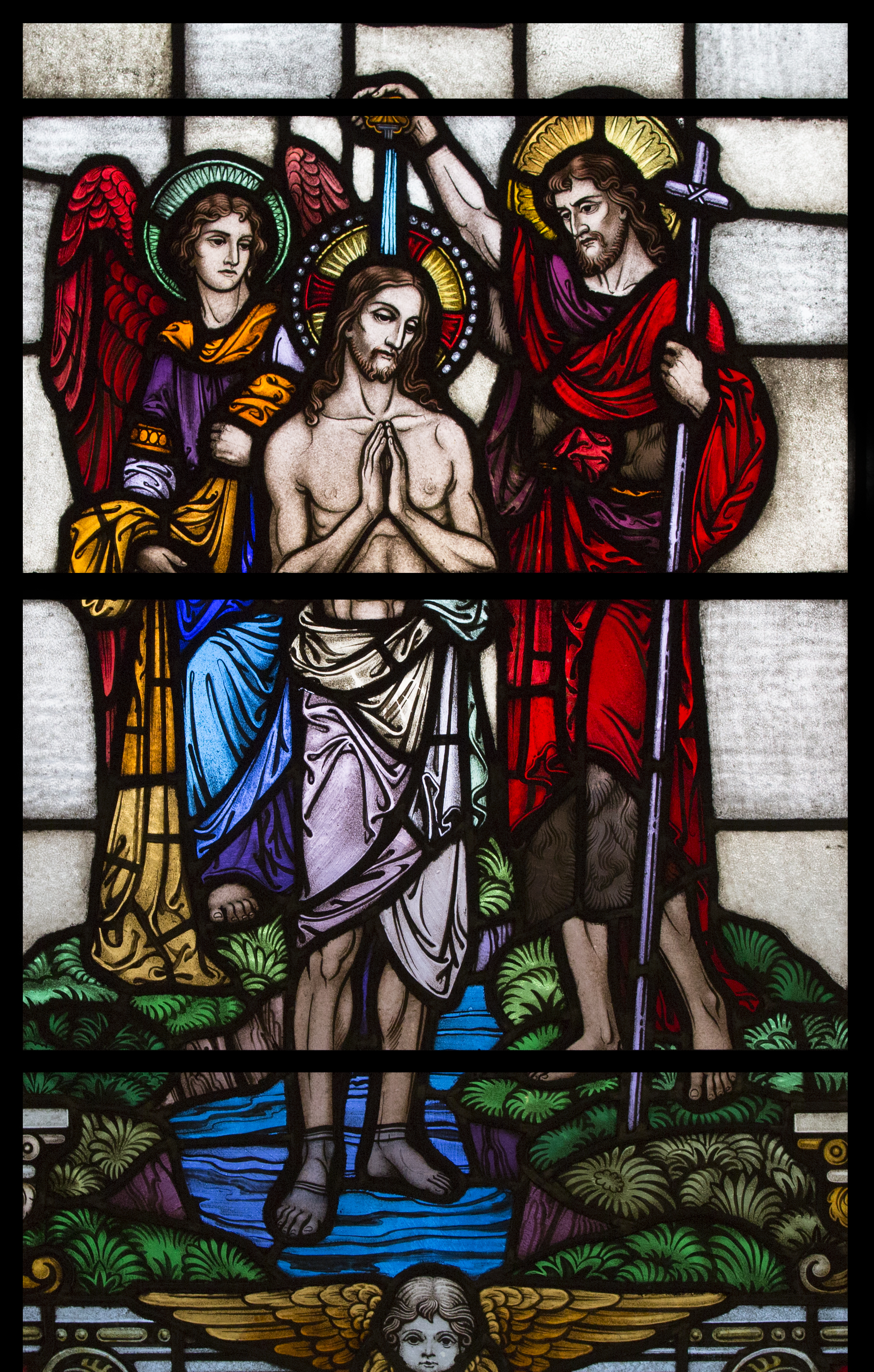
A depiction of St. John the Baptist baptizing Jesus on the Jordan River is seen in a stained-glass window in late March at St. Paul Church in Wilmington, Del. St. John the Baptist feast day is celebrated June 24. (CNS photo/Octavio Duran)
BAPTISM OF THE LORD
Isaiah 42:1-4, 6-7; Acts of the Apostles 10:34-38; Luke 3:15-16, 21-22
The Feast of the Baptism of the Lord is very important to the church’s process of bringing us to Christ. It reveals both the identity of the Lord and begins the Gospel revelation of the Lord’s work of salvation.
Jesus was baptized in the Jordan River by John the Baptist. The three Synoptic Gospels, Matthew, Mark and Luke, report this event. It is not recorded in John, although John’s Gospel alludes to John the Baptist’s baptisms in the Jordan, and in John’s Gospel John the Baptist gives Jesus the title, “Lamb of God.”
The first reading is one of the four Suffering Servant Songs of Isaiah. These quite poetic passages are prominent in the liturgies of Lent, and indeed of Good Friday. They convey an ominous overtone. Who was this Suffering Servant? To whom do these passages refer? The future Messiah? One of the prophets? The author? Was it a collective reference to the people of Israel? No one knows.
Regardless, the Christian liturgies over the centuries have seen Jesus in the Suffering Servant Songs. Certainly this is the message for this feast. In this Scripture, God reveals that a faithful and pure servant will come, who will endure an outrageous fortune. Many will turn against him. Yet he will be steadfast.
Supplying the second reading is the Acts of the Apostles. After Easter, almost every liturgy contains a reading from the Acts of the Apostles, but this source rarely furnishes readings at Mass in any other time. So the appearance of Acts on this weekend is unusual.
The reading is important. Peter’s own identity is revealed. Peter speaks on behalf of all the Apostles. He is chief among the Apostles. He reaches out to the Gentiles, by teaching Cornelius, a Roman officer, a foreigner and pagan. Peter proclaims Jesus, declaring that the saving ministry of Jesus began with the Lord’s baptism. Peter’s message is the continuation of the Lord’s message.
St. Luke’s Gospel provides the last reading.
Luke’s report of the baptism, as Mark’s, highlights the Lord’s divine identity and mission of salvation. In Luke, as in Mark, God announces that Jesus is the Son of God. Jesus is fulfilling the plan of God.
Certain images are important. In a distant echo of Creation, the reading says that life comes from the water. Jesus emerges from the water to begin the mission of redemption. Looking ahead, it prefigures Christian baptism.
Another image is that of the sky. God speaks from the sky, an ancient image of divinity in the Old Testament.
Reflection
In Advent, the church called us to renew ourselves in holiness and grace. The church joyfully has led us to Christmas, the anniversary of the Lord’s birth. If we responded in Advent, Christmas was much more than a commemoration. It was a personal event in which faithful hearts and souls truly received Christ and were restored, healed and freed from the inevitability of death.
In the great revelation of the Epiphany, celebrated last week, the church continued to tell us about Jesus. Son of Mary and therefore human, the Lord also is God, as the Magi realized.
Now, on this feast, the church instructs us further about Jesus. He is the instrument of God’s love for us. Doomed by our sins, we find another chance in Jesus. He is our savior. He reconciles sinners with God. Union with Jesus is critical, if we wish to be saved. We must be inseparably bonded to Christ. He is God. God is love. God forgives us and restores us to eternal life; however, we must accept the Lord.
Practically-speaking, Jesus comes to us through Peter and the Apostles, the Lord’s students, whom Jesus commissioned to bring salvation to all people.